

Myth, Metaphor, and Making Meaning
What if the stories that shaped us—whether read under church rafters, whispered in family living rooms, or broadcast under the Hollywood lights—weren’t just comforting fictions or childish tales, but invitations to a different kind of seeing?
What if the “myth or metaphor” debate, which so often circles the Bible like a pair of rival lawyers, has actually hidden the most vital truth of all: that meaning emerges not in spite of story, but because of it?
This week’s Created in the Image of God conversation with Dean Simone spun around the perennial question: Is the Bible myth, metaphor, or something else entirely? I’ve argued in these pages (and in my own personal labyrinth) that the answer is rarely a simple yes or no, fact or fiction, literalism or imagination. Instead, it must be lived—read, wrestled, and, when necessary, outgrown and returned to again.
A Library, Not a Lockbox
Dean’s take on sacred story has been forged across a life of movement—born in New Jersey, shuffled across the country as a “corporate gypsy,” steeped in Catholic ritual but delighting in the art and curiosity that made him, as he put it, “the first and only person in my family to go into the arts.” His first encounter with Jesus Christ Superstar as a fifth grader didn’t fix his faith, but unsettled it—showing that for every catechism answer, there might be a parallel, unrulier question.
What marked Dean’s spiritual journey was not a slavish devotion to every word—nor a bored dismissal of “old myths”—but an understanding of the Bible as a living library. “It is a collection of 66 books… ‘canonized,’ yes, but so many more left outside the walls,” he reflected. “I don’t feel the need to look at it and feel like I have to believe that or have to believe this.”
For Dean, as for many of us on the journey, the moment myth ceases to be an invitation and becomes a lockbox—when the story hardens into dogma, when the metaphor calcifies into a club for propping up our old identities—we lose not only the beauty, but the beating heart of the thing itself.
Myth or Metaphor? Why Not Both?
It’s a tempting move in the modern world to declare: “Just give me the facts.”
We live in an age where evidence rules, and myths, we’re told, must be left for the children. But myth is not the enemy of fact.
It is the scaffolding by which human beings—across cultures, religions, and centuries—have framed the unframeable: grief, wonder, shame, hope, the weird “in-between” of being both naked and unashamed, and the ache to be truly seen.
Take Genesis, for instance. Its stories can be (and endlessly have been) debated—is the world literally created in seven days? Did a snake really speak? But to get stuck at the surface is to risk missing the deeper currents.
“Who told you you were naked?” God asks in the aftermath of paradise lost. That single question—myth or metaphor—has more to say about the birth of shame, the problem of alienation, and the flickering possibility of reconciliation than a hundred bullet points in a systematic theology manual.
As Dean wisely said, “When we get hung up on the metaphor, we miss the transcendent at the core of it.”
In my own journey, I’ve returned again and again to these stories not simply for answers, but for the way their questions keep pulling me—sometimes gently, sometimes wrenchingly—toward growth.
Evolving Eyes: Stories That Change as We Change
If you’ve walked through my trilogy—The People of the Sign, The Hardness of the Heart, The Rod of Iron—you know that story isn’t what you bend to your will. It’s what bends you. A tale that felt childish at sixteen returns at forty, ravaged by loss or warmed by new experience, and says something else entirely.
Dean described that evolving reading: “At first, I wanted to find secret clues—hacks, almost, for how to live. In my wild years, I looked for loopholes. Now, I look for what is common in all these worlds and thought processes. The words become less about legalism and more about being.” That’s the hallmark of a living mythology: it grows with you—sometimes stretching, sometimes snapping back, sometimes asking you to let go of your conclusions, just long enough for new wisdom to slip in.
For those who still worry that myth is the opposite of reality, I offer this: sometimes what is most real—love, belonging, forgiveness, the call to unity—exists first and finally in the language of story, before we can chart or prove it.
This is as true for culture as it is for confession.
If we lose our mythic imagination, we lose the bridge between facts and meaning, between “what happened” and “why it matters.”
The One-ness We’ve Always Been After
In the show, Dean named his own core: “I am a firm believer now that it is all one. You cannot really name it because in naming it you do it a disservice.” The mythic task, then, isn’t just sorting true from false, but rediscovering the unity behind all our half-told tales.
Christ himself, as Jesus—and as “the Christ”—becomes both particular narrative (born, died, rose, for us) and universal metaphor (the way, the truth, the life, the one-ness for which we ache). He is myth made flesh—not as an “untrue story,” but as the most true thing that ever walked the earth. His is the invitation to read the story, and then let the story read you.
Practical Spirituality: How Do We Live Into the Myth?
So what do we do, in an age tired of fairy tales and raw from literalism?
The call is not to throw away story, but to enter it more deeply.
If you find yourself weary—divided, shamed, hiding from God and neighbor—maybe the answer isn’t one more law, or even one more argument, but a willingness to be read anew.
Find yourself in the myth, not above it. Let metaphor be a doorway, not a fence.
This week’s conversation reminded me: the Bible is not merely a set of codes for the pure or the pious. It is our collective songbook, testimony, field guide, and mirror. It is myth and metaphor, fact and parable, all woven together—and, when read with humility, can still guide us home.
You are created in the image of God. And God loves His creation.
Next on Created in the Image of God
The journey continues this Sunday with Licensed art psychotherapist Tracey Saia, who has spent over 25 years helping people process trauma, strained relationships, and life transitions through creative expression, and this coming Tuesday with David French, opinion columnist for The New York Times, for a conversation on “media literacy in a world of echo chambers.”
Together, we’ll delve into how stories—old and new, sacred and secular—compete to shape us, and what it takes to remain curious, united, and truly free in a world of spin.
If today’s reflection gave your old myths new life, or raised new questions, I invite you to comment, share, or subscribe. Let’s keep reading—and living—the stories that make us whole.
With gratitude,
Wade Fransson
An Invitation: Start Your Journey Here
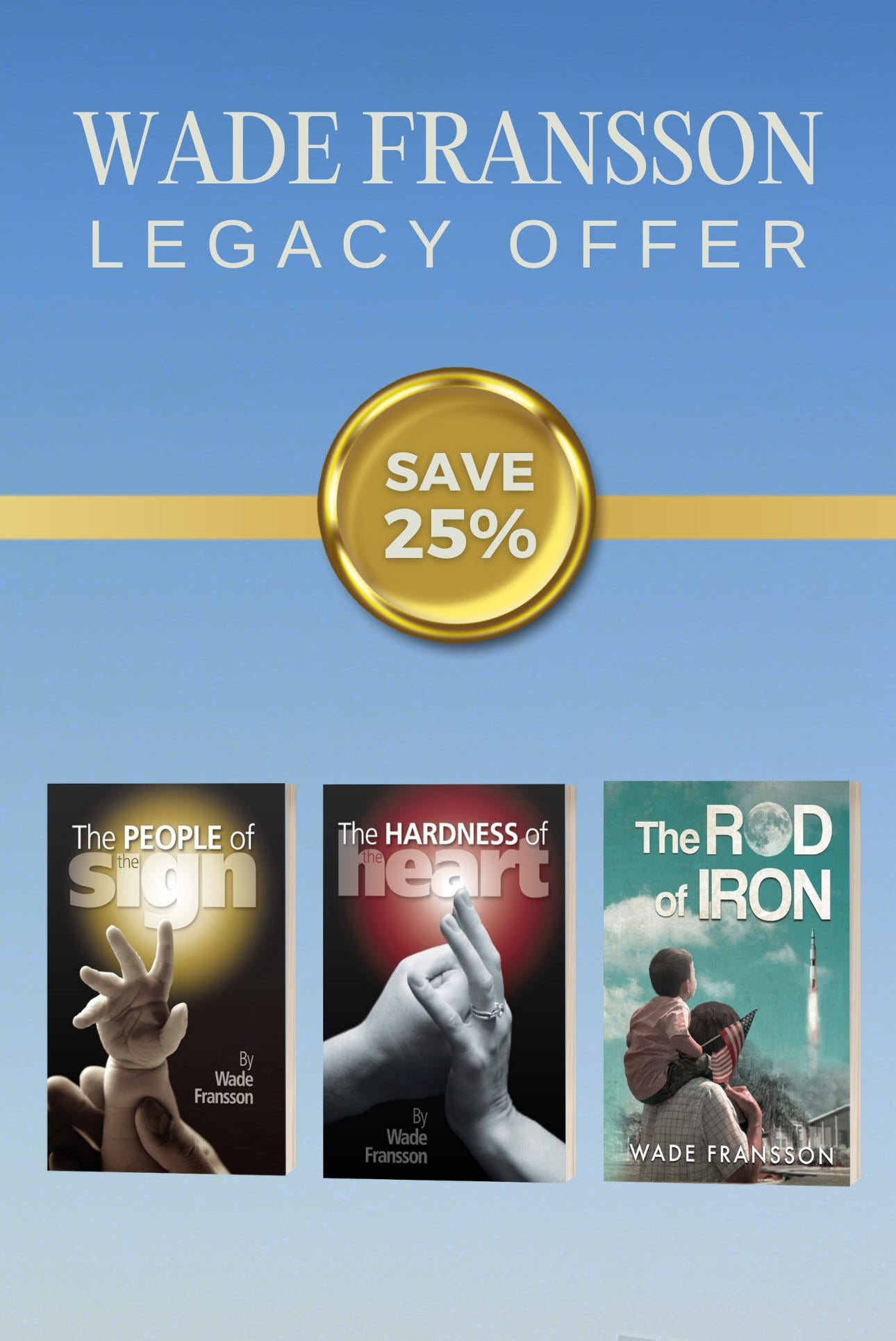
For a limited time, I’m offering my complete legacy trilogy set—The People of the Sign, The Hardness of the Heart, and The Rod of Iron—all original editions, autographed, for just $29.95 (US addresses only, due to shipping costs). These are the stories and struggles, chronicled honestly, that shaped me—and perhaps, might serve as companions and signposts on your own pilgrimage.
And if you sign up for an annual paid subscription to my Substack, you can receive the signed trilogy set for just $9.99 (to cover shipping and handling—again, US-only).


