

Memory as the Basis of Experience
Memory is not merely a passive archive of past events; it is the active, foundational force that shapes our perception, understanding, and very sense of self. Without memory, our experiences would be fleeting, disconnected sensations, devoid of meaning, context, or continuity. It is through the intricate workings of memory that we construct our individual realities, forge our knowledge, and develop the intricate tapestry of our mind. This article delves into how memory underpins every facet of human experience, exploring its symbiotic relationship with imagination and its indispensable role in the acquisition of knowledge.
The Architecture of Experience: Memory's Blueprint for the Mind
Our daily lives are a ceaseless flow of sensory input, but it is memory that transforms this raw data into coherent experience. Imagine a world where every moment is entirely new, where recognition is impossible, and learning is a perpetual impossibility. This is the world without memory. Instead, our minds, as explored by the great thinkers in the Great Books of the Western World, are built upon a continuous accumulation and interpretation of past events.
- Continuity of Self: From Augustine's profound explorations of memory in Confessions, we understand that our personal identity is a narrative woven from remembered experiences. Who we are, our habits, our beliefs, our relationships—all are anchored in what we recall.
- Pattern Recognition: The ability to identify a face, understand a language, or navigate a familiar street relies entirely on recalling past patterns. This faculty allows us to move beyond mere sensation to meaningful perception.
- Emotional Resonance: Our emotional responses are deeply tied to memory. A familiar scent can evoke a powerful feeling because it is linked to a remembered event or person, enriching our present experience.
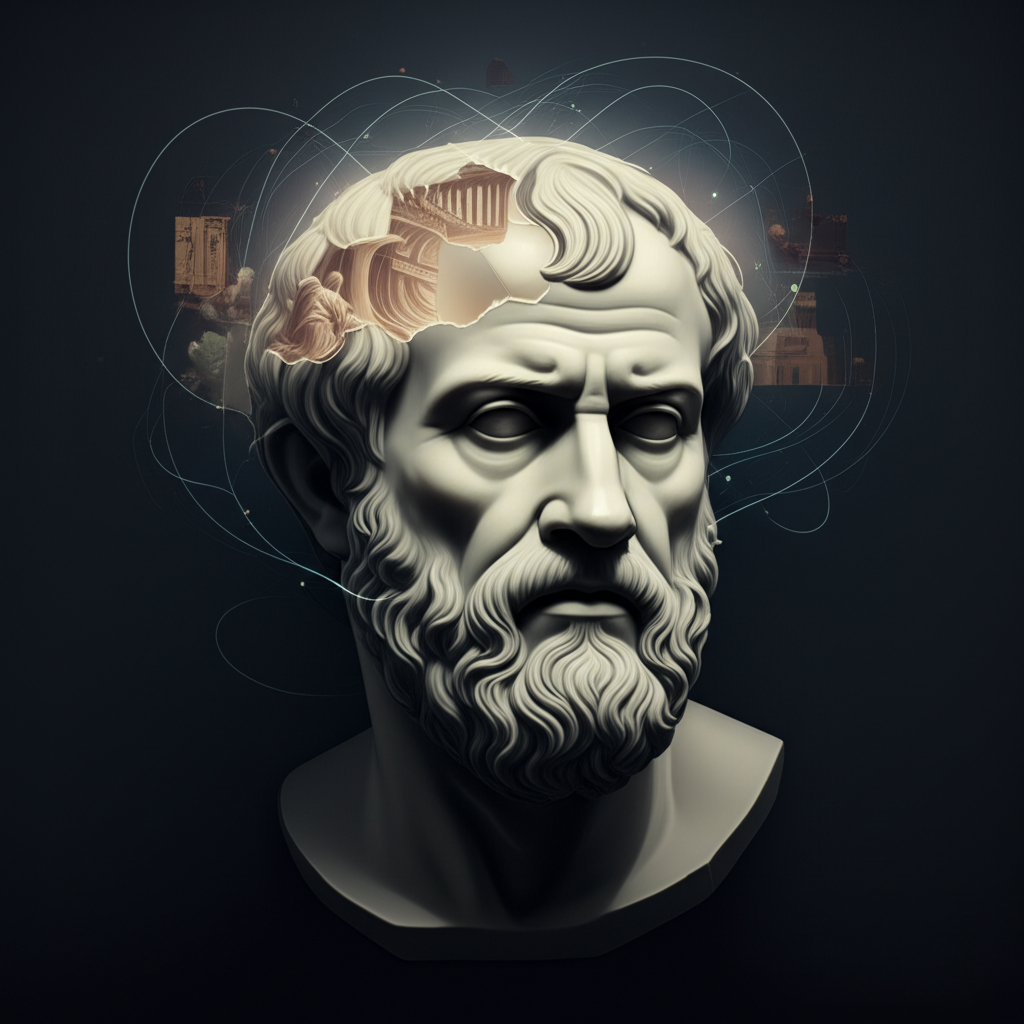
The Interplay of Memory and Imagination
While often seen as distinct faculties, memory and imagination share a profound and dynamic relationship, each feeding into the other to enrich our mental landscape. Memory provides the raw material, the building blocks of past experience, which imagination then reconfigures, extrapolates, and transforms.
Consider the following distinctions and connections:
- Memory as Re-presentation: Memory aims to accurately recall past events, though it is often reconstructive rather than perfectly reproductive. It brings the past into the present.
- Imagination as Re-creation/Pre-creation: Imagination takes elements from memory and arranges them in novel ways, forming new ideas, scenarios, or possibilities. It can conjure things that have never been, or envision future events.
| Aspect | Memory | Imagination |
|---|---|---|
| Primary Function | Recalling past experiences and knowledge | Creating new ideas, images, or scenarios |
| Orientation | Past-oriented | Future-oriented, hypothetical, creative |
| Reliance | Relies on stored information | Draws from memory, but transforms and combines |
| Truth Claim | Aims for factual accuracy (often flawed) | Not bound by factual accuracy |
This symbiotic relationship is crucial for problem-solving, planning, and artistic creation. We imagine solutions by drawing on memories of similar problems and their resolutions. We envision future possibilities by rearranging remembered elements into new configurations.
Knowledge Forged in the Crucible of Memory
The pursuit of knowledge, a central theme across the Great Books, is inextricably linked to memory. Whether one considers Plato's theory of anamnesis (recollection) in dialogues like Meno, where learning is seen as remembering innate truths, or the empiricist views that emphasize experience as the source of all knowledge, memory is the essential conduit.
- Empirical Knowledge: For thinkers like John Locke, all knowledge begins with sensory experience. However, for these experiences to coalesce into understanding, they must be retained and recalled. Without memory, each new sensation would be an isolated event, preventing the formation of concepts, patterns, or principles.
- Conceptual Knowledge: Abstract ideas, philosophical arguments, scientific laws—these are not merely experienced in a single moment. They are built up through a process of learning, recalling, comparing, and synthesizing various pieces of information over time. The ability to remember premises, arguments, and conclusions is fundamental to logical thought.
- Skill Acquisition: From learning a language to mastering a craft, the development of any skill relies on the repeated practice and memory of correct movements, rules, and procedures. Muscle memory, cognitive memory, and procedural memory all play vital roles.
YouTube:
- Plato Theory of Recollection Explained
- Augustine on Memory and Time Philosophy
The Imperfect Recorder: Memory's Nuances
It is important to acknowledge that memory is not a perfect, objective recording device. Modern philosophy and psychology have shown that memory is often reconstructive, influenced by present biases, emotions, and subsequent information. We don't just retrieve memories; we often re-create them each time they are accessed. This fallibility, however, does not diminish its central role. Even our misrememberings shape our experience and contribute to our unique subjective reality. The very act of attempting to recall, and the subsequent adjustments we make, are part of the dynamic process that defines our mind.
Conclusion
Memory is far more than a simple storage facility for the past. It is the dynamic engine of our being, the very foundation upon which our experience is built. It stitches together moments into a coherent narrative, allows our mind to learn and evolve, and provides the essential raw material for both knowledge and imagination. To understand human consciousness, to grasp the essence of how we perceive and interact with the world, we must first appreciate the profound and pervasive influence of memory. It is the silent architect of our reality, constantly shaping and enriching the experience of being human.
📹 Related Video: What is Philosophy?
Video by: The School of Life
💡 Want different videos? Search YouTube for: "Memory as the Basis of Experience philosophy"