

Memory as the Basis of Experience: The Mind's Enduring Tapestry
Summary: At the very core of what it means to experience, to learn, and to be a conscious individual lies memory. It is not merely a storage unit for past events but the active, dynamic process that shapes our present perception and future understanding. Without memory, our sensory inputs would be fleeting, disconnected fragments, rendering genuine experience impossible and severing the threads that weave together our sense of self and the world around us. This article delves into how memory underpins every aspect of our cognitive and emotional life, from the simplest perception to the most profound knowledge.
The Indispensable Archive of Self
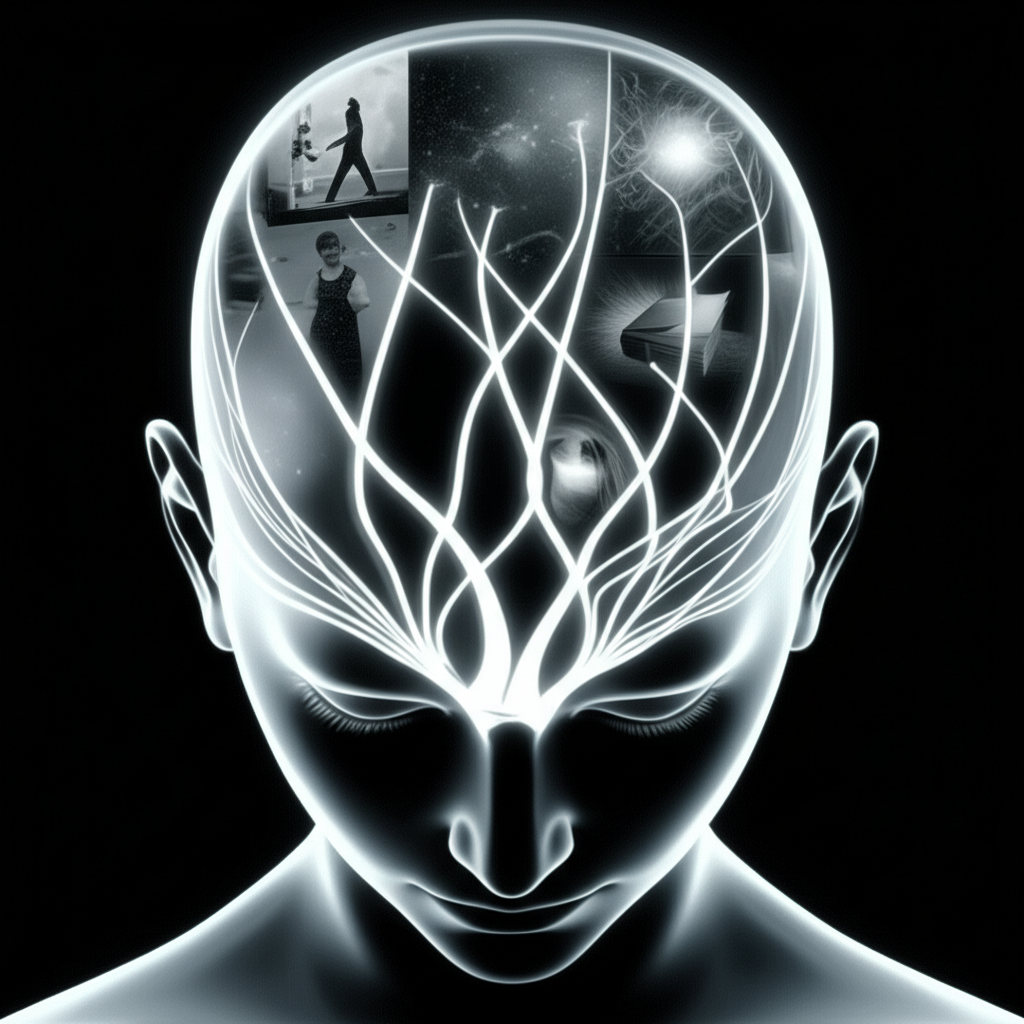
To speak of experience is to speak of something retained, processed, and ultimately, remembered. Imagine a world where every sensation, every sight, sound, and touch, vanished the instant it occurred. In such a world, there would be no learning, no recognition, no personal identity. Each moment would be an utterly novel encounter, devoid of context or meaning. It is memory that transforms raw sensory data into coherent experiences, allowing us to build a continuous narrative of our existence.
What is Experience Without Recall?
Consider the simple act of recognizing a friend. This isn't just about seeing a face; it's about recalling countless past interactions, shared moments, and an entire history of association. The visual input triggers a vast network of stored information, allowing us to identify, contextualize, and react appropriately. Without this recall, the face would be just another pattern of light and shadow, indistinguishable from any other.
- Perception: Memory provides the framework for interpreting sensory information. We perceive a chair as a chair because we remember what chairs are and how they function.
- Learning: All learning is fundamentally an act of memory. From mastering a skill to understanding a complex philosophical concept, the retention and recall of information are paramount.
- Identity: Our sense of self is a continuous narrative woven from our memories. Who we are, what we've done, and what we've learned are all products of our personal history, held together by memory.
The Interplay: Memory and Imagination
Often viewed as distinct faculties, memory and imagination are, in fact, deeply intertwined, forming a dynamic duo within the mind. Memory provides the raw materials—the images, sensations, and concepts—from which imagination constructs new scenarios, ideas, and possibilities.
Memory is not a perfect, static recording. It is reconstructive, often influenced by our present state and our imaginative faculties. We can "re-experience" a memory, embellishing details or focusing on different aspects, much like an artist reinterprets a scene. Conversely, imagination draws heavily on memory to create. When we envision a future event or conjure a fantastical world, we are recombining elements and experiences stored in our memory.
| Aspect of Cognition | Role of Memory | Role of Imagination |
|---|---|---|
| Recollection | Recalls past events with detail | Can fill in gaps, embellish, or distort memories |
| Problem Solving | Provides past solutions/data | Creates novel solutions by combining existing knowledge |
| Creativity | Supplies foundational elements | Recombines elements into new forms and ideas |
| Empathy | Recalls similar past feelings | Projects self into another's situation using stored emotional data |
Building the Mind's Edifice of Knowledge
The acquisition of knowledge is inextricably linked to memory. From the empirical observations of science to the abstract principles of philosophy, knowledge is built layer upon layer, with each new insight resting upon previously retained information. The human mind is a vast repository, constantly cross-referencing new data with existing memories to form a coherent understanding of the world.
Without memory, there would be no cumulative learning, no scientific progress, and no cultural transmission of wisdom. Each generation would start from scratch, forever trapped in an eternal present. It is through the collective memory, enshrined in texts, traditions, and institutions, that humanity builds its edifice of knowledge.
Echoes from the Great Books
Philosophers across millennia have grappled with the profound significance of memory. In Plato's Meno, the concept of anamnesis (recollection) suggests that learning is not acquiring new knowledge but remembering what the soul already knows from a prior existence. This radical idea places memory at the very heart of philosophical inquiry and the pursuit of truth.
Aristotle, in On the Soul and On Memory and Reminiscence, treats memory as a faculty of the sensitive soul, essential for both animals and humans. He distinguishes between memory (the retention of an impression) and reminiscence (the active search for a past impression), highlighting the active nature of our engagement with the past. For Aristotle, memory is crucial for practical wisdom and the development of experience.
Later, John Locke in his Essay Concerning Human Understanding famously tied personal identity directly to consciousness and memory. "As far as this consciousness can be extended backwards to any past Action or Thought, so far reaches the Identity of that Person." For Locke, it is the continuity of memory that makes us the same person over time. These foundational texts from the Great Books of the Western World underscore memory's enduring philosophical weight, not just as a psychological function but as a cornerstone of being, knowing, and identity.
The Enduring Legacy
Ultimately, memory is not a passive archive but an active, shaping force. It defines our individual experiences, fuels our imagination, and forms the bedrock of our knowledge. To understand memory is to understand the very essence of human consciousness and our capacity to navigate, interpret, and shape the world around us. It is the thread that binds fleeting moments into a coherent life, making us who we are.
📹 Related Video: PLATO ON: The Allegory of the Cave
Video by: The School of Life
💡 Want different videos? Search YouTube for: ""Plato's Theory of Recollection Explained" or "John Locke Personal Identity Memory Philosophy""