

Memory as the Basis of Experience
Memory is often perceived as a mere storage facility for past events, a passive archive we consult when needed. However, to confine memory to simple recall is to profoundly misunderstand its true nature and indispensable role in shaping our reality. This article posits that memory is not just a basis, but the fundamental basis of all human experience, actively constructing our perception, identity, and capacity for knowledge. Without memory, our present would be an unintelligible chaos of sensory input, our self a fleeting moment, and our future an unchartable void. It is the continuous thread that weaves together the fabric of our "Mind," allowing us to connect, learn, and truly experience the world.
The Indispensable Role of Memory in Perception
Consider for a moment what it means to perceive. When you look at a tree, you don't merely register green leaves and a brown trunk; you recognize a tree. This act of recognition is entirely dependent on memory. Your "Mind" instantly accesses countless past "Experience"s of trees, categorizing the new sensory data against established patterns. Without this recall, every sight, sound, and sensation would be utterly novel, devoid of context or meaning.
- Sensory Coherence: Memory allows us to synthesize disparate sensory inputs into a coherent whole. The sound of a voice, the sight of a face, and the feeling of a handshake are integrated into the "Experience" of meeting a person, thanks to our brain's ability to retain and relate these individual sensations.
- Language and Understanding: The very act of understanding a sentence relies on memory. We remember the meaning of individual words, grammatical structures, and the flow of conversation, building meaning from one moment to the next. Without this continuous retention, communication would be impossible, and our "Knowledge" would be limited to the immediate, fleeting present.
Memory and the Construction of Self
Our personal identity is not a static entity but a dynamic narrative, meticulously constructed and continuously updated by memory. Who we are is, in essence, the sum total of our remembered "Experience"s, our past choices, triumphs, and failures.
The philosopher John Locke famously argued that personal identity is founded not on substance, but on consciousness, which extends backward in time through memory. He proposed that "as far as this consciousness can be extended backwards to any past Action or Thought, so far reaches the Identity of that Person." This suggests that without the capacity to remember our past, our sense of self would dissolve into an endless succession of isolated moments, each a new beginning without a history.
Key Elements of Self-Construction through Memory:
- Narrative Identity: We tell ourselves stories about who we are, and these stories are composed of memories.
- Emotional Resonance: Past emotional "Experience"s stored in memory inform our present reactions and future expectations.
- Moral Compass: Our understanding of right and wrong, our values, and our character are built upon a foundation of remembered lessons and ethical dilemmas.
Beyond Recall: Memory and Imagination
The relationship between "Memory and Imagination" is far more intimate than often acknowledged. Imagination is not merely the ability to conjure fictional worlds; it is deeply rooted in our store of past "Experience"s. When we imagine, we are often recombining, reconfiguring, and projecting elements drawn from memory.
Consider an architect designing a new building. They draw upon their "Knowledge" of existing structures, materials, and spatial relationships (all stored in memory) to envision something entirely new. Even the most fantastical creations in art or literature are built from fragments of remembered reality, twisted and transformed.
The Dynamic Interplay:
- Reconstructive Memory: Memory itself is not a perfect recording device; it is reconstructive. Each time we recall an event, we are, in a sense, re-imagining it, filling in gaps, and subtly altering details based on our current state of mind and existing "Knowledge."
- Anticipation and Planning: Our ability to anticipate future events and plan for them is a direct function of "Memory and Imagination." We use past "Experience"s to project potential outcomes and mentally simulate different scenarios.
Memory as the Foundation of Knowledge
All "Knowledge," whether empirical or rational, is ultimately predicated on memory. Learning is the process of acquiring and retaining information, skills, and understanding. Without memory, each lesson would be forgotten the moment it was learned, and no cumulative body of "Knowledge" could ever be established.
From the simplest facts to the most complex philosophical systems, the "Mind" builds upon what it has retained. Scientific theories are developed by remembering past observations and experiments. Mathematical principles are understood by recalling foundational axioms and theorems. Even abstract reasoning relies on remembering logical rules and previous deductions.
The Pillars of Knowledge Built on Memory:
- Empirical Knowledge: Derived from sensory "Experience," which must be remembered to form patterns and generalizations.
- Procedural Knowledge: Skills and habits (e.g., riding a bike, playing an instrument) are stored as motor memories.
- Semantic Knowledge: Facts, concepts, and language are accumulated and organized in our memory networks.
Memory is not merely a component of "Knowledge"; it is the very medium through which "Knowledge" is acquired, stored, and retrieved, making it the bedrock of intellectual growth and human civilization.
Philosophical Perspectives on Memory's Primacy
The "Great Books of the Western World" consistently highlight memory's profound importance, though often through different lenses:
| Philosopher/Tradition | Perspective on Memory's Role If ## Memory as the Basis of Experience: Constructing Reality from the Threads of the Past
Our perception of the present, our understanding of the self, and our capacity for future action are all deeply rooted in the intricate architecture of memory. It's far more than a simple storage vault; memory is the active constructor of our reality, shaping every moment of our "Experience." To truly comprehend the "Mind," we must first grasp how memory lays the very groundwork for what it means to perceive, to know, and to be.
The Foundation of Perception: Memory's Silent Hand
Imagine a world without memory. Every sight, sound, and sensation would be utterly new, a disjointed flash without context or meaning. We wouldn't recognize a face, understand a word, or even perceive a coherent object. It is memory that provides the interpretative framework, the vast library of past "Experience"s, through which our "Mind" filters and makes sense of the continuous stream of sensory data.
- Pattern Recognition: Our ability to identify patterns – be it a familiar melody, a human face, or the danger of a predator – is entirely dependent on recalling and comparing current sensory input with stored information. Without memory, every tree would be just a collection of colors and shapes, not a 'tree'.
- Temporal Coherence: Memory stitches together discrete moments, allowing us to perceive continuity. A conversation, for instance, requires remembering the beginning of a sentence to understand its end. This temporal binding is crucial for any meaningful "Experience."
The Self, Threaded by Memory
Our personal identity is not a static entity, but a dynamic, evolving narrative woven from the countless threads of memory. The 'who' of who we are is fundamentally defined by what we remember of our past actions, thoughts, and feelings. As John Locke, a prominent figure in the Great Books of the Western World, argued, personal identity extends "as far as this consciousness can be extended backwards to any past Action or Thought."
This continuous, remembered consciousness forms the bedrock of our selfhood. Without it, each moment would present us as a new, unfamiliar being, devoid of personal history or character. It's the memory of our commitments, our relationships, and our growth that gives substance to our "Mind" and fuels our sense of continuity.
Components of Self-Identity Forged by Memory:
- Autobiographical Memory: The unique collection of personal events that forms our life story.
- Emotional Memory: Recalling past emotions helps us understand and navigate present feelings, shaping our emotional intelligence.
- Moral Framework: Our values, ethics, and understanding of ourselves as moral agents are deeply informed by remembered choices and their consequences.
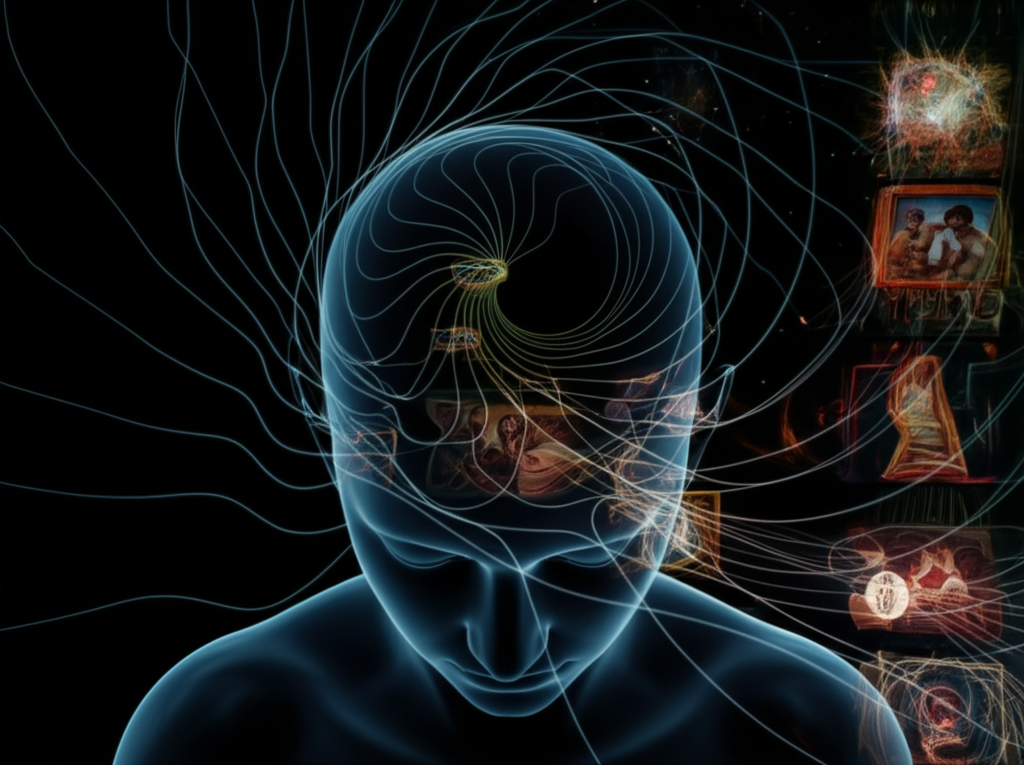
The Interwoven Tapestry: Memory and Imagination
The distinction between "Memory and Imagination" is often blurred upon closer inspection. Far from being separate faculties, they are deeply interdependent. Imagination is not conjured from a vacuum; it draws upon the vast reservoir of past "Experience"s and "Knowledge" stored in memory, recombining and reconfiguring them to create novel scenarios, ideas, and solutions.
Think of a philosopher constructing a new ethical theory. They don't invent concepts from thin air; they draw upon remembered principles, historical examples, and past philosophical arguments, using their imagination to synthesize these elements into a new coherent whole. Henri Bergson, another voice from the Great Books, explored how memory isn't just a static record but a dynamic process, actively engaged in projecting possibilities and shaping our engagement with the present.
The Dynamic Nexus of "Memory and Imagination":
- Scenario Planning: Our ability to envision future possibilities, from daily plans to long-term goals, relies on our "Mind"'s capacity to access past "Experience"s and project them forward imaginatively.
- Creative Synthesis: Artistic and scientific breakthroughs often stem from imaginatively connecting previously disparate pieces of "Knowledge" stored in memory.
- Empathy: To understand another's perspective requires imagining oneself in their situation, drawing upon remembered emotions and "Experience"s.
Knowledge: The Accumulation of Remembered Experience
Every piece of "Knowledge" we possess, from the simplest fact to the most complex theory, is ultimately built upon the foundation of memory. Learning is, at its core, the acquisition and retention of "Experience." Without memory, the lessons of yesterday would be lost today, rendering cumulative learning and intellectual progress impossible.
Whether we consider the empirical observations that fuel scientific inquiry or the logical deductions that form philosophical arguments, both rely on the "Mind"'s capacity to store, retrieve, and relate past information. The entire edifice of human "Knowledge" – scientific, historical, cultural, and personal – is fundamentally a monument to memory.
How Memory Underpins "Knowledge" Acquisition:
- Retention of Facts: Rote memory allows us to recall specific data points, names, dates, and definitions.
- Understanding of Concepts: Memory enables us to build conceptual frameworks by linking new information to existing "Knowledge" structures.
- Skill Development: Procedural memory allows us to master complex tasks, from playing an instrument to performing surgery, through repeated practice and retention.
Conclusion
Memory is far more than a passive repository of the past; it is the active, dynamic engine that drives our "Mind" and shapes every facet of our "Experience." It is the loom upon which our perceptions are woven, the narrative thread of our self, the wellspring of "Imagination," and the very foundation of all "Knowledge." To understand human consciousness, therefore, is to appreciate the profound and indispensable role of memory in constructing the rich, meaningful world we inhabit.
YouTube Video Suggestions:
-
📹 Related Video: What is Philosophy?
Video by: The School of Life
💡 Want different videos? Search YouTube for: ""John Locke personal identity memory philosophy""
2. ## 📹 Related Video: PLATO ON: The Allegory of the Cave
Video by: The School of Life
💡 Want different videos? Search YouTube for: ""Henri Bergson memory and perception explained""