

Medicine and the Maintenance of Life: A Philosophical Inquiry
Medicine, at its core, is the art and science of preserving life. Yet, beyond the biological imperatives and clinical interventions, lies a profound philosophical landscape that challenges our very understanding of existence, suffering, and mortality. This article delves into how medicine intersects with our deepest philosophical questions, exploring the human body not merely as a biological machine, but as a vessel for consciousness, meaning, and the inevitable journey between life and death. Drawing inspiration from the vast repository of the Great Books of the Western World, we will explore the enduring quest for health, the evolving definition of life, and the ultimate acceptance of our mortal condition.
The Enduring Quest for Health: Beyond the Clinical Gaze
From the earliest shamanistic rituals to the precision of modern surgery, humanity's pursuit of health has been relentless. This quest is not solely about eradicating disease; it's deeply entwined with our conception of a "good life" – a life free from pain, full of vitality, and capable of pursuing higher ends. But what does it truly mean to "maintain life"? Is it merely delaying the inevitable, or is it about enhancing the quality of our existence?
The ancient Greeks, whose wisdom forms a cornerstone of Western thought, saw health as a state of balance. Hippocrates, often considered the father of Western medicine, emphasized observation, prognosis, and the body's natural healing powers. His aphorisms, born from careful empiricism, reflect a philosophy where the physician assists nature rather than dominates it. This holistic view, where the body is understood within its environment and lifestyle, provides a timeless counterpoint to purely mechanistic approaches.
Medicine as a Philosophical Enterprise
The practice of medicine compels us to confront fundamental philosophical questions about our nature, our existence, and our place in the cosmos.
The Body as a Philosophical Battleground
The human body is the primary subject of medicine, yet its philosophical interpretation has varied wildly across millennia.
- Ancient Greek Perspectives: For thinkers like Aristotle, the body was an integral part of the living being, animated by a soul (psyche) that was the form of the body. In De Anima, he explored how life functions – nutrition, sensation, locomotion – were inherent to the living organism. Health was a harmonious functioning of these parts, and disease, a disruption. This view resisted a strict separation, seeing the physical and vital as deeply intertwined.
- Cartesian Dualism: René Descartes, in his Meditations on First Philosophy, famously posited a radical separation between mind (the thinking substance) and body (the extended, material substance). This dualism profoundly influenced Western science and medicine, leading to a view of the body as a complex machine that could be dissected, repaired, and understood through mechanical principles, often distinct from the non-physical mind or soul. While revolutionary for scientific advancement, it also created challenges for understanding psychosomatic illness and the integrated experience of human suffering.
- Modern Materialism: Contemporary science largely operates on a materialistic premise, viewing the body and its functions as entirely reducible to physical and chemical processes. While incredibly effective for diagnosis and treatment, this perspective often leaves little room for the philosophical dimensions of illness, suffering, and the subjective experience of life.
The Definition of Life and Death: A Moving Target
Perhaps no area highlights the philosophical depth of medicine more than its grapple with the definitions of life and death. These are not static biological facts but concepts imbued with ethical, social, and spiritual significance.
- When Does Life Begin? Debates surrounding abortion, in-vitro fertilization, and embryonic research force us to define the moment a human life merits full moral status. Philosophers, theologians, and scientists offer differing criteria, from conception to viability to the development of consciousness.
- When Does Life End? The advent of life support technologies has complicated the traditional understanding of death. Is death the cessation of heartbeat and respiration, or the irreversible loss of brain function? The concept of "brain death", while medically established, remains a philosophical challenge, prompting questions about personal identity, consciousness, and the moral permissibility of organ donation or withdrawal of care. These discussions echo ancient philosophical inquiries into the nature of the soul and its departure from the body, as explored in Plato's Phaedo.
The Science of Healing and the Art of Living
Modern medicine is a triumph of science, utilizing rigorous methodologies, technological innovation, and vast empirical data to combat disease. From antibiotics to gene therapy, our capacity to intervene in the body's processes has expanded exponentially, extending life expectancy and alleviating suffering for millions.
| Era of Medicine | Key Philosophical Contributions | Impact on Life and Death |
|---|---|---|
| Ancient (e.g., Hippocrates) | Holistic view, balance of humors, natural healing | Focus on comfort, prognosis, limited intervention |
| Medieval (e.g., Galen) | Integration of classical texts with theological perspectives | Emphasis on divine will, rudimentary surgery |
| Renaissance/Enlightenment (e.g., Vesalius, Descartes) | Anatomical dissection, mind-body dualism, mechanistic view | Foundation for scientific inquiry, body as machine |
| Modern (e.g., Pasteur, Fleming) | Germ theory, pharmacology, advanced diagnostics | Dramatic increase in life expectancy, complex ethical dilemmas |
Yet, even with all our scientific prowess, medicine remains an art. It requires empathy, judgment, and an understanding of the individual patient's unique context. The great physicians often possess a philosophical sensibility, recognizing that treating a disease is different from healing a person. The goal isn't just to extend the body's functions, but to preserve the quality of life, its meaning, and its dignity.
The Limits of Medicine and the Embrace of Mortality
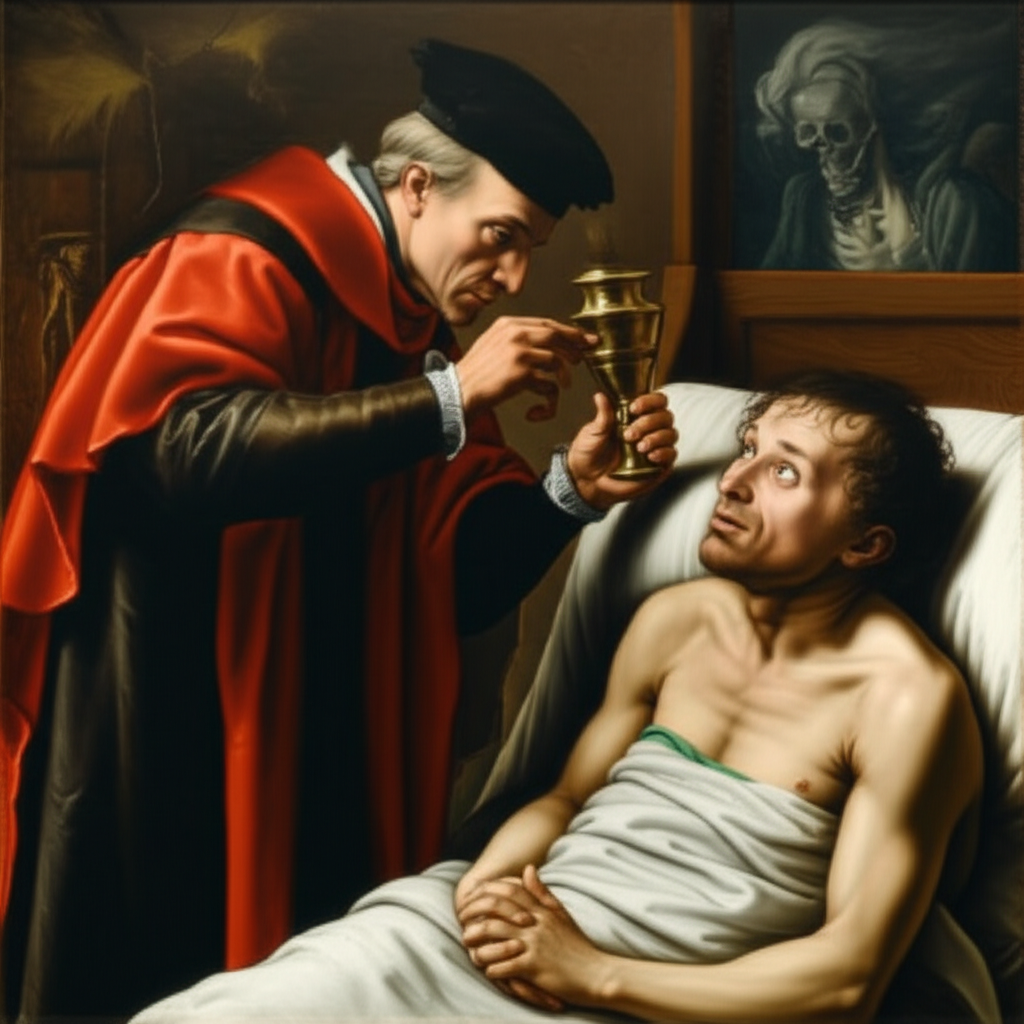
Despite all its advancements, medicine cannot conquer death. It can delay it, mitigate its suffering, and sometimes even prevent it temporarily, but mortality remains the ultimate human condition. This unyielding truth brings us face-to-face with perhaps the most profound philosophical challenge: how do we live meaningful lives knowing they will end?
Philosophical traditions from Stoicism to existentialism have grappled with this inevitability. Seneca, in his Moral Letters to Lucilius, reminds us that true wisdom lies in accepting our limited time and living fully in the present. The pursuit of eternal life through medical means, while a recurring dream, often distracts from the richness of finite existence. Medicine, in its highest form, helps us live well, not just live long, allowing us to confront death with dignity and a sense of completeness. It is here that the science of medicine meets the wisdom of philosophy, guiding us not only in the maintenance of life but also in the preparation for its inevitable conclusion.
Conclusion: A Holistic View of Life's Maintenance
The relationship between medicine and the maintenance of life is a dynamic interplay of science, ethics, and profound philosophical inquiry. From the ancient insights into the body's natural balance to the cutting-edge technologies that redefine life and death, humanity's journey with healing is a continuous dialogue with its own nature. As Chloe Fitzgerald, I believe that a truly comprehensive approach to health requires not only scientific rigor but also a deep philosophical understanding of what it means to be alive, to suffer, and ultimately, to embrace our shared mortality. Medicine may mend the body, but philosophy helps us understand the life within it.
YouTube Video Suggestions:
- "Plato Phaedo Summary: The Immortality of the Soul"
- "Descartes Mind Body Problem Explained"
📹 Related Video: What is Philosophy?
Video by: The School of Life
💡 Want different videos? Search YouTube for: "Medicine and the Maintenance of Life philosophy"