

In this episode, we delve into the connection between ancient wisdom and our modern-day dilemmas. When Plato reflected on the cardinal virtues, he wasn’t merely outlining an abstract moral code; he was offering a practical blueprint for a meaningful life. Imagine a society where the cultivation of virtues like courage and prudence shapes not only individual choices but also the broader cultural landscape. This alignment between personal growth and collective well-being lies at the heart of Platonic thought.
We often find ourselves at crossroads where our ideals clash with the challenges of daily life. The wisdom of ancient Greece reminds us that these aren’t just philosophical quandaries—they’re deeply human experiences. As you read on, consider how these lessons echo in your life today. Are you striving to reconcile conflicting priorities? Do you see opportunities to live in greater harmony with your values?
At planksip.org, we invite you to explore how this wisdom can be personified. Plato’s dialogues become more than historical texts; they emerge as a guiding framework for navigating our contemporary world. Through this lens, the pursuit of the Good isn’t just an intellectual exercise—it’s a path to a life well-lived.
From the Archives of Ancient Greece: Featuring Dr. Michael Sugrue
This week, Dr. Michael Sugrue takes us on a journey through The Republic, focusing on the enigmatic “Myth of Er.” Sugrue’s commentary sheds light on how this ancient myth serves as an ethical anchor, illustrating the connection between our choices in life and their consequences beyond death. In ancient Greece, stories like this one weren’t merely cautionary tales—they were woven into the very fabric of civic and personal life. The idea was simple yet profound: live well, and you’ll leave behind a legacy worthy of memory.
Sugrue’s analysis invites us to ask: What myths shape our ethical choices today? Whether it’s the stories we tell ourselves about success or the narratives we inherit from our cultures, these myths play a critical role in guiding our actions. Sugrue suggests that Plato used the Myth of Er to subtly critique those who act without considering the long-term implications of their deeds. Rather than viewing life as a series of isolated events, Plato offers us a model where every choice is a thread in the tapestry of existence.
By reflecting on Sugrue’s insights, we can reexamine our own “myths” and reconsider the stories that influence us. Visit planksip.org to join the discussion and share your reflections on how these ancient stories resonate with your life today.
Insights from the Dialogues: Quoting Plato
“Justice in the individual resembles justice in the state” (Republic 443d). With this statement, Plato invites us to contemplate justice not just as a political construct but as a deeply personal virtue. Consider the parallels Plato draws between the order of the soul and the order of society. Just as a harmonious society is one where every citizen fulfills their role, a just individual is one whose desires, spirit, and reason work in concert.
Take, for example, a leader who prioritizes personal gain over the well-being of their community. Plato would argue that such a person lacks inner harmony, and their actions reflect a deeper dissonance within. Conversely, when we act with integrity, balancing our desires with rational reflection, we contribute to a more just and balanced society. The harmony of the individual, according to Plato, ripples outward, shaping the world around us.
This idea challenges us to consider our own lives: Are we cultivating justice within? Do our actions reflect a balance between what we want and what we know to be right? We encourage you to explore these questions in our Reader’s Corner at planksip.org, where we continue to explore the connections between personal growth and societal impact.
Chance and Fate: Exploring Ancient Games
The ancient Greeks played astragali, a game of knucklebones, with a mix of skill and chance that captivated their imagination. The Venus throw, the most favorable outcome, was seen as a sign of divine favor—an intersection between human agency and the whims of fate. But beyond the game’s entertainment value, it held deeper philosophical implications. For the Greeks, games like astragali were more than pastimes; they were metaphors for life’s unpredictability and the interplay between choice and chance.
Explore the Mystical World of Astraguli: Ancient Games of Chance with Cultural Significance.
Imagine a general planning his next move in battle. He knows that strategy and preparation are essential, but he’s also acutely aware of the uncontrollable elements—the weather, the enemy’s tactics, and the morale of his troops. The general’s success depends not only on his skill but also on his ability to adapt to unforeseen circumstances. The game of astragali encapsulated this dynamic, reminding players that even in the most calculated situations, there’s always an element of the unknown.
At planksip.org, we explore how ancient games like astragali can offer insights into the balance between control and surrender in our own lives. Join the conversation and discover what these ancient metaphors can teach us about navigating today’s uncertainties.
Virtues Revisited: Practical Lessons for Today
In Plato’s Laches, courage is not merely physical bravery; it’s the resolve to stand firm in our convictions even when faced with fear or uncertainty. Take the story of Nicias, a character in Laches, who argues that true courage isn’t the absence of fear but rather the informed judgment that allows us to persevere despite it. For Plato, courage is rooted in wisdom, making it an essential component of living well.
In our own lives, courage often manifests in unexpected ways. It might mean standing up for a colleague in a difficult meeting, pursuing a new career path despite doubts, or even voicing an unpopular opinion because it aligns with your values. These moments of courage define our character and shape the course of our lives.
As you reflect on your own experiences, consider how you’ve faced fear and uncertainty. Were there moments where courage emerged, even when you didn’t anticipate it? Share your stories with our community at planksip.org, where we’re reimagining ancient virtues for modern times.
Engage with Us: Reader’s Corner
We invite you to reflect on this episode and share your insights: How do you define courage in your daily life? Have you encountered moments where fear threatened to override your principles? Maybe there was a time when you acted courageously without even realizing it at the moment. Tell us your story, and we’ll feature select responses in our next newsletter. At planksip.org, we’re cultivating a community where ancient wisdom and modern experience come together in a dialogue worth imagining.
Closing Reflection: Socrates’ Enduring Legacy
Socrates famously said, “The unexamined life is not worth living” (Apology 38a). These words continue to challenge us to reflect deeply on our beliefs, choices, and actions. Socrates wasn’t advocating for endless self-doubt; instead, he urged us to seek coherence between our inner values and outer actions. In a world filled with distractions and competing narratives, this call to self-examination is more relevant than ever.
Consider how this idea applies to the choices you make every day. Are you living in alignment with your values, or are there areas where you feel disconnected? Reflecting on these questions isn’t just an intellectual exercise—it’s a way of reclaiming agency over your life. We close this episode by inviting you to explore how the wisdom of Socrates can inspire a deeper engagement with yourself and the world around you.
Join us at planksip.org, where we’re not just examining ancient wisdom—we’re bringing it to life in ways that resonate today.
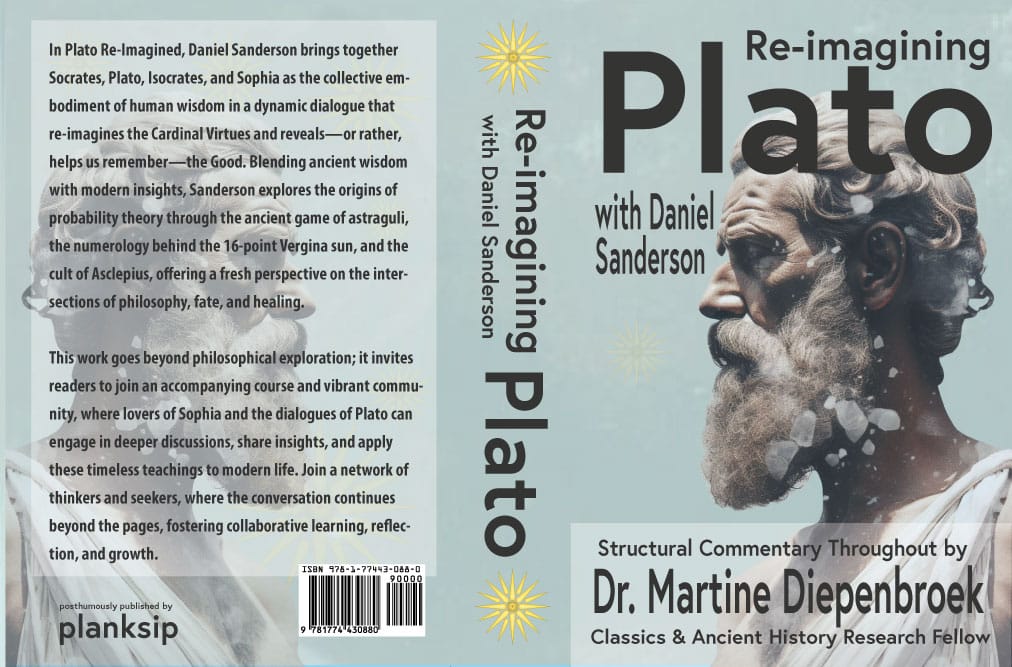
Plato Re-Imagined
This course offers 32 comprehensive lectures exploring most of Plato's dialogues. These lectures guide students toward a consilient understanding of the divine—a concept that harmonizes knowledge across disciplines and resonates with secular and religious leaders. As a bonus, Lecture #33 focuses on consilience, demonstrating how different fields of knowledge can converge to form a unified understanding.


