

Labor, Liberty, and the Chains We Forge: A Philosophical Inquiry
The relationship between labor, liberty, and slavery forms one of the most enduring and challenging inquiries in Western thought. From ancient city-states to modern industrial societies, philosophers have grappled with how work shapes human identity, the conditions under which it becomes oppressive, and the fundamental principles of justice that ought to govern our collective existence. This article explores the historical evolution of these concepts, drawing from the profound insights of the Great Books of the Western World, to illuminate the intricate dance between human effort, freedom, and the specter of bondage.
The Ancient Foundations: Labor, Hierarchy, and "Natural" Slavery
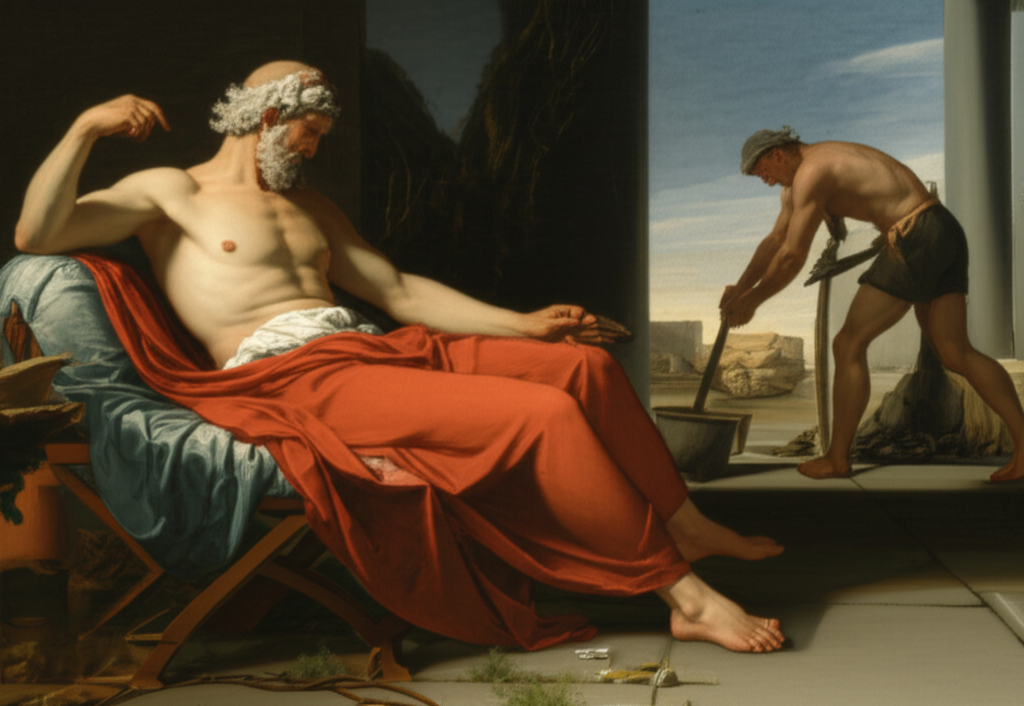
In the ancient world, particularly among the Greeks, the concept of labor was often viewed with a degree of disdain, especially manual or menial work. For philosophers like Plato and Aristotle, liberty was largely reserved for citizens who could devote themselves to political life, contemplation, and the pursuit of virtue. This leisure was often made possible by the labor of others, including slaves.
Aristotle, in his Politics, famously articulated the notion of "natural slavery." He posited that some individuals were naturally suited to be ruled, lacking the full capacity for reason and self-governance. For Aristotle, the slave was a "living tool," an extension of the master's property, whose labor served the household's economic needs. This perspective, though deeply problematic to modern sensibilities, provided a foundational (and often convenient) justification for the institution of slavery in classical antiquity.
- Key Ancient Perspectives:
- Plato (e.g., Republic): Emphasized a division of labor within the ideal state, with different classes performing specific functions. While not explicitly justifying slavery as Aristotle did, his hierarchical vision often implied forms of servitude.
- Aristotle (Politics): Advocated for "natural slavery" where some individuals are inherently suited to be slaves, their labor providing the necessary foundation for citizens' liberty and political engagement.
- The Citizen's Liberty: Free citizens were liberated from the necessity of manual labor to pursue higher civic and intellectual endeavors.
The Enlightenment's Challenge: Redefining Liberty and Justice
Centuries later, the Enlightenment brought a radical re-evaluation of liberty and human rights, laying the groundwork for the eventual abolition of chattel slavery. Thinkers like John Locke fundamentally shifted the discourse by asserting that all individuals possess natural rights, including the right to life, liberty, and property.
In his Two Treatises of Government, Locke argued that property is acquired through mixing one's labor with the earth. This idea elevated labor from a base activity to a source of legitimate ownership and a cornerstone of individual liberty. For Locke, slavery was a state contrary to natural law, justifiable only in extreme cases as a consequence of a just war, and even then, not absolute. The notion that all men are born free and equal directly challenged the Aristotelian concept of natural slavery, demanding a new understanding of justice.
- Shifting Paradigms:
- John Locke (Two Treatises of Government): Argued for natural rights, including liberty, and the right to property derived from labor. Slavery was seen as a violation of these natural rights, contrary to justice.
- Jean-Jacques Rousseau (The Social Contract): Famously declared, "Man is born free, and everywhere he is in chains." Rousseau critiqued forms of social and political slavery that undermined true liberty and the general will, emphasizing that individuals alienate their liberty only through consent, and never absolutely.
- The Problem of Justice: If all are born free, then slavery becomes an inherent injustice, not a natural order.
Labor as Self-Realization and Alienation: Hegel and Marx
The 19th century witnessed further profound philosophical inquiries into the nature of labor, recognizing its potential not just for oppression but also for self-realization.
G.W.F. Hegel, in his Phenomenology of Spirit, introduced the famous master-slave dialectic. In this dynamic, the slave, through his labor, transforms nature and, in doing so, transforms himself. The master, by contrast, consumes the fruits of the slave's labor but remains dependent and static. Paradoxically, it is the slave, through his active engagement with the world, who ultimately achieves a deeper self-consciousness and a path towards true liberty. The slave's labor becomes a crucible for freedom.
Following Hegel, Karl Marx critically examined the nature of labor in industrial capitalism. In works like Das Kapital and the Economic and Philosophic Manuscripts of 1844, Marx argued that under capitalism, labor becomes alienated. Workers are separated from the products of their labor, the process of production, their species-being, and ultimately, from each other. This alienation, for Marx, constitutes a form of "wage slavery", where formal liberty masks profound economic exploitation and a lack of true human flourishing. For Marx, genuine justice could only be achieved when labor was emancipated from capitalist exploitation.
- Dialectics of Labor:
- Hegel (Phenomenology of Spirit): The master-slave dialectic posits that the slave, through transformative labor, develops self-consciousness and a path to liberty, while the master remains dependent.
- Marx (Das Kapital, Economic and Philosophic Manuscripts of 1844): Critiqued alienated labor in capitalism, arguing that it constitutes a form of "wage slavery" that denies workers true liberty and justice.
Enduring Questions: Modern Slavery and the Future of Work
The historical journey through the concepts of labor, liberty, and slavery reveals that these are not static ideas but rather dynamic fields of struggle and redefinition. While chattel slavery has been formally abolished in most parts of the world, the echoes of these philosophical debates persist.
Today, we confront new forms of slavery – human trafficking, forced labor, and debt bondage – which highlight the ongoing failure of justice and the vulnerability of human liberty. Moreover, contemporary discussions about the future of work, automation, and the gig economy compel us to revisit Marx's concerns about alienated labor and the pursuit of meaningful work.
The Great Books remind us that the quest for true liberty is inextricably linked to how we understand and organize our labor. Achieving a society founded on genuine justice requires constant vigilance against all forms of exploitation and an unwavering commitment to ensuring that labor serves to elevate, rather than diminish, human dignity.
YouTube Video Suggestions:
-
📹 Related Video: ARISTOTLE ON: The Nicomachean Ethics
Video by: The School of Life
💡 Want different videos? Search YouTube for: "Hegel Master Slave Dialectic Explained"
2. ## 📹 Related Video: PLATO ON: The Allegory of the Cave
Video by: The School of Life
💡 Want different videos? Search YouTube for: "John Locke Natural Rights Property Labor"