

Labor, Freedom, and Slavery: An Enduring Philosophical Reckoning
The relationship between labor, freedom, and slavery forms one of the most persistent and ethically charged inquiries in the history of philosophy. From ancient Greek city-states to the industrial revolutions and beyond, thinkers have grappled with how human work shapes our identity, defines our liberty, and, in its coercive forms, utterly negates our humanity. This article explores the philosophical lineage of these concepts, drawing from the Great Books of the Western World, to unravel the complex interplay of these fundamental pillars of human existence and the timeless quest for justice.
The Enduring Paradox of Human Endeavor
At its core, human existence is inextricably linked to labor. We work to survive, to create, to build, and to transform the world around us. Yet, this very act of labor, seemingly a source of human flourishing and self-realization, has historically been both a path to liberty and the chains of slavery. How can the same fundamental activity yield such divergent outcomes? This paradox compels us to confront the deepest questions about human nature, societal structure, and the moral imperatives that ought to govern our interactions.
Labor: The Human Condition and Its Contradictions
Philosophers have long debated the essence and value of labor. Is it a curse, a necessary evil, or the very crucible of our self-creation?
Ancient Perspectives: Necessity and Hierarchy
For many ancient thinkers, particularly Aristotle in his Politics, labor was often seen as a practical necessity, but one that ideally should be performed by others, allowing citizens to pursue higher intellectual and political endeavors. He famously posited a form of "natural slavery," arguing that some individuals were inherently suited to be instruments for others, though this view has been thoroughly repudiated by subsequent philosophical and moral progress. The polis required labor, but the free citizen was defined by their leisure, not their toil.
Modern Perspectives: Property, Self-Creation, and Alienation
The Enlightenment brought a radical shift. John Locke, in his Two Treatises of Government, argued that labor is the very foundation of property rights. By mixing one's labor with nature, one appropriates it, making it one's own, thus linking labor directly to individual liberty and self-ownership.
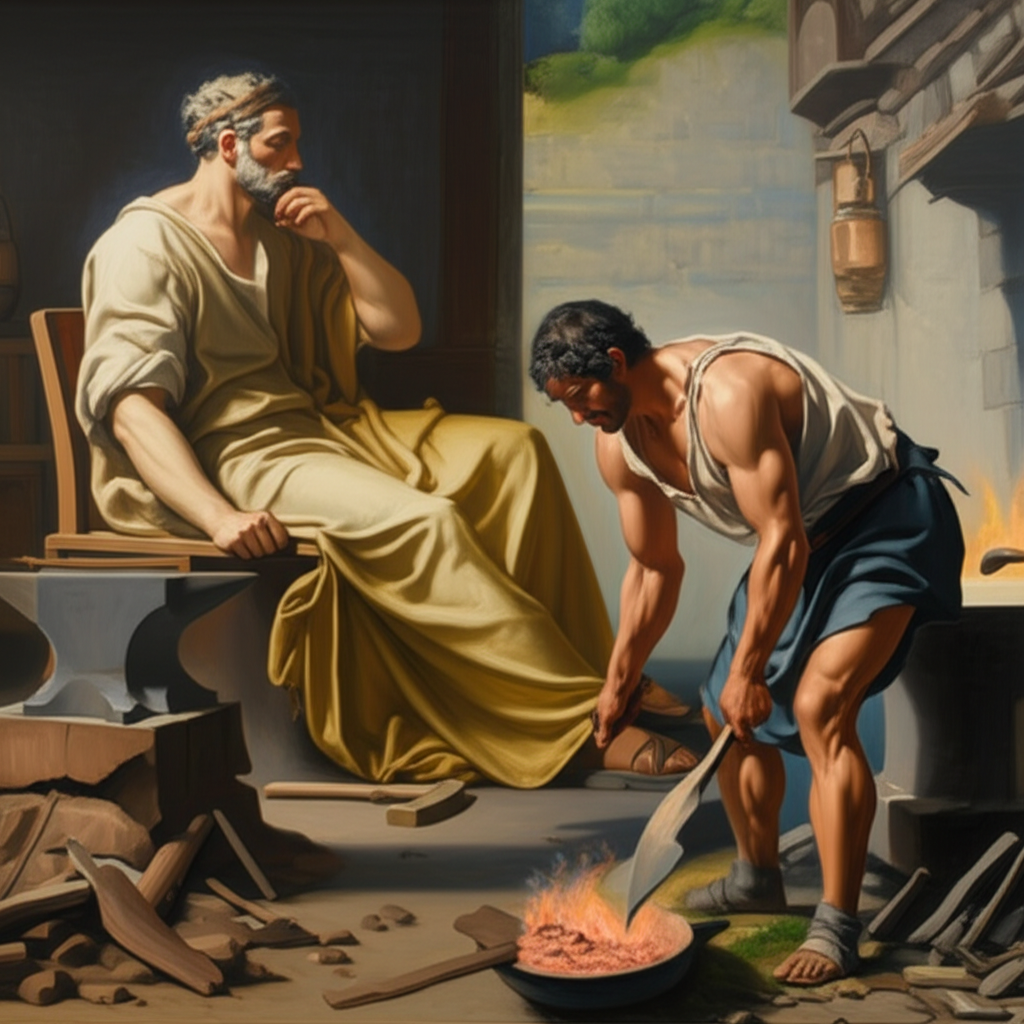
Later, G.W.F. Hegel, in his Phenomenology of Spirit, introduced the profound concept of the "master-slave dialectic," where the slave, through their labor transforming the natural world, comes to a deeper self-consciousness and mastery over their environment than the master, who merely consumes. Labor, in this view, is a process of self-formation and recognition.
However, Karl Marx, building upon Hegel but inverting his idealism, saw labor in capitalist societies as a source of alienation. In Das Kapital, he argued that under capitalism, the worker is estranged from the product of their labor, the process of labor itself, their species-being, and other humans. Labor, instead of being a means of self-expression and freedom, becomes a dehumanizing force, reducing the worker to a mere commodity.
Table 1: Philosophical Views on Labor
| Philosopher | Key Concept of Labor | Relationship to Freedom |
|---|---|---|
| Aristotle | Necessary for society; performed by slaves/non-citizens | Allows citizens leisure for political/intellectual freedom |
| John Locke | Foundation of property rights; mixing labor with nature | Direct link to individual liberty and self-ownership |
| G.W.F. Hegel | Self-formation; means of self-consciousness (master-slave dialectic) | Potential path to recognition and mastery |
| Karl Marx | Source of alienation under capitalism; productive force | Can be dehumanizing, negating true human freedom |
Liberty: The Quest for Self-Determination
Liberty, or freedom, is arguably the most cherished ideal in Western thought, yet its definition remains contested. Is it merely the absence of external constraints, or does it demand something more profound?
Jean-Jacques Rousseau, in The Social Contract, distinguished between natural liberty (bound only by one's own strength) and civil liberty (limited by the general will but offering moral freedom). For Rousseau, true freedom is not merely doing as one pleases, but moral liberty, which is obedience to a law one prescribes for oneself. This links freedom intrinsically to rational self-governance.
Immanuel Kant further developed this idea, asserting that moral autonomy—the capacity to be a law unto oneself—is the essence of human dignity and freedom. To act freely is to act morally, guided by universal reason, not by inclination or external coercion. In this light, any form of forced labor or subjugation is a profound violation of human autonomy.
Slavery: The Ultimate Betrayal of Liberty
If liberty is the capacity for self-determination and moral autonomy, then slavery stands as its absolute negation. It is the condition where one individual's will, body, and labor are entirely subjected to another's, rendering them a mere instrument.
Historically, slavery was justified on various grounds—conquest, debt, or even Aristotle's "natural slavery"—but these justifications have been systematically dismantled by the philosophical and moral progress of humanity. John Locke, despite his problematic personal connections to slavery, argued vehemently against it in his Two Treatises, stating that no one can voluntarily enslave themselves, as it would be giving up their fundamental right to life and liberty. To be enslaved is to be reduced to a chattel, a thing, stripped of one's inherent human dignity and moral personhood.
The abolitionist movements, fueled by Enlightenment ideals, recognized that the institution of slavery was not merely an economic or social arrangement but a profound moral evil, an egregious affront to universal human rights and the very notion of justice. It is the ultimate form of coerced labor, where the fruits of one's toil are stolen, and the spirit itself is imprisoned.
The Interplay of Justice: Seeking a Humane Equilibrium
The interwoven threads of labor, freedom, and slavery culminate in the concept of justice. A just society, as envisioned by many philosophers from Plato onwards, must strive to create conditions where individuals can engage in meaningful labor without coercion, where their inherent liberty is respected, and where the possibility of slavery—in all its forms, overt or subtle—is eradicated.
The pursuit of justice demands:
- Recognition of Intrinsic Worth: Every human being possesses inherent dignity, which cannot be alienated or commodified.
- Fair Labor Practices: Work should be a means of self-realization, not exploitation. This implies fair wages, safe conditions, and the right to meaningful engagement.
- Protection of Liberty: Laws and social structures must safeguard individual autonomy and prevent any form of subjugation, whether political, economic, or social.
The philosophical journey through these concepts reveals a progressive understanding of human rights and the ethical obligations of society. It is a journey from the acceptance of coercive labor to the demand for dignified work, from limited notions of freedom to the universal aspiration for self-determination.
Conclusion: Towards a Future of Dignified Labor and Universal Freedom
The questions surrounding labor, liberty, and slavery are not relics of the past; they resonate profoundly in contemporary debates about economic exploitation, human trafficking, and the nature of work in an increasingly globalized world. The Great Books of the Western World provide not just historical context but a powerful framework for understanding these enduring challenges. They compel us to continually examine our social structures, ensuring that labor serves to uplift human dignity, that liberty is truly universal, and that the shadow of slavery—in any guise—is forever banished in the relentless pursuit of justice.
YouTube Video Suggestions:
-
📹 Related Video: PLATO ON: The Allegory of the Cave
Video by: The School of Life
💡 Want different videos? Search YouTube for: "John Locke Labor Theory of Property Explained"
2. ## 📹 Related Video: ARISTOTLE ON: The Nicomachean Ethics
Video by: The School of Life
💡 Want different videos? Search YouTube for: "Hegel Master Slave Dialectic Summary"