

Justice as the Virtue of the State: A Philosophical Exploration
The concept of justice extends far beyond individual morality; it is a fundamental characteristic, indeed a virtue, of a well-ordered State. From ancient Greek philosophers like Plato and Aristotle to modern thinkers such as Locke and Kant, the question of what constitutes a just State has been central to political philosophy. This pillar page delves into how justice manifests as the core virtue of political communities, examining its historical evolution, key debates, and its intricate relationship with law and the cultivation of collective virtue and vice.
Understanding the Core: Justice, Virtue, and the State
At its heart, the idea of justice as the virtue of the State posits that a political community's ultimate good, its very excellence, lies in its capacity to be just. This isn't merely about upholding laws, but about embodying principles of fairness, equity, and the common good in its structure, governance, and treatment of its citizens.
Defining Key Concepts
- Justice: More than simply legality, justice in this context encompasses fairness, proportionality, the protection of rights, and the equitable distribution of duties and benefits. It is about rendering to each what is due.
- Virtue and Vice: A virtue is a moral excellence, a disposition to act in the right way. For a State, justice is the overarching virtue that allows for the flourishing of its citizens and the proper functioning of its institutions. Conversely, vice in the State would be injustice, leading to disorder and societal decay.
- The State: An organized political community living under a single system of government, typically sovereign over a defined territory. It is the framework within which human flourishing, or decline, is largely determined.
- Law: The system of rules which a particular country or community recognizes as regulating the actions of its members and which it may enforce by the imposition of penalties. Law is often seen as the primary instrument through which the State seeks to achieve justice.
The Interconnection
The State provides the framework for collective life, and justice is the principle that guides this framework towards its highest good. A just State cultivates virtue among its citizens by establishing fair laws, ensuring equitable systems, and upholding a moral order that encourages individual and collective excellence. Without justice, the State risks descending into tyranny or anarchy, fostering vice rather than virtue.
Historical Evolution: Echoes from the Great Books
The concept of justice as the virtue of the State has a rich lineage in Western thought, explored deeply by many of the philosophers compiled in the Great Books of the Western World.
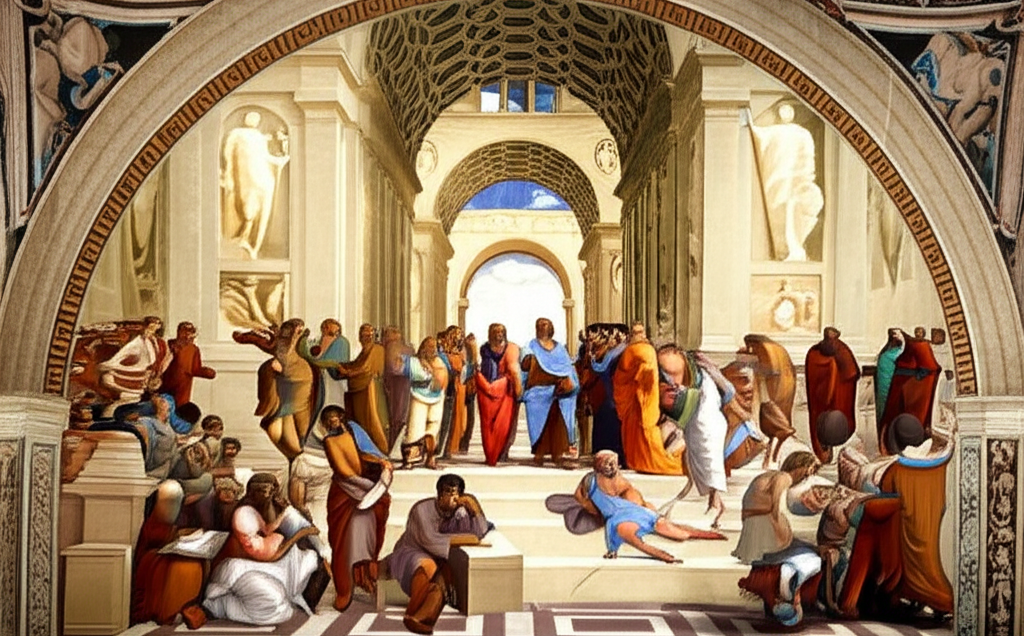
Key Thinkers and Their Contributions
| Philosopher/Era | Key Work(s) | Concept of Justice in the State A just state is a key to human flourishing.
* The Republic: Plato's vision of a just State is based on a tripartite soul (reason, spirit, appetite) mirrored in the societal structure (philosopher-kings, auxiliaries, producers). Justice is achieved when each part performs its proper function without interfering with others, creating a harmonious whole. This harmony allows for the flourishing of other virtues like wisdom, courage, and temperance.
- Aristotle: The Political Animal and the Good Life
- Politics & Nicomachean Ethics: For Aristotle, the State exists for the sake of the good life, not merely for life itself. Justice is considered the most complete of the virtues because it is exercised toward others. He distinguishes between distributive justice (fair distribution of goods and honors according to merit) and corrective justice (rectifying wrongs). The State, through its laws, aims to cultivate virtuous citizens and ensure a just society where individuals can achieve eudaimonia (human flourishing).
- Medieval Thought: Thomas Aquinas and Natural Law
- Summa Theologica: Aquinas integrated Christian theology with Aristotelian philosophy. He posited that human law must be in conformity with natural law, which in turn reflects eternal law. Justice is understood as giving to each person their due, a concept rooted in divine order. The State's virtue lies in its capacity to enact and enforce laws that align with this natural and divine order, thereby guiding its citizens towards their proper end.
- Early Modern Era: Social Contract and Rights
- Thomas Hobbes (Leviathan): Justice is the adherence to covenants made. In the state of nature, there is no justice or injustice. The sovereign State creates justice through its laws and enforcement, compelling individuals to uphold agreements to escape the brutal "war of all against all."
- John Locke (Two Treatises of Government): Justice is rooted in natural rights to life, liberty, and property. The State is formed by consent to protect these pre-existing rights through established laws. A just State is one that limits its power and acts solely to preserve these fundamental rights, preventing arbitrary rule.
- Jean-Jacques Rousseau (The Social Contract): Justice arises from the general will, which aims at the common good. Laws are legitimate only when they are expressions of this general will, to which all citizens consent. A just State fosters true freedom by ensuring that laws apply equally to all and serve the collective interest, transforming natural liberty into civil liberty.
- Immanuel Kant (Metaphysics of Morals): Justice is tied to universal moral law and the categorical imperative. The State's primary duty is to guarantee external freedom for all individuals under universal laws. A just State is a Rechtsstaat (state of rights/law) where individuals' freedom is limited only by the consistent freedom of others, ensuring that everyone can act according to universalizable maxims.
Key Debates and Challenges
The concept of justice as the virtue of the State is not without its complexities and ongoing philosophical debates.
- Defining "The Good": Whose conception of "the good life" should the State promote? Plato's ideal State sought a unified good, but in pluralistic societies, defining a singular common good for all can be contentious, leading to conflicts over virtue and vice.
- Individual Rights vs. Collective Good: How does a State balance the pursuit of collective justice (e.g., social welfare programs) with the protection of individual liberties and property rights? This tension is a recurring theme from Locke to contemporary political discourse.
- The Problem of Unjust Law: If justice is the virtue of the State, what happens when the State's laws are perceived as unjust? This raises questions about civil disobedience and the moral obligation to obey or resist state authority. Aquinas would argue such laws are not true laws, while Hobbes would insist on obedience to maintain order.
- Idealism vs. Realism: Is a perfectly just State an achievable ideal, or merely a theoretical construct? Philosophers often grapple with the gap between the theoretical aspirations of justice and the practical realities of political power, human nature, and societal imperfections.
Related Concepts and Intersections
The pursuit of justice within the State intersects with numerous other philosophical and practical considerations:
- Justice and Legality: While often intertwined, justice and legality are not synonymous. A law can be perfectly legal but deeply unjust (e.g., historical segregation laws). The State's virtue lies in striving for laws that are both legal and just.
- Justice and Equality: The relationship between justice and equality is complex. Does justice demand strict equality of outcome, equality of opportunity, or equity based on need or merit? Different theories of justice offer varying answers, impacting the State's policies on distribution and recognition.
- Justice and Power: The exercise of power by the State is inextricably linked to justice. A just State uses its power legitimately and equitably, avoiding oppression and ensuring accountability. The potential for power to corrupt highlights the constant struggle against vice within the State.
- Justice and Peace: A just State is often seen as a prerequisite for lasting peace, both internally among its citizens and externally in its relations with other nations. Injustice breeds resentment, conflict, and instability, underscoring justice's role as a foundational virtue.
Conclusion: The Enduring Quest for a Virtuous State
From the ancient polis to the modern nation-state, the aspiration for justice as the virtue of the State remains a central pillar of philosophical inquiry. Plato's vision of a harmonious, ordered society, Aristotle's emphasis on the State as the enabler of the good life, and the Enlightenment thinkers' focus on rights and universal law all underscore the profound importance of justice in political communities.
While the definition and implementation of justice continue to evolve and provoke debate, the core idea persists: a State achieves its highest form of excellence, its true virtue, when it successfully establishes a framework that promotes fairness, upholds rights, and fosters the flourishing of its citizens, guided by equitable laws and a commitment to the common good. The journey to understand and realize this ideal is an ongoing philosophical endeavor, inviting continuous reflection and engagement.
YouTube:
- "Plato's Republic Justice State"
- "Aristotle Politics Ethics Law"
📹 Related Video: ARISTOTLE ON: The Nicomachean Ethics
Video by: The School of Life
💡 Want different videos? Search YouTube for: "Justice as the Virtue of the State philosophy"