

Justice as the Virtue of the State: An Enduring Classical Ideal
In the grand tapestry of political philosophy, few concepts are as foundational and contested as justice. For the ancient Greeks, particularly Plato, justice wasn't merely a legalistic framework but the very virtue that allowed the State to flourish, mirroring the harmonious balance of a well-ordered individual soul. This article explores the classical understanding of justice as the paramount virtue of the state, delving into how its presence ensures stability, order, and the common good, while its absence — vice — leads to societal decay. Drawing heavily from the Great Books of the Western World, we'll uncover how philosophers like Plato envisioned a just state, where every element performs its proper function under the guiding hand of Law.
The Platonic Blueprint: Justice as Harmony
Plato, in his seminal work The Republic, doesn't shy away from presenting an audacious vision of an ideal state, or polis. His inquiry into justice begins not with Law or punishment, but with the very essence of what makes a state good. For Plato, justice in the state is analogous to justice in the individual soul: a condition of internal harmony where each part performs its natural function without encroaching upon the others.
The Tripartite State and Its Virtues
Plato’s ideal state is structured into three distinct classes, each possessing a primary virtue, much like the three parts of the human soul (reason, spirit, appetite) each have their own virtues:
- Guardians (Rulers): These are the philosophers, guided by reason and possessing the virtue of Wisdom. Their role is to govern, to make decisions for the common good, and to understand the Form of the Good.
- Auxiliaries (Soldiers): Driven by spirit, these are the protectors of the state, embodying Courage. They enforce the decisions of the Guardians and defend against external threats.
- Producers (Workers): Comprising farmers, artisans, and merchants, they are driven by appetite and contribute to the state's material needs, exercising Temperance (self-control and moderation).
Justice, in this context, emerges not as a separate virtue, but as the overarching principle that ensures each class performs its specific duty and does not interfere with the others. When the Guardians rule wisely, the Auxiliaries defend courageously, and the Producers exercise moderation in their pursuits, the state achieves a state of perfect harmony and balance. This is the very definition of a just state.
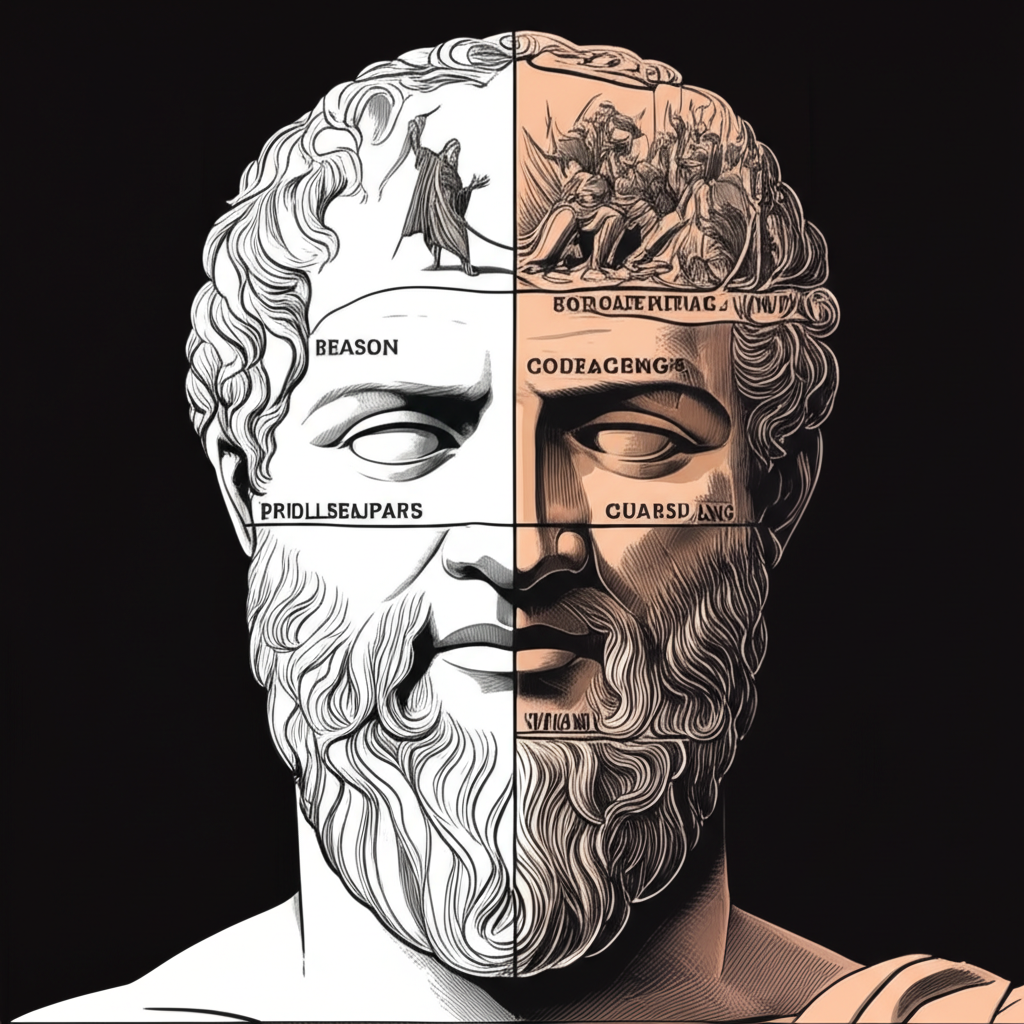 , a strong chest (spirit), and a full belly (appetite) – is shown. On the other side, an architectural representation of a state with three tiers: an elevated, serene temple (Guardians), a fortified wall with vigilant soldiers (Auxiliaries), and bustling market stalls and workshops below (Producers). Lines connect the corresponding virtues and functions between the individual and the state, emphasizing the harmonious division of labor.)
Vice: The Discord of Injustice
Conversely, vice in the state arises when this natural order is disturbed. If the soldiers decide to rule, or the merchants seek political power, the state descends into chaos. This transgression of boundaries, where parts of the state attempt to perform functions for which they are not suited, is what Plato identifies as injustice. It's a fundamental imbalance, a disharmony that undermines the very foundation of the polis.
Aristotle: Law as the Embodiment of Justice
While Plato laid the theoretical groundwork, Aristotle, his student, further elaborated on the practical manifestation of justice within the state, particularly through the concept of Law. For Aristotle, the polis is a natural institution, essential for human flourishing and the realization of our rational and social nature.
Aristotle argues in Politics that Law is critical for a well-ordered society. A just state is one governed by good laws, which aim to cultivate virtue in its citizens and promote the common good. He distinguishes between different forms of justice, including distributive justice (fair allocation of resources and honors) and corrective justice (rectifying wrongs). In essence, Law serves as the concrete expression of the state's pursuit of justice, ensuring fairness and preventing the excesses of individual or factional interests.
Key Aspects of Justice in the Aristotelian State:
- Rule of Law: The law, not individuals, should be supreme. This ensures impartiality and stability.
- Common Good: Laws are designed to benefit all citizens, fostering a sense of community and shared purpose.
- Cultivation of Virtue: Just laws encourage citizens to develop virtuous habits, contributing to the moral fabric of the state.
| Element of the State | Platonic Virtue | Aristotelian Connection to Law |
|---|---|---|
| Rulers/Guardians | Wisdom | Crafting and upholding just laws |
| Auxiliaries | Courage | Enforcing laws fairly and bravely |
| Producers | Temperance | Abiding by laws for societal order |
| Overall State | Justice | The overarching aim of all laws and governance |
The Enduring Legacy: Why Justice as a State Virtue Still Matters
The ancient Greek understanding of justice as the fundamental virtue of the State offers profound insights that remain relevant today. In an era marked by political polarization and societal fragmentation, the call for each part of the body politic to perform its function responsibly, guided by Law and focused on the common good, echoes with timeless wisdom.
When leaders prioritize wisdom and the welfare of all, when institutions demonstrate courage in upholding principles, and when citizens exercise temperance and civic responsibility, the state approaches its virtuous ideal. Conversely, when corruption, self-interest, and factionalism – the very embodiments of vice – dominate, the state's capacity to serve its people diminishes, leading to instability and injustice.
The Great Books of the Western World remind us that the pursuit of a just state is not merely an academic exercise but a perpetual civic duty, a constant striving for harmony and balance under the rule of righteous Law.
YouTube Video Suggestions:
-
📹 Related Video: PLATO ON: The Allegory of the Cave
Video by: The School of Life
💡 Want different videos? Search YouTube for: "Plato Republic Justice State Summary"
-
📹 Related Video: ARISTOTLE ON: The Nicomachean Ethics
Video by: The School of Life
💡 Want different videos? Search YouTube for: "Aristotle Politics Law Justice Virtue"