

Justice as the Virtue of the State: A Quest for Collective Excellence
Justice, far from being a mere abstract ideal, stands as the foundational virtue of any well-ordered State. From ancient Athens to contemporary democracies, philosophers have grappled with the notion that a state's true excellence—its virtue—is inextricably linked to its capacity to embody and uphold justice. This article explores how classical thinkers, particularly Plato and Aristotle, established this profound connection, arguing that a just State, governed by equitable Law, is not just a desirable outcome but the very essence of its purpose and legitimacy.
The State's Moral Compass: Why Justice Isn't Optional
Hello, fellow travelers on the philosophical path! When we talk about the State, what image comes to mind? Is it a sprawling bureaucracy, a national border, or perhaps the collective will of a people? For many of the great minds of Western thought, the State was far more than a geographical or administrative entity; it was a moral project, an arena where human flourishing could either be nurtured or crushed. And at the heart of this project lay Justice.
But what does it truly mean for a State to possess virtue? Just as an individual's virtue might manifest as courage, wisdom, or temperance, a state's virtue is its excellence in fulfilling its proper function. And what is that function? To create the conditions for a good life for its citizens, to ensure fairness, stability, and the common good. Without Justice, the state descends into chaos, oppression, or self-serving interests—a clear manifestation of vice.
Plato's Republic: Harmony as the Blueprint for Justice
Perhaps no one articulated the State's virtue of Justice more compellingly than Plato in his monumental work, The Republic. For Plato, Justice in the State was a grand, macroscopic reflection of Justice in the individual soul. He posited that a just individual achieves inner harmony when the rational part of the soul guides the spirited and appetitive parts. Similarly, a just State is one where its constituent parts—its citizens—function harmoniously, each performing its natural role.
Plato envisioned a society divided into three distinct classes, each embodying a particular virtue:
- Rulers (Guardians): Possessing wisdom, these philosopher-kings are tasked with governing, making decisions based on truth and the good of the whole.
- Auxiliaries (Soldiers): Embodying courage, they protect the state and enforce the rulers' decisions.
- Producers (Workers): Exercising temperance (self-control and moderation), they provide for the material needs of the society.
Justice, Plato argued, arises when each of these classes performs its designated function, and only its designated function, without meddling in the affairs of others. It's the overarching virtue that binds the other virtues together, ensuring the health and stability of the body politic. When this harmony breaks down, when, for instance, the producers seek to rule or the auxiliaries become tyrannical, the state falls into vice—degenerating into timocracy, oligarchy, democracy (as Plato understood its potential pitfalls), or ultimately, tyranny.
Aristotle's Politics: Law as the Embodiment of Justice
While Plato sought an ideal, abstract form of Justice, his student Aristotle brought the concept down to earth, emphasizing its practical application through Law. In Politics and Nicomachean Ethics, Aristotle argued that the State exists not merely for living, but for living well. And this "good life" (eudaimonia) is made possible through the establishment of just Law.
For Aristotle, Justice is often synonymous with legality and fairness. He distinguished between:
- Distributive Justice: Concerned with the fair allocation of honors, wealth, and other goods according to merit or contribution.
- Corrective Justice: Aims to rectify wrongs and restore balance in transactions or disputes, often through the judicial system.
The virtue of the State, in Aristotle's view, lies in its capacity to create and uphold Law that embodies these principles of fairness and proportion. A state ruled by Law, rather than by the arbitrary will of individuals, ensures stability and predictability, allowing citizens to pursue their ends within a framework of equality. When the State deviates from the rule of Law, or when its Law becomes unjust, it ceases to be virtuous and instead becomes a corrupted form, serving private interests over the common good. The best State is one where the Law itself is virtuous, guiding citizens towards ethical conduct and collective flourishing.
The Interplay of Virtue and Vice in Statecraft
The classical understanding of Justice as the virtue of the State provides a powerful framework for evaluating political systems.
Manifestations of State Virtue:
- Rule of Law: Consistent application of impartial Law to all citizens.
- Fair Distribution: Equitable access to opportunities, resources, and protection.
- Public Service: Leaders prioritizing the common good over personal gain.
- Stability and Order: A state that effectively maintains peace and security through just means.
Manifestations of State Vice:
- Tyranny: Arbitrary rule, oppression, and disregard for individual rights.
- Corruption: Self-serving governance, embezzlement, and abuse of power.
- Inequality: Systemic injustices that create vast disparities and prevent flourishing for many.
- Instability: Frequent unrest, civil strife, or collapse due to a lack of legitimate authority.
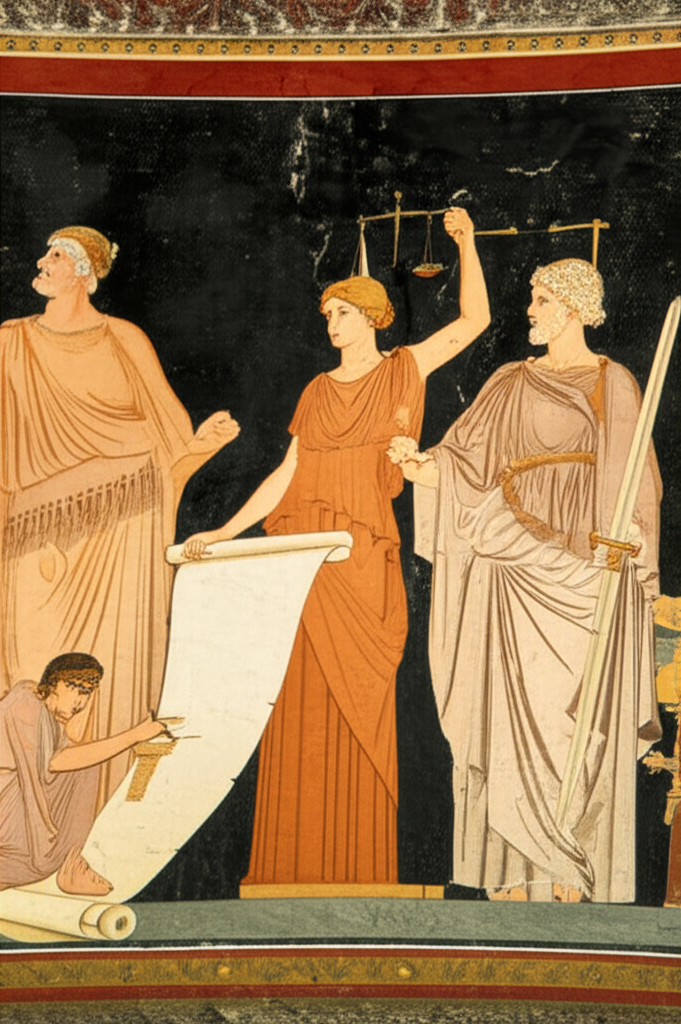
The continuous struggle for a just society is, in essence, the struggle to cultivate and safeguard the State's virtue against the ever-present threat of vice. It's a reminder that the health of our collective existence depends not just on economic prosperity or military might, but on our unwavering commitment to fairness, equity, and the rule of Law.
Modern Echoes: An Enduring Quest
While our modern States look vastly different from the city-states of ancient Greece, the fundamental insights of Plato and Aristotle remain profoundly relevant. Concepts like constitutionalism, human rights, and the separation of powers are all, in their own way, attempts to institutionalize Justice as the paramount virtue of the State. We continue to debate what constitutes a "fair" Law, how power should be distributed, and what responsibilities the State owes its citizens. These are not new questions, but rather ancient ones, continually re-examined through the lens of our own times.
Conclusion: A Perpetual Pursuit
Ultimately, viewing Justice as the virtue of the State compels us to see governance not merely as an administrative task, but as a moral endeavor. It challenges us to demand more from our institutions and our leaders, recognizing that the true excellence of any collective enterprise lies in its dedication to fairness and the common good. This pursuit of a just State is not a destination we reach and then abandon; it is a perpetual journey, a constant striving for collective excellence that defines our humanity.
📹 Related Video: PLATO ON: The Allegory of the Cave
Video by: The School of Life
💡 Want different videos? Search YouTube for: "Plato's Republic - Justice in the State"
📹 Related Video: ARISTOTLE ON: The Nicomachean Ethics
Video by: The School of Life
💡 Want different videos? Search YouTube for: "Aristotle on Law and Justice"