

How Labor Creates Wealth and Poverty: A Philosophical Inquiry
Summary: Labor, at its core, is the transformative force that converts raw potential into tangible value, serving as the fundamental wellspring of all wealth. Yet, paradoxically, the very mechanisms by which labor generates prosperity can, under certain socio-economic and political structures, simultaneously entrench and exacerbate poverty. This article explores the philosophical underpinnings of this duality, examining how human effort, while inherently productive, becomes entangled in systems that either uplift or diminish the laborer, often leading to the concentration of riches in the hands of an oligarchy and raising critical questions about the role of the State in mediating these outcomes.
The Genesis of Wealth: Labor as the Primal Act of Creation
From the earliest philosophical inquiries into property and value, labor has been recognized as the foundational act of creation. It is through the exertion of human energy, intellect, and skill that raw materials are shaped, ideas are realized, and goods and services come into being.
Locke's Legacy: Labor as the Origin of Property
John Locke, a towering figure in the Great Books of the Western World, famously articulated that the primary origin of property lies in labor. When an individual "mixes his labour" with something from the common stock of nature, that thing becomes his property, as he has added something of himself to it. This concept posits that value is not inherent in nature but imputed through human effort. The land itself may be barren, but the farmer's toil transforms it into a source of sustenance and, by extension, wealth.
- The transformative power: Labor transforms unowned natural resources into usable goods.
- The individual claim: It establishes a legitimate claim to what one has produced or improved.
- The basis of value: It is the primary input that gives things their economic worth.
The Productive Power of Human Endeavor
Beyond individual property, aggregated labor forms the basis of societal wealth. The division of labor, as illuminated by Adam Smith, multiplies productive capacity exponentially. When individuals specialize and exchange their outputs, the collective wealth of a nation grows far beyond what isolated efforts could achieve. This collaborative labor builds infrastructure, innovates technology, and creates the complex tapestry of modern economies. Without labor, capital lies dormant, resources remain untapped, and societies stagnate.
The Shadow Side: How Labor Can Create Poverty
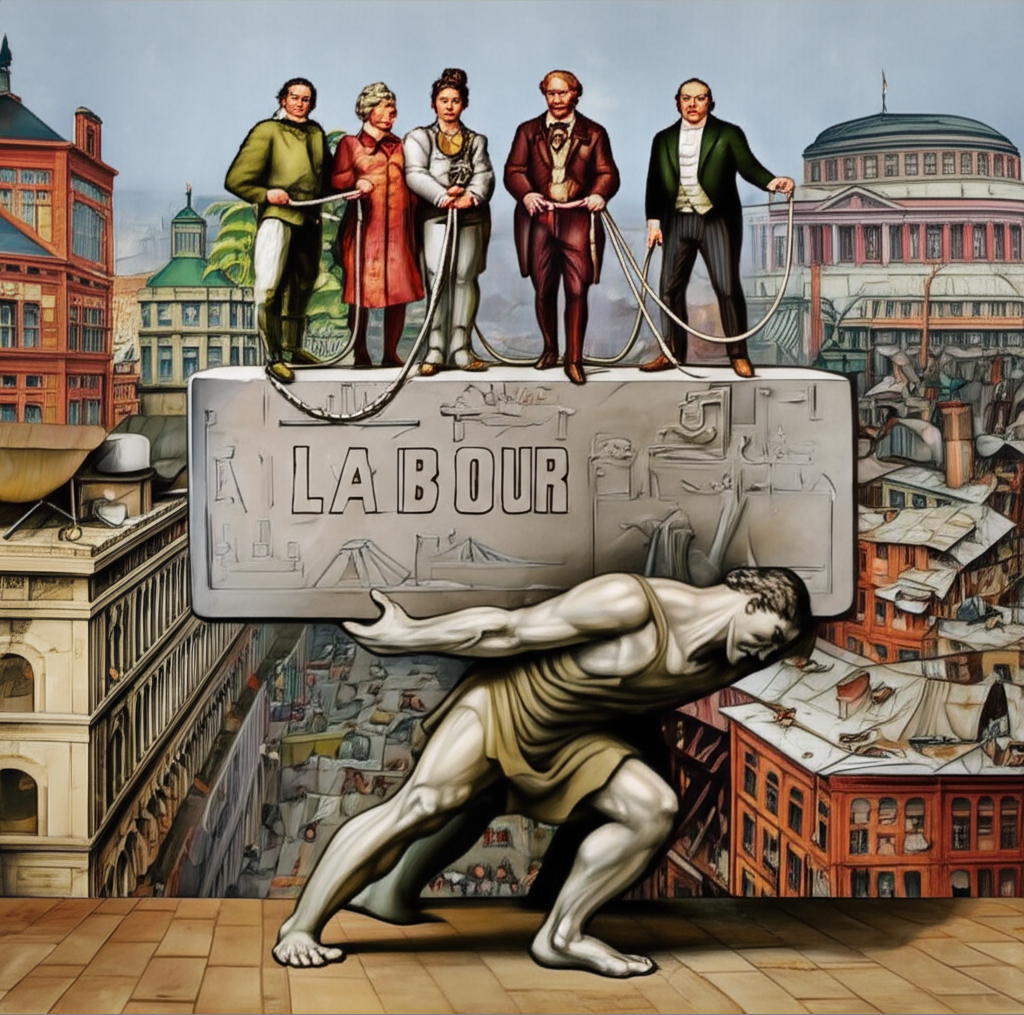
While labor is undeniably the engine of wealth, its organization and distribution within a society can just as readily be the architects of poverty. The very systems designed to maximize production can, paradoxically, disempower and impoverish those who contribute their labor.
Alienation and Exploitation: The Marxist Critique
Karl Marx, another indispensable voice from the Great Books, meticulously detailed how labor under capitalism could lead to the alienation of the worker. When the means of production are owned by a few, the laborer sells their labor-power as a commodity. The value they produce often exceeds the wages they receive – this surplus value is appropriated by the capitalist. This inherent imbalance, Marx argued, leads to:
- Alienation from the product: The worker does not own what they produce.
- Alienation from the act of production: Work becomes a means to an end, rather than a fulfilling activity.
- Alienation from species-being: The worker is separated from their creative, human essence.
- Alienation from other humans: Competition replaces cooperation.
This exploitation, where the worker receives less than the full value of their labor, is a direct mechanism by which wealth is concentrated at the top, while the majority of laborers remain in or near poverty.
The Concentration of Wealth and the Rise of Oligarchy
Over time, the accumulation of wealth derived from labor can lead to extreme disparities. As capital begets more capital, often through the ongoing appropriation of surplus value, wealth tends to concentrate in fewer and fewer hands. This creates an oligarchy – a small group of powerful individuals or families who control the majority of resources and influence.
Mechanisms of Oligarchic Entrenchment:
| Mechanism | Description | Impact on Poverty |
|---|---|---|
| Capital Accumulation | Reinvestment of profits, often at the expense of worker wages. | Reduces opportunities for workers to build their own capital, perpetuating dependence. |
| Monopoly & Cartel | Control over markets, allowing for price manipulation and suppression of competition. | Limits consumer choice, stifles small businesses, and restricts worker mobility. |
| Inheritance | Generational transfer of wealth and assets, independent of individual labor or merit. | Creates a permanent class divide, making upward mobility difficult for the poor. |
| Financialization | Deriving wealth from financial instruments and speculation rather than productive labor. | Can lead to economic instability and crises that disproportionately affect the working class. |
This oligarchy can then leverage its economic power to influence political processes, creating a feedback loop where laws and policies further favor the wealthy, making it increasingly difficult for those in poverty to escape their circumstances.
The Role of the State in Structuring Economic Outcomes
The State, as the ultimate arbiter of laws and regulations, plays a critical role in how labor creates both wealth and poverty. Depending on its structure and priorities, the State can either be a force for equitable distribution or an instrument for the entrenchment of inequality.
Philosophers from Plato to Aristotle examined the ideal State and its responsibility for the well-being of its citizens. An unjust State, or one captured by an oligarchy, might:
- Protect property rights of the wealthy exclusively: Neglecting the rights and protections of laborers.
- Enforce low wages: Directly or indirectly by suppressing unions or setting minimum wages below a living standard.
- Create regressive tax systems: Where the poor pay a higher percentage of their income in taxes than the rich.
- Underinvest in public goods: Such as education, healthcare, and infrastructure, which are crucial for social mobility and reducing poverty.
Conversely, a State committed to justice might implement policies that empower labor, redistribute wealth, and ensure a more equitable society.
Philosophical Perspectives on Justice and Distribution
The enduring question for philosophers, from ancient Greece to the present day, remains: How ought the wealth generated by labor be distributed justly?
Aristotle on the Polis and Economic Justice
Aristotle, in his Politics, grappled with the ideal polis (city-state) and the dangers of extreme inequality. He recognized that a large middle class was essential for political stability and that excessive wealth or poverty could lead to factionalism and revolution. For Aristotle, the State's purpose was to enable its citizens to live a good life, which implied a certain level of material sufficiency and the avoidance of destitution. He critiqued purely acquisitive forms of wealth accumulation, advocating for a more balanced economic life geared towards the common good.
Modern Dilemmas: Bridging the Divide
Today, the philosophical debate continues, drawing on these historical insights. How do we reconcile the undeniable power of labor to create wealth with its potential to foster poverty? This involves examining:
- The ethics of ownership: Who truly owns the fruits of collective labor?
- The role of regulation: How should the State intervene to prevent exploitation and ensure fair distribution?
- The concept of a just wage: What constitutes fair compensation for labor?
- The purpose of economic activity: Is it solely profit maximization, or does it serve broader societal well-being?
These questions highlight that the relationship between labor, wealth, and poverty is not merely economic but profoundly philosophical, demanding continuous re-evaluation of our societal values and structures.
YouTube Video Suggestions:
-
📹 Related Video: PLATO ON: The Allegory of the Cave
Video by: The School of Life
💡 Want different videos? Search YouTube for: ""John Locke Labor Theory of Value Explained""
2. ## 📹 Related Video: ARISTOTLE ON: The Nicomachean Ethics
Video by: The School of Life
💡 Want different videos? Search YouTube for: ""Karl Marx Alienation of Labor Explained""