

From Observation to Insight: How Induction Bridges the Gap to Universal Knowledge
The quest for knowledge has long been humanity's defining characteristic, a relentless drive to understand not just the 'what' but the 'why' and 'how' of existence. At the heart of this pursuit lies induction, a powerful yet often debated method through which we ascend from the scattered observations of the particular to the unifying insights of the universal. This article explores how induction, by systematically gathering empirical evidence and discerning patterns, serves as an indispensable pathway to acquiring robust, if never absolutely certain, knowledge that underpins both our daily lives and the grand edifice of science. It is through this intellectual leap that we transform isolated facts into coherent understanding, moving from individual instances to general principles that illuminate our world.
The Foundations of Inductive Reasoning: From Particulars to Generals
At its core, induction is a form of reasoning that moves from specific observations to broader generalizations. Unlike deduction, which proceeds from general premises to specific conclusions (guaranteeing truth if the premises are true), induction draws probable conclusions based on repeated experiences. Imagine observing countless individual swans, each one white. Inductive reasoning leads us to the general conclusion: "All swans are white." This process is fundamental to how we learn, adapt, and build our understanding of the world.
Ancient philosophers, notably Aristotle in the Great Books of the Western World, recognized a form of induction, or epagoge, as a means to arrive at the first principles that deduction could then operate upon. For Aristotle, repeated experience of particulars could, through intuition or insight, lead to the grasp of universal truths. This highlights a crucial dynamic: the interplay between the Universal and Particular. Our senses perceive particulars, but our intellect strives for universals.
- The Inductive Process:
- Observation: Gathering data from specific instances (e.g., observing a metal expands when heated).
- Pattern Recognition: Identifying regularities or commonalities across these instances (e.g., all observed metals expand when heated).
- Generalization: Formulating a general principle or hypothesis based on these patterns (e.g., "All metals expand when heated").
- Verification/Refinement: Testing the generalization with new observations or experiments, leading to further knowledge or refinement of the principle.
The Inductive Leap: Building Universal Knowledge
The true power of induction lies in its ability to transcend individual experiences and construct statements of universal knowledge. When we assert that "gravity attracts all objects with mass," we are not merely describing a single event but proposing a principle that applies across all space and time. This leap from a finite set of observations to an infinite set of applications is the very essence of universalization.
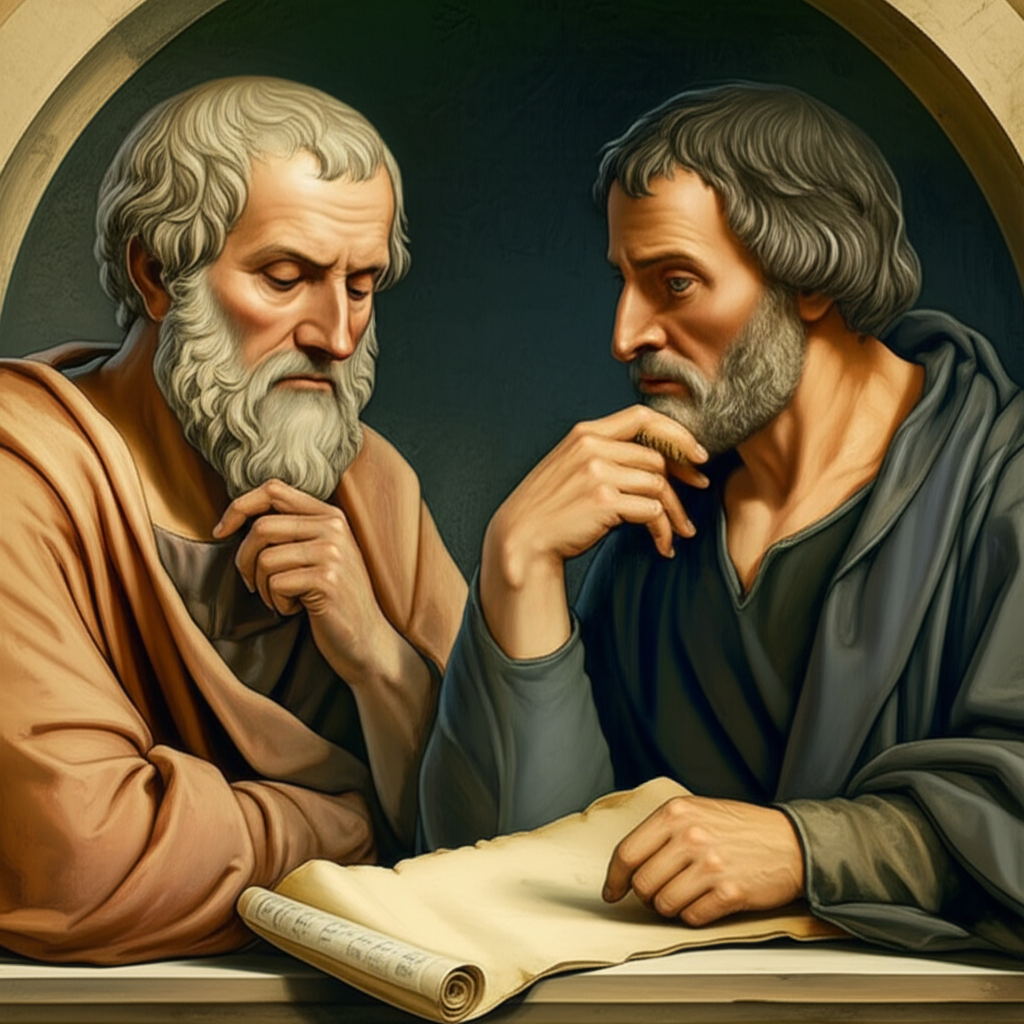
While David Hume, another giant in the Great Books, famously highlighted the "problem of induction" – that past regularities do not logically guarantee future ones – the practical utility of induction remains undeniable. We operate daily under the assumption that the sun will rise tomorrow, that fire will burn, and that gravity will hold us to the earth, all based on inductive inference. This pragmatic success underscores its role in shaping our understanding and expectations.
Induction in Practice: The Engine of Science
It is in the realm of science that induction truly comes into its own as a systematic method for acquiring knowledge. Francis Bacon, a pivotal figure in the development of the scientific method, advocated for a rigorous, empirical approach to induction. He argued against relying solely on deductive reasoning from preconceived notions and instead championed careful observation and experimentation to build knowledge from the ground up.
Bacon's method, as outlined in his Novum Organum, emphasized the collection of instances, the creation of "tables of presence, absence, and degrees," and the gradual ascent to axioms (general principles). This approach directly informs how scientific laws are formulated:
- Observation of Particulars: Scientists conduct experiments, gathering specific data points (e.g., measuring the velocity of falling objects at different times).
- Formulation of Hypotheses: They propose general explanations or relationships based on these observations (e.g., Galileo's hypothesis about uniform acceleration).
- Testing and Generalization: Repeated experiments across varying conditions lead to the confirmation and generalization of these relationships into scientific laws (e.g., Newton's laws of motion).
This iterative process of observing particulars, formulating universals, and then testing those universals against new particulars is the engine of scientific progress. It allows us to move beyond mere description to predictive power, understanding underlying mechanisms, and ultimately, accumulating a vast body of universal knowledge about the natural world.
Challenges and Refinements
Despite its power, induction is not without its philosophical challenges. Hume's problem reminds us that no amount of past evidence can logically guarantee a future outcome. Yet, our reliance on induction is not based on logical certainty but on its overwhelming practical success and its probabilistic nature. Modern philosophy of science, influenced by thinkers like Karl Popper, introduces concepts like falsification, where scientific theories (universal statements) are not proven true by induction but are provisionally accepted until they are falsified by counter-evidence. This acknowledges the inherent fallibility of induction while still recognizing its indispensable role in the growth of knowledge.
Conclusion
From the simplest observation of a falling apple to the grand theories of cosmic evolution, induction is the intellectual bridge that connects the myriad particulars of our experience to the unifying principles of universal knowledge. It is the fundamental process by which science builds its understanding, transforming raw data into coherent laws and theories. While always open to revision and never absolutely certain, the inductive method remains our most potent tool for expanding our understanding of the world, allowing us to navigate, predict, and ultimately, comprehend the vast tapestry of existence. Our journey from individual observation to sweeping insight is, in essence, the story of induction, a testament to humanity's enduring quest for deeper knowledge.
📹 Related Video: SOCRATES ON: The Unexamined Life
Video by: The School of Life
💡 Want different videos? Search YouTube for: ""Problem of Induction Explained" or "Francis Bacon Scientific Method""
📹 Related Video: ARISTOTLE ON: The Nicomachean Ethics
Video by: The School of Life
💡 Want different videos? Search YouTube for: ""Aristotle Induction Epagoge Philosophy""