

How Desire Motivates Human Action: The Unseen Architect of Our Lives
Human action, in its myriad forms, from the simplest gesture to the grandest endeavor, finds its fundamental impetus in the intricate wellspring of desire. It is the ceaseless current beneath the surface of our existence, propelling Man through the currents of life, shaping his choices, and ultimately defining his journey. Far from a mere fleeting whim, desire, as explored by the great minds of Western thought, is an essential force, an inherent orientation of the Mind that, through the faculty of Will, translates into tangible reality. Understanding this profound connection is to grasp the very essence of what it means to be human, to strive, to build, and to become.
The Primal Urge: Understanding Desire's Roots
At its most elemental, desire is a recognition of an absence or a potential, a yearning for something not yet possessed or a state not yet achieved. This fundamental impulse is not merely a biological drive, though it certainly encompasses those, but a complex psychological and spiritual phenomenon that has captivated philosophers for millennia.
From Instinct to Aspiration
From the ancient Greek understanding of eros – a powerful, often divine, longing that seeks beauty, truth, and goodness – to the more modern psychological interpretations, desire reveals itself as both a primitive instinct and a sophisticated aspiration. For the earliest thinkers, the desire for happiness (eudaimonia) was seen as the ultimate end, the driving force behind all ethical action. Aristotle, in his Nicomachean Ethics, meticulously dissects the human pursuit of this ultimate good, illustrating how every choice, every pursuit, is ultimately aimed at some perceived benefit or fulfillment.
Consider the infant's cry for nourishment, a basic desire for survival. As Man matures, these desires evolve, becoming increasingly complex and abstract. The desire for knowledge, for justice, for love, for recognition – these are not merely biological imperatives but products of a developed Mind engaging with the world and its possibilities. They are the refined expressions of a deeper longing for completeness, meaning, and connection.
The Mind's Crucible: Where Desire Takes Form
While desire originates as an internal stirring, it is within the Mind that it gains definition, direction, and potency. The human intellect acts as a crucible, processing raw impulses, weighing potential outcomes, and shaping vague yearnings into concrete goals.
The Interplay of Reason and Emotion
The Mind is not a passive receptacle for desires; it actively interprets, filters, and prioritizes them. Plato, in The Republic, famously describes the soul as having three parts: the appetitive, the spirited, and the rational. Desire often springs from the appetitive and spirited parts, but it is the rational part – the thinking Mind – that ought to guide and govern these desires, ensuring they lead to a harmonious and virtuous life. Without the guiding hand of reason, desires can become chaotic and destructive.
Here, we see the intricate dance between emotion and intellect. A strong emotional desire, say for revenge, might arise, but the rational Mind intervenes, considering the consequences, the moral implications, and alternative paths. Conversely, a purely intellectual understanding of a concept, like justice, can ignite a powerful desire to see it realized in the world. The Mind actively evaluates, imagines, and plans, transforming a nascent longing into a structured objective.
Table: The Mind's Role in Shaping Desire
| Stage of Desire Processing | Description | Philosophical Implication |
|---|---|---|
| Perception | Recognizing a lack, a need, or an attractive potential in the external or internal world. | Awareness of the "good" or "missing" element (Plato's Forms, Aristotle's potentiality). |
| Evaluation | Assessing the nature, value, and feasibility of fulfilling the desire. | Application of reason and judgment; weighing consequences (Aristotle's practical wisdom, Kant's categorical imperative). |
| Imagination | Envisioning the desired outcome, planning steps, and anticipating feelings of fulfillment. | Creative faculty envisioning future states; a key component of motivation. |
| Prioritization | Deciding which desires to pursue, especially when multiple desires conflict. | Exercise of rational choice and moral discernment; forming a hierarchy of values. |
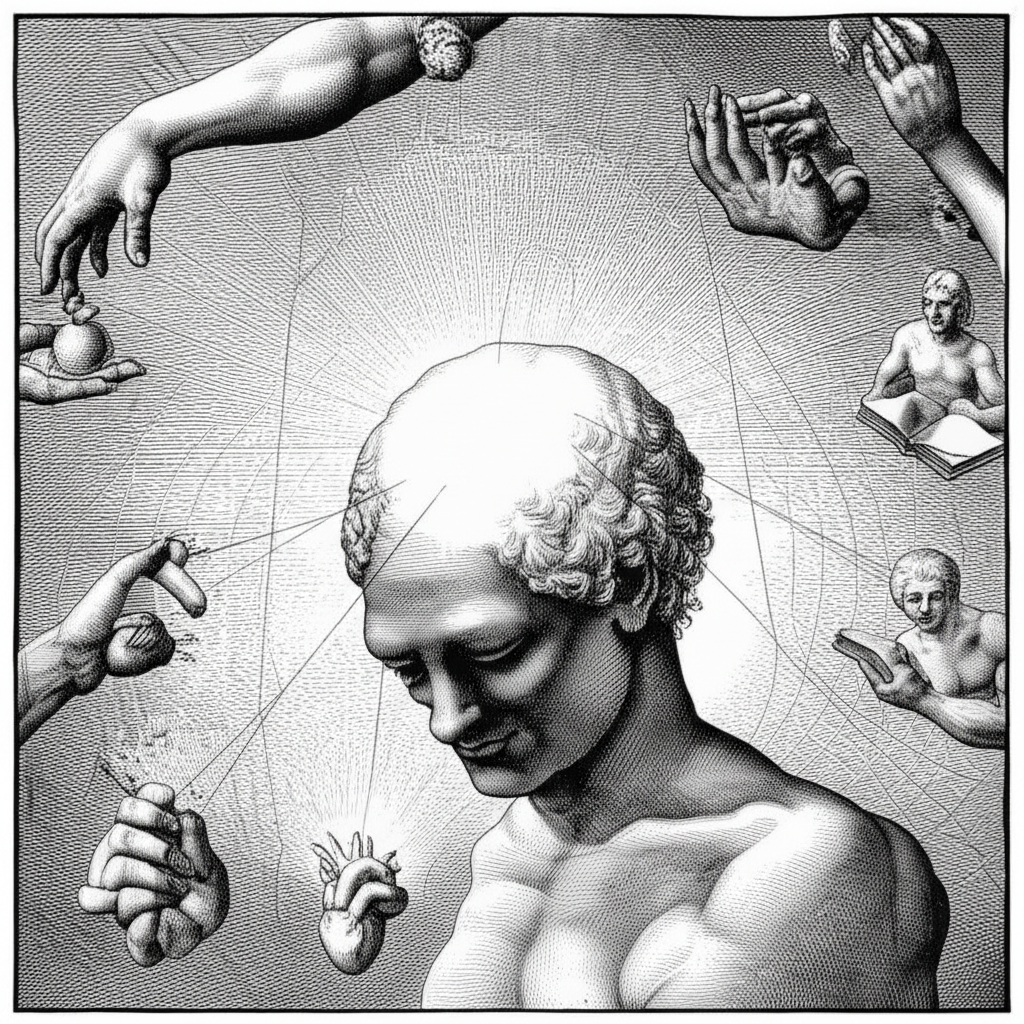 , all radiating outwards towards a distant, shimmering goal.)
The Will's Command: Translating Desire into Action
The bridge between the internal world of desire and the external realm of action is the Will. It is the executive faculty of the soul, the power by which Man makes choices and executes intentions. Without the Will, desires would remain mere fantasies, unfulfilled yearnings trapped within the confines of the Mind.
The Bridge Between Intention and Reality
For philosophers like Augustine and Aquinas, the Will is inherently tied to the good. We will what we perceive as good, even if that perception is flawed. The act of willing is the deliberate choice to pursue a desired end. It is the commitment to move from contemplation to concrete effort. Kant, in his exploration of moral philosophy, elevates the "good Will" as the only thing unconditionally good, emphasizing its role in acting out of duty, even when desires might pull in another direction.
The Will manifests in perseverance, discipline, and the ability to overcome obstacles. A student desires to learn, but it is their Will that compels them to sit and study. An artist desires to create, but it is their Will that guides their hand to the canvas. This faculty empowers Man to transform abstract intentions into tangible achievements, shaping not only his own destiny but also the world around him.
The Complex Tapestry of Human Motivation
The interplay of Desire, Man, Mind, and Will weaves a rich and complex tapestry of human motivation. It's rarely a simple, singular drive but rather a confluence of many factors, often contradictory, always dynamic.
Beyond Simple Gratification
While some desires are immediate and focused on gratification, many of our most profound motivations stem from deeper, more enduring desires. These include the desire for self-knowledge, for communion with others, for spiritual transcendence, or for leaving a lasting legacy. These are the desires that have fueled philosophical inquiry, artistic creation, and societal progress throughout history.
The Great Books remind us that Man is not merely a creature of instinct but a being capable of self-reflection, moral choice, and the pursuit of higher goods. Our desires, when guided by a cultivated Mind and a strong Will, can elevate us, leading to lives of purpose and fulfillment.
The Unending Quest
In conclusion, desire is far more than a simple want; it is the fundamental engine of human action, intrinsically linked to the very nature of Man. It begins as an impulse, is refined and directed by the Mind, and finally actualized through the power of the Will. From the most basic needs to the loftiest aspirations, desire compels us forward, shaping our individual journeys and the collective narrative of humanity. It is an unending quest, a testament to our ceaseless striving for something more, something better, something true.
YouTube Video Suggestions:
-
📹 Related Video: PLATO ON: The Allegory of the Cave
Video by: The School of Life
💡 Want different videos? Search YouTube for: ""Plato's Theory of Desire and the Soul Explained""
2. ## 📹 Related Video: ARISTOTLE ON: The Nicomachean Ethics
Video by: The School of Life
💡 Want different videos? Search YouTube for: ""Aristotle Nicomachean Ethics Will and Action""