

From Hardship to True Success: Rejecting the Idolatry of Comfort—for Ourselves and Our Children
America loves a success story: the rags-to-riches immigrant, the kid who works his way up, the family who finally “makes it,” and then, if all goes according to plan, can retire with ease.
But after hearing Vicken Baklayan’s story—an odyssey from literally dodging bombs in Lebanon to building and losing an empire in America, and only then discovering a deeper kind of abundance—I can’t help but question what kind of success we’re aiming for.
And if the next generation, soaked in Uber Eats, TikTok, and endless convenience, is missing the real lesson.
The School of Hard Knocks
Vic’s early life was defined by survival.
“My mom was only sixteen or seventeen when she got married. By the time she had me, she was weak, they tried to get rid of me—pills, a shot. Couldn't get rid of me. I was born anyway.” Then: “Three years old, they burned down my father's little store in Lebanon. We lived in a predominantly Muslim country, we were Orthodox Armenians. So my uncle says, 'Come to America.' Four years old, coming to America, seeing an escalator for the first time—felt like The Jetsons.”
Like so many, the Baklayan family started with next to nothing. “Dad had 2,000 bucks, three kids, a wife. He got a job sewing in an alteration place, minimum wage. But he wanted to do more. He started going to flea markets, buying bankrupt stores, bringing all the inventory, and selling what people actually wanted.”
By the time Vic was in his teens, he was working—really working. “I dropped out of school at 15 to help Mom in the store. Tough neighborhood, but that's how you did things. My dad put me there because that’s what you did in an immigrant family when you needed to survive. You worked.”
Ask most parents today if they’d want their own kids to do the same and the answer is almost always no. We wish for our children a safer childhood, a better education, fewer risks and certainly no exposure to hardship. But is that tradeoff as simple—or as wise—as it sounds?
The Comfort Crisis
Vic is blunt:
“The abundance in this country and just the overabundance, the overwealth, has become its own prison. People are locked up and don’t even see it... The convenience of DoorDash, Uber Eats, not getting out of your bed—getting everything delivered is what’s creating the mental health issues.”
He’s right. We see it everywhere: record rates of anxiety and depression, kids unable to cope with setbacks, a culture of “influencers” modeling lives with very little real-world challenge.
There’s no need to “accustom your children to hardship” if you can simply buffer every difficulty with comfort. But slowly, quietly, resilience vanishes.
You see it most in parenting—and Vic and I both recognized the pattern.
My own father came from rural Sweden, worked his way to America, and put in hard labor so his children could have a better life. Yet, as parents, we struggle with the contradiction.
We want our kids to be happy and safe; we want to solve their problems; we want them to have it easier. But is that actually building them up, or setting them up for disappointment and weakness when the world inevitably fails to cooperate?
When Success Is a Mirage
Vic’s upward trajectory didn’t end in comfort for long.
“We learned to sell what the neighborhood wanted, and pretty soon we were making serious money. Bought buildings, opened more stores, and suddenly, it was all about more. My father starts going to Atlantic City, gambling—more money, more stores, more risk.”
Then, with the dot-com boom: “We played the stock market. Put all my money in Lucent—we call it Lucifer now. We lost everything. Everyone blamed everyone else. We’d become what this country trains you to want—success for the sake of it, and it all implodes.”
Vic’s conclusion:
“We're living under the greatest deception in the world... USA, the most materialistic country, and the biggest perpetrators of this deception. We bought in big time... consumerism, big house, bigger house. What does it matter if you gain the whole world and lose your soul?”
Grit as Gospel: Resilience Redefined
What changed for Vic wasn’t sudden wealth, but total loss: “After I lost that money, I remember cursing God. I said, ‘How do you do this to me? … I got nothing left.’ That’s when I made the worst deal—I told God, ‘Take my love, give me all the money in the world.’ And for a while, it worked. Until it didn’t.”
Spiritual transformation—real, not symbolic—came only when control and comfort were stripped away. “It came to the point where after I lost everything, finally I opened this little pocket-sized Bible. Just the New Testament. I start reading and I’m saying to myself, my gosh, how did I miss this?”
Every parent, every business owner, every person pursuing conventional “success” needs to hear this: unless we go through (and guide others through) valleys—not just over padded hills—we will never know the difference between lasting and fleeting. “There is nobody who has ever fully, fully, fully surrendered their heart 100% that's been forsaken by God.”
What Are We Really Preparing Our Children For?
The punchline isn’t that hardship is good for its own sake, or that suffering is a virtue.
The lesson is more practical (and urgent): hardship can’t be escaped, only postponed and sometimes worsened by overprotecting, overindulging, or overvaluing ease over growth.
Vic’s immigrant grit and the American shortcut to comfort collide, with his own life as the example. Children need preparation for trouble, not insulation from it. If we want to raise a generation that can handle uncertainty, economic booms and busts, relational ups and downs, and the inevitable pain of aging and loss, we must model and teach not just patience, but perseverance.
It’s about more than work ethic. It’s about character. As Vic said: “It's only when it's all gone—when you have nothing left, no bank account, no backup plan—that you realize real victory is surrender. God's not interested in your comfort. He's interested in your heart.”
Defining Success—A New Model
Success, by any lasting measure, is not found in accumulating, in retiring early, or shielding your children from every bruise and disappointment. It’s being tested, sometimes broken, but always refined. It’s learning how to be “on fire,” not lukewarm. How to lose everything—and then regain what matters.
So what do we want for the ones we love, for ourselves, and for those who look to us for wisdom?
- Practical grit: Let them struggle at something that matters. Don’t short-circuit their learning or clean up every mess.
- Spiritual clarity: Give them (and yourself) something real to surrender to—a story, a Scripture, a faith that stands when comfort runs out.
- A better target: Teach them to aim not for ease, but for purpose, character, and the kind of mature, surrendered resilience that will serve them—win or lose, rich or poor.
As Vic put it, “The only thing that excites me now is preaching the gospel to a world that needs it. I’ve had everything in life. Nothing excites me more than seeing someone turn away from the world’s crumbs to find true bread.”
Next on Created in the Image of God
This Sunday, join me as I sit down with Claudette Milner—a prolific author whose books for young people and adults alike tackle faith, race, immigration, and finding peace in our own stories.
As Claudette says, “God wants us to know that he's watching. He’s hearing the voices of our children and he wants us to follow up on it—we have to have these discussions.” We’ll explore why our public storytelling matters, and how narrative can prepare the next generation for both challenge… and hope.
Tune in for a perspective that’s tough, honest, and absolutely necessary.
Signed Copies of My Trilogy Available!
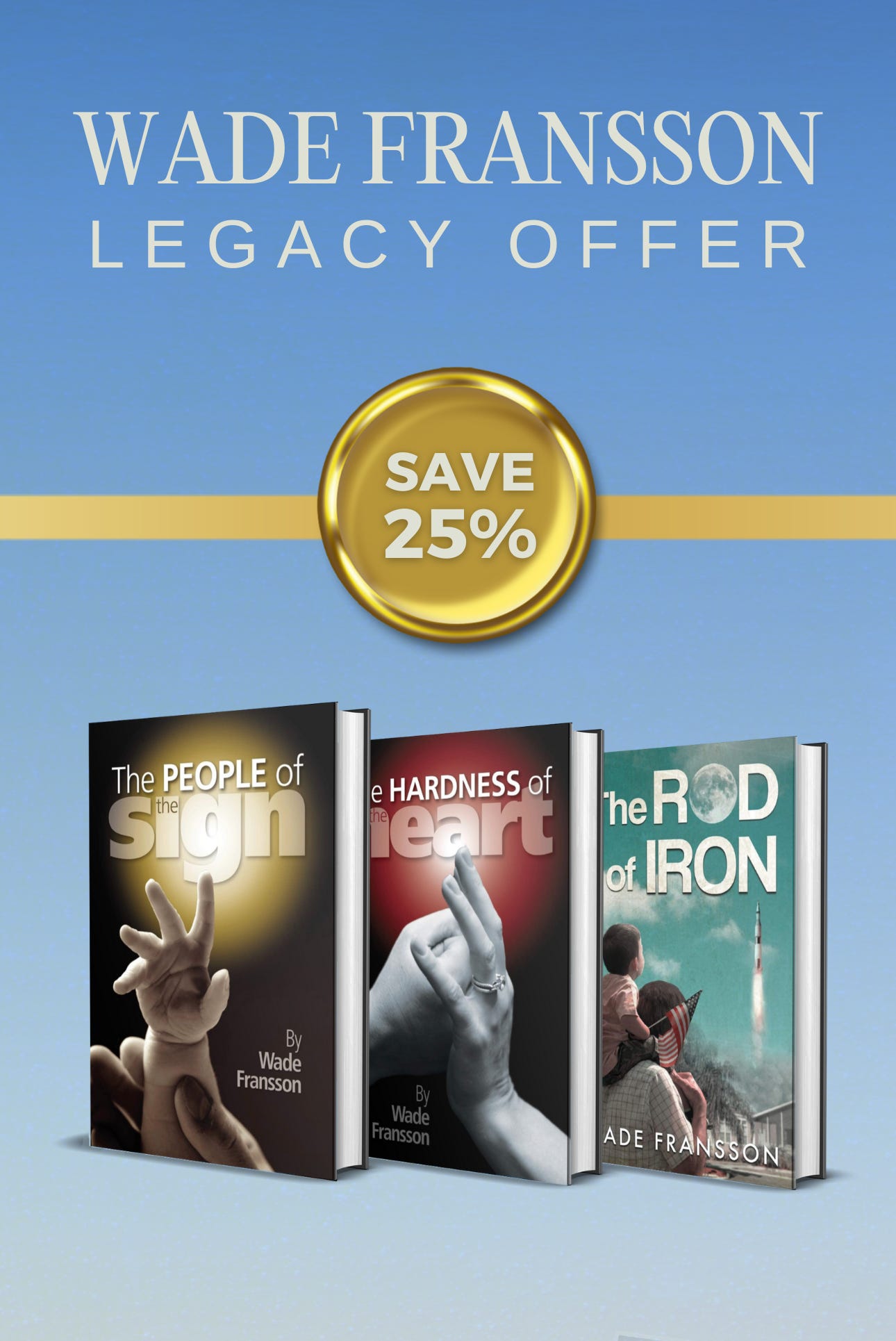
For a limited time, we’re giving you an exclusive 10% discount on top of our already-reduced 25% trilogy bundle. That means you can grab all three volumes of The People of the Sign, The Hardness of the Heart, and The Rod of Iron — personally signed by the author.
Use Code: WLEGACY10 at checkout.
Use the button or click here to claim your signed trilogy at SOOP.
If today’s reflection hit home—if you’re wrestling with how to model or teach true resilience in a culture obsessed with comfort—share your thoughts below, subscribe, and join the conversation. The next generation is always watching.
You are created in the image of God. And God loves His creation.
— Wade Fransson


