

Nietzsche's Hammer: Shattering Idols and Forging New Values
Friedrich Nietzsche remains one of philosophy's most potent provocateurs, a thinker who dared to question the very foundations of Western morality, truth, and societal ideas. From his pronouncements on the "death of God" to his vision of the Übermensch, Nietzsche, particularly through the voice of Zarathustra, challenged the prevailing opinions of his age, including the burgeoning democracy and its perceived leveling effects. His work is a call to radical self-overcoming, urging individuals to re-evaluate all values and become creators of their own meaning in a world devoid of inherent purpose.
The Uncomfortable Truth-Teller: Why Nietzsche Still Stings
Let's be honest, Nietzsche isn't for the faint of heart. He wasn't just suggesting we might rethink a few things; he was wielding a philosophical hammer, intent on smashing the idols of his time – and, by extension, many of ours. His work, especially the poetic and parabolic Thus Spoke Zarathustra, isn't a gentle invitation to dialogue; it's a thunderous proclamation that demands a response. He challenges our most cherished beliefs, our most comfortable assumptions, and the very fabric of the moral universe we often take for granted.
Nietzsche's genius lies in his ability to diagnose the underlying currents of Western thought, to expose the "will to truth" as often a "will to power" in disguise, and to reveal the psychological motivations behind our grandest ethical systems. He saw the impending crisis of nihilism long before many others, and he offered a radical, if often misunderstood, path forward.
Zarathustra's Descent: The Death of God and the Birth of the Übermensch
The most famous, and perhaps most misinterpreted, of Nietzsche's pronouncements comes directly from Zarathustra: "God is dead. God remains dead. And we have killed him." This wasn't an atheist's triumphant cheer; it was a lament, a profound cultural observation. Nietzsche wasn't speaking of a literal deity ceasing to exist, but rather the erosion of the Christian-Platonic worldview that had provided the bedrock for Western morality, meaning, and truth for millennia.
With the death of God, he argued, comes the collapse of objective values. If there's no divine legislator, no transcendental realm of Forms, then on what foundation do we build our ethics? This is where the concept of the Übermensch (often translated as "Overman" or "Superman") emerges from the pages of Thus Spoke Zarathustra. The Übermensch is not merely a stronger human, but a human who has overcome themselves, who has transcended conventional morality to create new values, affirming life in its entirety, including its suffering and chaos. It's an idea of human potential, a goal for humanity to strive for in the face of a meaningless cosmos.
The Will to Power: Beyond Good and Evil
At the core of Nietzsche's philosophy, and deeply intertwined with Zarathustra's teachings, is the will to power. This concept is frequently misunderstood as a crude drive for domination. However, for Nietzsche, it's far more nuanced:
- Not mere domination: It's not simply about exerting power over others, but about self-overcoming, growth, creation, and mastery.
- An affirmative force: The will to power is the fundamental drive of all living things to grow, expand, and actualize their potential. It's the artistic impulse, the drive to create meaning, and the courage to face existence without illusions.
- The source of values: Our ideas of good and evil, right and wrong, are ultimately expressions of different wills to power. Societies, religions, and individuals create values that serve their particular drives and perspectives. This challenges the very notion of universal, objective morality, suggesting that all opinions are rooted in a will to power.
Consider this: when Zarathustra descends from his mountain, he seeks to give meaning to humanity, to encourage them to strive beyond their current state. This act of teaching, of inspiring, of challenging, is an expression of the will to power – not to dominate, but to elevate.
The Herd and the Last Man: Nietzsche's Critique of Democracy
Nietzsche was deeply skeptical of many prevailing ideas of his time, and his critique of democracy and egalitarianism is particularly sharp. He saw the rise of democratic ideals and mass culture as leading to a "herd mentality," a leveling down of human excellence. In Thus Spoke Zarathustra, he introduces the terrifying figure of the Last Man:
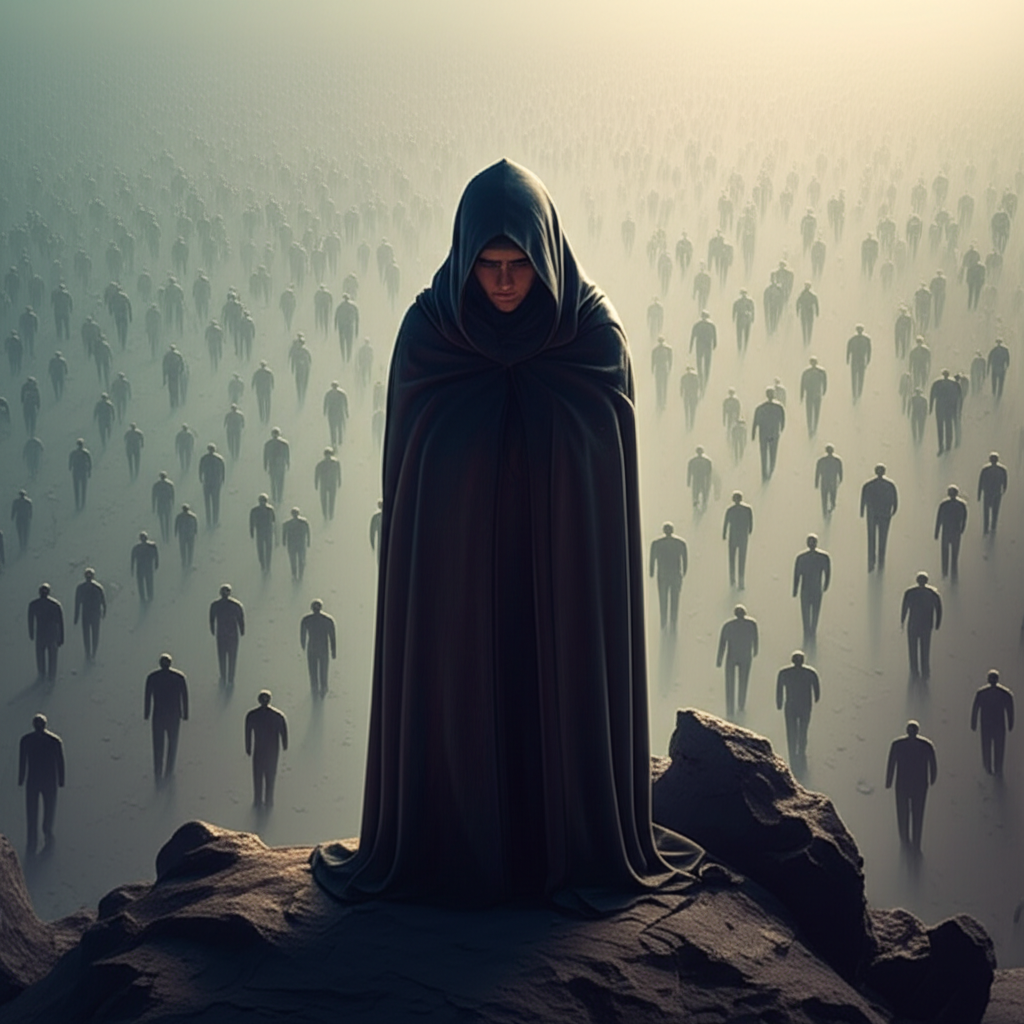
The Last Man represents the antithesis of the Übermensch. He is content, comfortable, and risk-averse, having abolished all struggle, suffering, and aspiration. He values security above all else and sees no need for grand ideas or individual distinction. He is the ultimate product of a society that prioritizes universal happiness and mediocrity over individual greatness and self-overcoming.
Nietzsche feared that democracy, in its pursuit of equality and comfort for all, would inadvertently foster this "last man" mentality, stifling the emergence of truly great individuals and leading to a widespread decline in vital human drives. He saw the prevailing opinions of the masses as a force that could crush individual genius.
| Characteristic | Übermensch (Overman) | Last Man |
|---|---|---|
| Core Drive | Will to Power (self-overcoming, creation) | Comfort, security, absence of struggle |
| Values | Self-created, individual, life-affirming | Inherited, conformist, nihilistic (unacknowledged) |
| Approach to Life | Embraces suffering, risk, growth | Avoids pain, seeks ease, stagnation |
| Perspective | Seeks new horizons, challenges | Content with the status quo, mediocrity |
| Relationship to Society | Stands apart, leads, inspires (or is misunderstood) | Blends in, follows, seeks universal happiness |
| Goal | Self-mastery, becoming more than human | Prolonged, comfortable existence; "we have invented happiness" |
Re-evaluating All Values: The Path of the Free Spirit
So, what does that mean for us, then? If God is dead and the herd beckons, what is an individual to do? Nietzsche's answer, channeled through Zarathustra, is a radical call to re-evaluate all values. This isn't an invitation to nihilism, but an imperative to become a creator of meaning. It means:
- Questioning everything: Don't accept inherited ideas or popular opinions merely because they are old or widespread.
- Self-overcoming: Constantly strive to become more than you are, to push your own boundaries, and to integrate your conflicting drives into a coherent, powerful self.
- Affirming life: Embrace existence in its entirety, including its pain, suffering, and uncertainty, rather than seeking escape or comfort.
- Creating your own table of values: In the absence of external authority, you must become your own lawgiver, forging your own purpose and meaning.
This is the path of the free spirit, the individual who has the courage to stand alone, to craft their own idea of what it means to live a meaningful life, even in a world that increasingly values conformity.
The Enduring Challenge of Nietzsche
Nietzsche's philosophy remains a profound challenge, forcing us to confront uncomfortable truths about ourselves, our society, and the foundations of our beliefs. He wasn't offering easy answers but demanding difficult questions. His insights into the nature of power, morality, and the individual's role in a post-religious world are more relevant than ever. In an age saturated with information, opinions, and democratic rhetoric, Nietzsche's voice cuts through the noise, urging us to look inward, to strive upward, and to become the creators of our own values, rather than mere consumers of those handed to us.
📹 Related Video: PLATO ON: The Allegory of the Cave
Video by: The School of Life
💡 Want different videos? Search YouTube for: ""Nietzsche Thus Spoke Zarathustra explained""
📹 Related Video: ARISTOTLE ON: The Nicomachean Ethics
Video by: The School of Life
💡 Want different videos? Search YouTube for: ""Nietzsche on Democracy and the Last Man""