

Fragments and Frameworks: Soul Integration, Trauma, and Healing the Rift Between Head and Heart
Dear Friends,
Some guests leave not only their stories, but shimmering frameworks that clarify our quest. In Episode 180, “Rising from the Ashes of Loss,” Michael Stone offered both: a soul laid bare by loss, and the hard-won wisdom that the path to healing—personal or collective—means nothing less than weaving our fragmented selves back together.
Michael’s experiences are almost mythic in their agony: early childhood marked by war, a mother’s suicide, abuse, abandonment, the death of his beloved dog, and, in adulthood, the violent loss of his wife and subsequent exile under suspicion. And yet, though each trauma could have shattered him completely, he reminds us that trauma—understood correctly—is not a static fate, but a vital force that, if met rightly, can lead us into deeper connection, integration, and even love.
Trauma Is Not a Problem—It’s Intelligence Unmet and Unintegrated
When we use the word “trauma,” most imagine wounds, problems to “fix,” pathologies to be cured. Michael’s perspective flips that script:
“Trauma is the most misunderstood, misdiagnosed source of suffering on the planet... my lens is not as a pathology, a disease or something to get rid of, but an incredible spiritual intelligence that has been evolving for hundreds of thousands of years to protect us in overwhelming situations.”
When a child’s plea for comfort is met with “there’s nothing to be scared about” instead of a warm embrace, his nervous system learns: “I am wrong to feel fear. Something is wrong with me.” The result is not simply pain, but a fragmentation—a part of our “essence,” or soul, is cut off, stored in the body as tension or numbness, and kept out of awareness. Michael is clear: “It’s not the event; it’s what happened inside me in that event, what decisions I made, and how I adapted.”
Pain’s legacy is not only in memory, but in the repetitious cycles of “unfinished past.” We suppress the shadow; we numb ourselves to avoid feeling. And yet, it lives on—“that tensing and numbing takes a lot of chi dollars, energy dollars, you know.” The refrigerator buzzing always in the background, consuming more than we realize.
Head Over Heart: The Great Coup
What perpetuates fragmentation more than anything? Our culture’s preference for the head over the heart—for concepts, narratives, and beliefs over experience, presence, and connection.
“The head has had a coup over the heart. That’s not the way it’s supposed to be set up. The heart is the one that runs the head and the emotions and the body. Every scripture is pointing to that.”
Here is the subtle idolatry of modern life—religious or not. We become so attached to our ideas (about God, ourselves, our tribe) that we cease to encounter reality itself. Michael reminded me of the parallel to the Genesis myth: after eating from the tree of knowledge, Adam and Eve develop self-consciousness, shame, and—most crucially—distance. “Who told you that you were naked?” God asks—not to shame, but to call out the rise of false mental constructs, the first separation from direct experience and from the divine.
This phenomenon is not just individual but collective. The “cognitive dissonance” of political tribes, the hypocrisy of thinking we love God while hating our neighbor, all stem from the same root: “When we become attached to our own idea about a thing... that’s a false idol.” The result? “We are engaging with our false conception of reality,” not with reality—ourselves, or one another—as God actually made it.
Intra-Connectedness, Not Just Inter-Connectedness
Michael offers a profound framework for healing: trauma makes us ‘interconnected’ in community (functionally, socially), but the deeper work is intra-connectedness—a return to wholeness inside ourselves that makes real connection possible.
“A sense of separate self gets created... but in a much more real sense you are over here in my nervous system and I am over there in your nervous system and that is a connection that is part of the work that I do: to re-allow ourselves to soften and open to that recognition.”
This “fragmented self”—driven by trauma, by ideas about reality rather than reality itself—cannot connect. We become isolated “apartment dwellers,” knowing little of the “building” of humanity (or divinity) in which we truly live.
True soul integration starts with feeling what is unfinished. Not talking about trauma, or explaining it away in story or diagnosis, but—when we feel safe—sitting with the fear, shame, anger, or loneliness we’ve exiled. “Integration process isn’t getting rid of something or fixing something. It’s recognizing the incredible intelligence of our nervous system and our humanity to actually suppress things and then to bring them up to heal them when it feels safe enough.” When we allow ourselves to feel, we “complete the past,” creating more “space, presence, stillness.”
“Integrated past shows up as more space, as presence, as stillness. Unintegrated past shows up as destiny. I’m bound to do the thing over and over again until finally I go, ‘Oh my god, I’m doing the same thing over and over again expecting different results.’ That’s insanity.”
The Danger of Living Only in the Head
So much of what ails our culture—polarization, addiction to “being right,” envious comparison, loneliness—can be traced, in Michael’s view, to this coup of the head. We allow habitual, crystallized responses—not just opinions, but ancient wounds and adaptations—to dominate our inner lives. The path home is never found by more analysis, but by going “into the body, into the emotions,” and finding where the unfinished past wants to be honored and felt.
The spiritual implications are profound. “If I’m seeing anyone for anything less than the mystery of God, then I’m blind in some way,” Michael says. To encounter God, neighbor, or even ourselves in fullness requires the heart to lead—the courage to be present, vulnerable, and still. The Word does not become flesh in us until the flesh surrenders the idol of its own concepts and stands receptive, attuned.
Why This Matters—For Now, and For Community
The implications are not just personal, but communal and global. Michael calls our “rugged individualism” a curse, a killer of authentic soul. Real community, real “building of vibrant communities,” requires intra-connected souls who have done the work within and thus can connect without transaction, ideology, or self-deception. In our anxious, noisy, and trauma-haunted age, the need for this integration is existential.
Takeaways
- Your wounds are not failures—they are invitations. The path to integration is through, not around, our unfinished past.
- Beware the idolatry of the head. We heal by returning to the body, heart, and felt experience, not by further analysis or attachment to abstract belief.
- Community is built from the inside out. We cannot be deeply present to others until we reclaim presence with ourselves and the divine mystery alive in us.
If you resonated with Michael Stone’s words—or if you have your own “unfinished past” waiting for validation and release—please share your reflections below. Have you noticed the difference between living in the head and leading from the heart? How might soul integration, rather than mere self-improvement, shape our communities and faith journeys?
Tonight:
Dean Simone joins us to ask whether the Bible is myth or metaphor, and whether true spiritual sovereignty may lie beyond all concepts.
Until then, remember: You are created in the image of God. It is never too late to become whole—heart, head, soul, and all.
—Wade Fransson
An Invitation: Start Your Journey Here
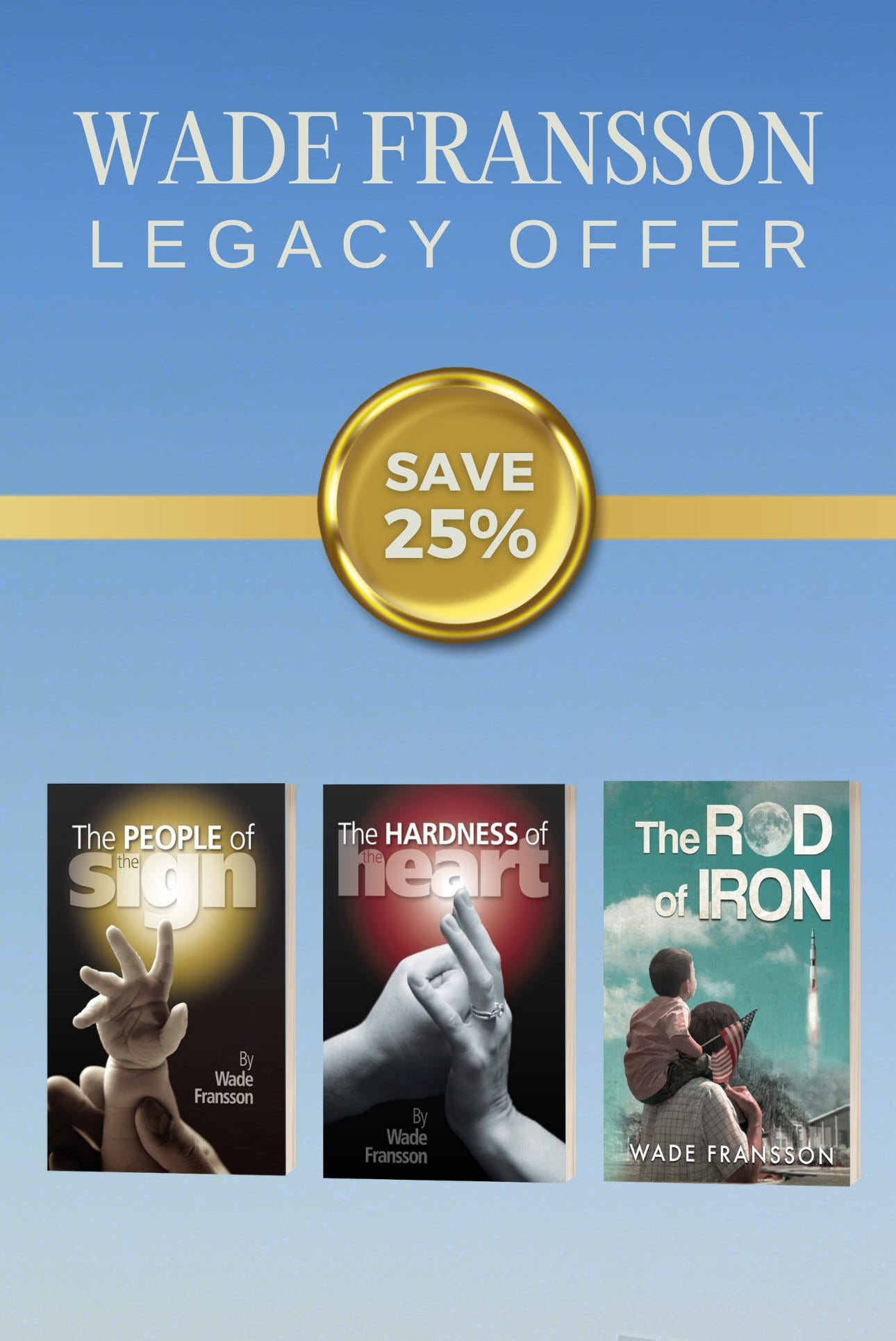
For a limited time, I’m offering my complete legacy trilogy set—The People of the Sign, The Hardness of the Heart, and The Rod of Iron—all original editions, autographed, for just $29.95 (US addresses only, due to shipping costs). These are the stories and struggles, chronicled honestly, that shaped me—and perhaps, might serve as companions and signposts on your own pilgrimage.
And if you sign up for an annual paid subscription to my Substack, you can receive the signed trilogy set for just $9.99 (to cover shipping and handling—again, US-only).


