

Five Lessons for Truth-Telling in an Age of Spin
What if journalism wasn’t a contest for clicks or a zero-sum struggle to “win the narrative,” but a real opportunity for connection—a way to share space, surface nuance, and remind each other that no person (or story) fits neatly on a team?
Tuesday’s deep-dive with journalist and author Nancy Rommelmann was a much-needed reminder: the best in media—like the best in community—requires curiosity, generosity, humility, and a clear-eyed resistance to the cheap storytelling of “us vs. them.”
Here are five takeaways from Nancy’s work—practical habits for readers, writers, or anyone who cares about the stories we tell, and the world we’re building together:
1. Make More Pie: Reject the Scarcity Mindset—in Community and Media
Nancy’s mantra, “make more pie,” is about baking more than you think you’ll need, then offering it to others. This isn't just her approach to hospitality or her Substack’s title; it’s a media strategy and a way of life. There’s a tendency—especially in the age of clicks, shares, and shrinking newsrooms—to believe there’s only so much space. Fight for your slice, defend your turf, chase everyone else off the table.
But as Nancy puts it: “There’s not one pie that we cut into smaller and smaller slices. We just make more pie.”
What would independent journalism look like if it stopped guarding old platforms and instead welcomed new voices, encouraged collaboration, and celebrated the stories still waiting to be told? Nancy’s career—writing, podcasting, publishing, and even sharing her kitchen—shows the ripple effects of generosity. The world gets bigger, not smaller, and the stories get richer.
2. Lead with Curiosity (Not Categories or Clicks)
Nancy’s reporting—from crime stories to war zones to coffee shops—depends on this simple rule: People are more than categories. “Whenever I look at a story that’s being reported and everybody’s reporting it like that way or that way, especially if they’re shouting about it, I’m always like, I don’t know if it’s really like that. And if you go in and look, it often is not.”
Instead of chasing the safety of predetermined “heroes” and “villains,” Nancy goes to see for herself. “Go out, go find the story, let the story tell itself to you.” In divided times, curiosity is an act of rebellion—and a way out of the echo chambers that keep us all suspicious and angry.
If you want to find the truth, be honestly curious. Try listening longer than you talk, and see what unfolds.
3. Who Gets to Tell the Story? The Ethics of Ownership and Perspective
Perhaps the most urgent issue Nancy raises is the simple, radical question: Who gets to tell the story? Is it the biggest outlet, the first to publish, or whoever shouts the loudest? Should stories be used to advance someone else’s narrative, packaged to fit a trend, or weaponized for clicks?
Nancy is clear: “The story has to be in charge. You’re not going to trim the facts to fit the theory. You’re not going to juice it up or make it sensational.” Her approach—letting people speak in their own words, honoring nuance, refusing quick judgments—reminds us that real stories belong to the people who live them. As a result, trust deepens and readers uncover something real, not just another “meta-narrative” that flatters their team.
It’s not just a media question—it’s a moral one. If we want stories that heal (and don’t just provoke or divide), we need to fight to make sure all voices are heard, honored, and never used as props for someone else’s project.
4. Forgive (and Practice Empathy) in a Culture Addicted to Outrage
Nancy’s reporting doesn’t run from tragedy or controversy. From covering heartbreaking crime to protests in polarized times, she doesn’t villainize or sentimentalize. But her work leans into what the Baha’i tradition calls “possess a pure, kindly, and radiant heart.” Her approach is echoed by her own words: “People need to tell their stories and they need someone to listen. And it’s such—I don’t know if honor is the right word, but... you feel it. You feel it when you’re just being spoken into and then it’s in you.”
In a world where outrage is a currency, instant forgiveness and empathy feel radical. But they’re necessary—not just to survive the news cycle, but to grow as communities, churches, and families. It means letting ourselves truly listen before reacting, to understand before condemning, and—even in hard stories—to imagine restoration and not just punishment.
5. Beware the Whispering Serpent: Don’t Let Spin Become Your Reality
From Genesis to the present, the most powerful lies begin as whispers. The serpent in the garden spun the truth; soon, enough people bought in to turn a subtle spin into a narrative dragon. Nancy described the danger perfectly: “When you have the stories of other people fit into your narrative, when you’re co-opting their story to weave your own tale... If there has to be a hero and a villain, you’re robbing yourself. You are robbing yourself of the experience of dealing with humans and dealing—interfacing with humanity.”
The antidote? Don’t let your news (or your circle) become a monologue. Read widely. Seek out stories from the source, not just filtered “spin.” Practice discernment, even skepticism—of easy certainty and tribal shorthand. The truth is always more textured than a “clickworthy” narrative.
In the End: Story-Builders, Not Spin-Doctors
If there’s one thing I’m taking forward from Nancy’s visit—and from years of wrestling with narratives, as a journalist, publisher, and seeker—it’s this: There’s always more pie to be made, more voices to be welcomed, more complexity to respect. The world needs honest stories—told with humility and curiosity—more than it needs another meta-narrative, clickbait, or scapegoat.
You are created in the image of God. And God loves His creation.
— Wade
Sneak Peek: Next on Created in the Image of God
This coming week, don’t miss my sit-down with Tom Snow—retired software developer and author of, among other books, Set the Captives Free. Our conversation takes us deep into what it means to live—and think—according to Jesus’ words in the modern religious landscape. From finding the truth among “a lot of garbage” in pulpits to learning the art of discernment, Tom’s story tackles the quest for real spiritual freedom in a world of mixed messages.
Tune in for an exploration of bondage, discernment, and how we can clean house—without throwing out what is most precious.
Get Signed Copies of My Trilogy
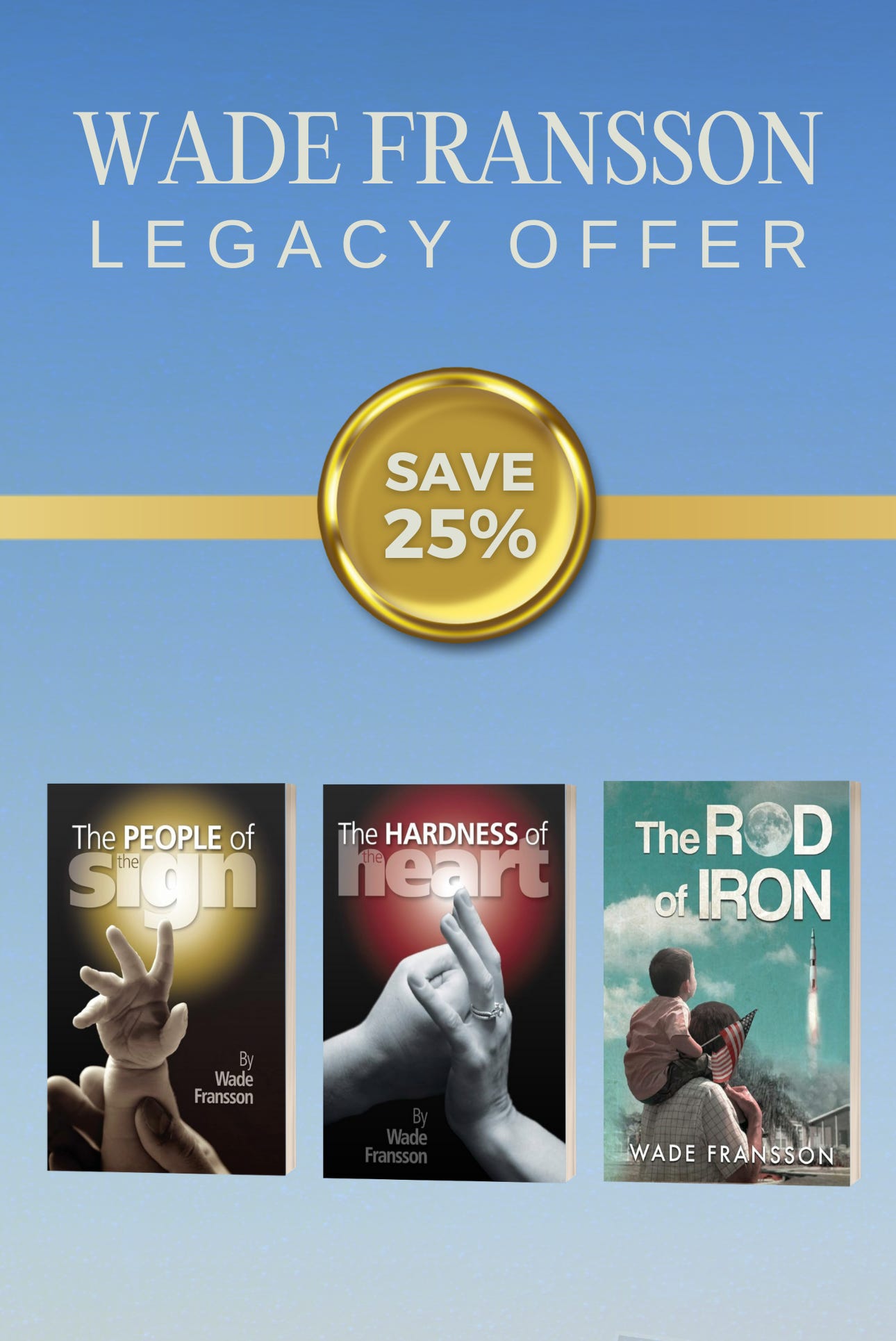
For a limited time, we’re giving you an exclusive 10% discount on top of our already-reduced 25% trilogy bundle. That means you can grab all three volumes of The People of the Sign, The Hardness of the Heart, and The Rod of Iron — personally signed by the author.
Use Code: WLEGACY10 at checkout.
Use the button or click here to claim your signed trilogy at SOOP.
If this article helps you reframe how you read, tell, or seek out stories, please share, comment, or subscribe. Let’s keep making more pie—together.


