

Fate vs. Free Will: Necessity and Contingency – The Eternal Dance of Existence
The age-old philosophical debate concerning Fate versus Free Will is not merely an academic exercise but a profound inquiry into the very nature of our existence, our choices, and our ultimate responsibility. At its heart lie the concepts of Necessity and Contingency, exploring whether events are predetermined and unchangeable, or if they are open to influence, subject to chance, and shaped by our conscious decisions. This article will delve into these intertwined concepts, tracing their historical interpretations through the lens of the Great Books of the Western World, examining how different understandings of Cause have shaped this enduring human question.
The Enduring Question: Are We Authors or Actors?
From the tragic pronouncements of Greek oracles to the intricate theological arguments of medieval scholars and the rigorous logical deductions of Enlightenment thinkers, humanity has grappled with a fundamental dilemma: are our lives scripted, our paths irrevocably set by some cosmic force or divine plan, or do we possess genuine agency, the power to forge our own destinies? This isn't just about personal choice; it extends to the very fabric of the universe – is it a deterministic machine, or does it contain genuine openness and unpredictability?
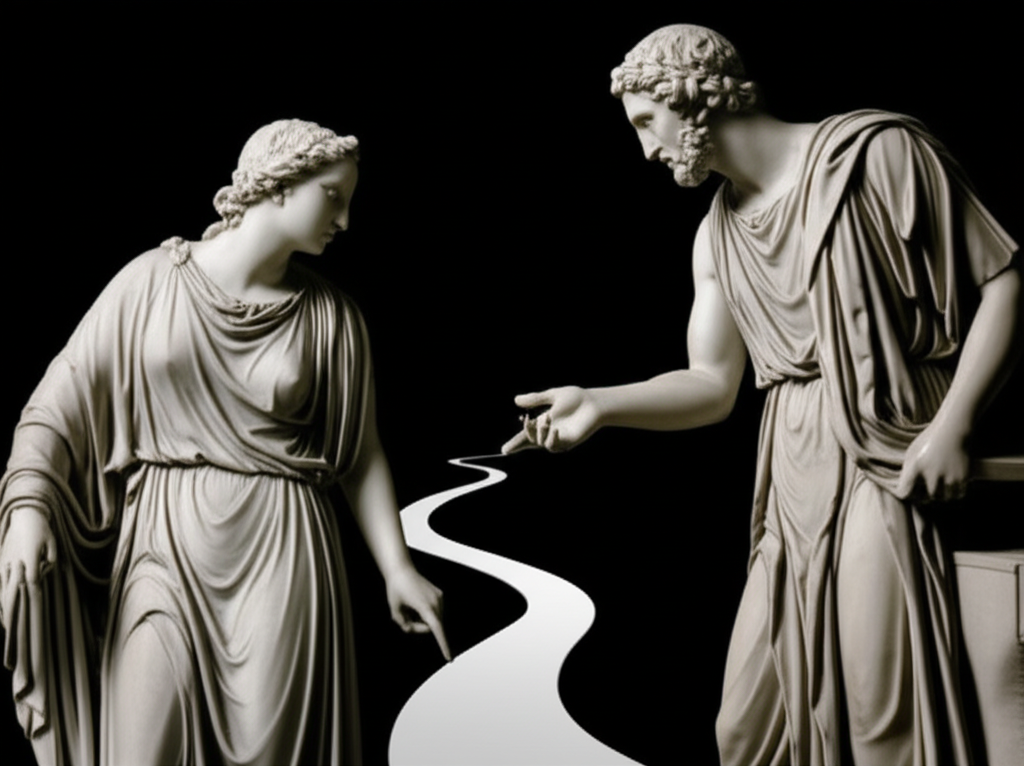
Unpacking the Core Concepts
To navigate this complex terrain, we must first establish a clear understanding of the key terms that form the pillars of this debate.
- Fate: Often understood as a predetermined course of events, an unalterable destiny. In its strongest form, it suggests that every event, every choice, every outcome is already decided. This can manifest as divine preordination, a natural law of Cause and effect, or an impersonal cosmic force.
- Free Will: The capacity of an agent to choose a course of action from among various alternatives. It implies that individuals possess genuine agency and that their choices are not merely the inevitable outcome of prior causes but originate from within themselves.
- Necessity: That which must be; a state of affairs that cannot be otherwise. In the context of fate, it implies that events unfold according to an unbreakable chain of causation, leaving no room for alternative outcomes. Logical necessity dictates that a statement cannot be false; physical necessity dictates that a certain effect must follow a given cause.
- Contingency: That which might be or might not be; a state of affairs that is not necessary and could be otherwise. It implies openness, possibility, and the absence of absolute determination. A contingent event depends on various factors and could have turned out differently.
- Cause: The fundamental link between events, actions, and their outcomes. How we understand causation – whether it's strictly linear, multi-faceted, or includes non-physical elements – profoundly impacts our view of fate and free will.
Historical Echoes from the Great Books
The Great Books of the Western World offer a rich tapestry of perspectives on these concepts, reflecting humanity's persistent struggle with the question of agency.
Ancient Greece: Oracles, Virtue, and Chance
- The Stoics: Proponents of a robust form of Fate and Necessity. They believed that the universe is governed by an all-encompassing rational principle (Logos) that determines every event. While external events are fated, humans possess the Will to choose their attitude towards these events, finding freedom in acceptance and virtue. Their emphasis on rational understanding of the universe's causal structure left little room for true contingency in the external world.
- Aristotle: While acknowledging Necessity in natural processes, Aristotle introduced concepts like potentiality and actuality, and the role of chance or spontaneity (tyche and automaton) in the sublunary world. He argued that human actions are often chosen, making room for Free Will and moral responsibility. His four causes (material, formal, efficient, final) provided a framework for understanding how things come to be, with the efficient cause being the primary mover, but not necessarily absolutely predetermining all subsequent events.
- Plato: In works like The Republic, Plato suggests a form of pre-existence where souls choose their lot before birth, hinting at a blend of prior choice and subsequent destiny. Yet, within that chosen life, individuals still possess the Will to act virtuously or otherwise, impacting their ultimate fate.
Medieval Theology: Divine Foreknowledge and Human Choice
The Abrahamic traditions introduced the concept of an omniscient God, posing a direct challenge to human Free Will. How can humans be truly free if God already knows all future events?
- St. Augustine: Grappled extensively with this paradox. He affirmed God's absolute sovereignty and divine foreknowledge, which implies a form of Necessity regarding what God knows. However, he fiercely defended Free Will, arguing that God's knowledge does not cause human actions but merely observes them. Humans are still responsible for their sins because they willfully commit them. This distinction was crucial for maintaining moral accountability.
- St. Thomas Aquinas: Building on Aristotle, Aquinas argued that God is the primary Cause of all things, but also grants creatures, especially humans, secondary causality. God moves the Will not by forcing it, but by presenting the good, allowing the intellect to deliberate and the will to choose. This preserves both divine providence and human freedom, viewing contingency as real within the created order, even if necessary from God's eternal perspective.
Early Modern Philosophy: Mechanism, Reason, and Moral Law
The scientific revolution brought a new emphasis on mechanistic Cause and effect, pushing the debate into new territory.
- Baruch Spinoza: A staunch determinist, Spinoza argued that everything in the universe, including human thoughts and actions, follows with absolute Necessity from the nature of God (or Nature). For Spinoza, Free Will is an illusion, born of our ignorance of the true causes that determine us. Freedom lies in understanding this Necessity and rationally accepting it, rather than in an arbitrary power of choice.
- René Descartes: A strong advocate for Free Will, Descartes posited a clear distinction between mind and body. The body, like a machine, operates on mechanical principles of Cause and effect, but the mind (soul) is a thinking substance whose primary attribute is the Will, capable of independent choice, thus introducing a domain of Contingency into an otherwise mechanistic world.
- Immanuel Kant: Attempted a profound synthesis. In the phenomenal world (the world of experience and science), everything operates according to Necessity and the laws of Cause and effect. However, in the noumenal world (the world as it is in itself), human beings possess Free Will, which is a postulate of practical reason, essential for morality and responsibility. We must act as if we are free to be moral agents, even if we cannot empirically prove this freedom.
The Interplay: Cause and Consequence
The concept of Cause is the linchpin in the debate between Fate and Free Will.
| Perspective on Cause | Implication for Fate/Free Will |
|---|---|
| Strict Determinism | Every event (effect) is necessitated by prior causes. No true Contingency. Fate reigns supreme; Free Will is an illusion. |
| Probabilistic Causation | Causes make effects more or less likely, but not absolutely certain. Allows for some Contingency and openness. |
| Agent Causation | The agent (individual) itself is the ultimate Cause of its actions, not merely a link in a prior causal chain. Supports Free Will. |
| Divine Causation | God is the ultimate Cause. Debate revolves around whether this primary causation allows for secondary, free human causes or necessitates all outcomes. |
Aristotle's framework of causes (material, formal, efficient, final) is particularly illuminating. If the final cause (purpose or telos) of an action is predetermined, does that negate the efficient cause (the agent's choice) in reaching that end? The interplay is complex.
The Unfolding Dialogue: A Persistent Mystery
The debate over Fate vs. Free Will, mediated by Necessity and Contingency, remains one of philosophy's most vibrant and challenging areas. While science continually uncovers more about the causal mechanisms of the universe and the human brain, the subjective experience of making a choice, of feeling responsible, persists. Perhaps the answer lies not in choosing one extreme over the other, but in embracing the paradox – acknowledging the necessary conditions of our existence while fiercely upholding the contingent possibilities of our Will.
The search for understanding continues, inviting us to reflect on our place in the cosmos, the meaning of our actions, and the profound implications for justice, morality, and the very essence of what it means to be human.
YouTube Video Suggestions:
-
📹 Related Video: What is Philosophy?
Video by: The School of Life
💡 Want different videos? Search YouTube for: ""determinism vs free will philosophy explained""
2. ## 📹 Related Video: PLATO ON: The Allegory of the Cave
Video by: The School of Life
💡 Want different videos? Search YouTube for: ""great books western world fate free will""