

Fate vs. Free Will: The Enduring Conundrum of Necessity and Contingency
The timeless philosophical debate concerning fate versus free will is not merely an academic exercise; it touches upon the very essence of human existence, moral responsibility, and our place in the cosmos. At its heart lies the tension between necessity—the idea that all events are predetermined and must occur—and contingency—the belief that events could be otherwise, shaped by choice or chance. This article delves into the historical and conceptual battleground, exploring how thinkers from the Great Books of the Western World have grappled with the intricate relationship between what must be and what could be, and how the concept of cause underpins much of this profound discussion.
The Age-Old Question of Our Chains
From ancient oracles to modern neuroscience, humanity has ceaselessly questioned the extent of its autonomy. Are we merely players in a cosmic drama, our lines already written, our exits and entrances preordained? Or do we possess a genuine capacity for self-determination, charting unique courses through a world brimming with possibilities? This fundamental inquiry into Fate and Free Will is not just about personal agency; it shapes our understanding of justice, ethics, and the very meaning of human endeavor.
Defining the Terms: Fate, Will, Necessity, and Contingency
To navigate this complex terrain, it's crucial to establish a clear understanding of the core concepts:
- Fate: Often conceived as a preordained sequence of events, a destiny or divine plan that is unalterable. It suggests that the future is already fixed, irrespective of human desires or actions.
- Free Will: The capacity of an agent to make choices that are genuinely uncoerced and self-determined. It implies that individuals are the ultimate source of their actions and could have chosen differently.
- Necessity: Pertains to events or truths that must be. This can be logical (e.g., 2+2=4), metaphysical (e.g., God's existence in some theological systems), or causal (e.g., if you drop a ball, it must fall due to gravity). It implies an inescapable chain of prior conditions.
- Contingency: Describes events or truths that could be otherwise. A contingent event is one that happens, but it was not inevitable; it depended on certain conditions or choices that might not have occurred.
| Concept | Core Implication | Relationship to Action |
|---|---|---|
| Fate | Future is predetermined, unalterable. | Human actions are merely enactments of what is fated. |
| Free Will | Agent is the ultimate source of their actions. | Human actions are genuine choices, not predetermined. |
| Necessity | Events must happen, given prior conditions. | Limits or negates free choice; actions are consequences. |
| Contingency | Events could be otherwise, not inevitable. | Opens space for free choice and unpredictable outcomes. |
The Philosophical Battleground: Ancient Roots and Modern Echoes
The debate over Fate and Free Will has deep roots, woven into the fabric of Western thought since its inception.
Ancient Perspectives: Destiny and Choice
- The Stoics: For philosophers like Zeno and Epictetus, the universe was a rationally ordered, deterministic system, where everything occurred by necessity through an unbroken chain of cause and effect. True freedom, for the Stoic, was not the ability to alter Fate, but the internal Will to accept it and live in harmony with nature's decrees. Our reactions, not the events themselves, were within our control.
- Aristotle: In his Metaphysics and On Interpretation, Aristotle distinguished between necessary truths (like mathematical axioms) and contingent future events. He argued that while past events are necessary, future contingents (e.g., "there will be a sea battle tomorrow") are not. To say they must happen would negate deliberation and moral choice. He explored the four causes (material, formal, efficient, final) as fundamental to understanding how things come to be, without necessarily endorsing a strict determinism for all human actions.
- Plato: While Plato's Republic suggests a cosmic order and a form of divine providence, his "Myth of Er" at the end of the Republic presents souls choosing their next lives, implying a profound element of individual Will and responsibility for one's destiny, even within a structured universe.
Medieval Insights: Reconciling God's Plan with Human Agency
- Augustine of Hippo: Grappled intensely with the apparent conflict between God's omniscience and omnipotence (implying necessity in His plan) and human Free Will. In Confessions and On Free Choice of the Will, Augustine concluded that God foreknows our choices but does not cause them. Our Will remains free, and thus we are morally responsible for sin, even if God's grace is ultimately necessary for salvation.
- Thomas Aquinas: Building on Aristotle, Aquinas in his Summa Theologica argued that God's necessity does not negate human contingency. God, as the first cause, moves all things, but He moves them according to their nature. Thus, rational creatures are moved by God in a way that preserves their Free Will. God's knowledge of future contingent events is not because He determines them, but because He sees all time simultaneously from an eternal perspective.
Early Modern Challenges: Mechanism and Subjectivity
- Baruch Spinoza: A staunch determinist, Spinoza, in his Ethics, argued that everything in the universe, including human actions and thoughts, follows from the eternal and infinite necessity of God (or Nature). Free Will is an illusion, a result of our ignorance of the true causes of our actions. We mistakenly believe we are free because we are conscious of our desires but unaware of the underlying causes that determine them.
- René Descartes: A champion of human freedom, Descartes, in his Meditations, emphasized the distinctness of mind (res cogitans) from body (res extensa). The mind, with its capacity for Will, was seen as fundamentally free, capable of choosing independently of mechanical causes. This dualism provided a space for genuine Free Will.
- David Hume: While not a strict determinist, Hume, in A Treatise of Human Nature, observed that human actions are as regular and predictable as natural events, flowing from causes like motives and circumstances. He redefined freedom as "a power of acting or not acting, according to the determinations of the will," which is known as compatibilism. For Hume, the problem wasn't between necessity and Free Will, but between necessity and chance.
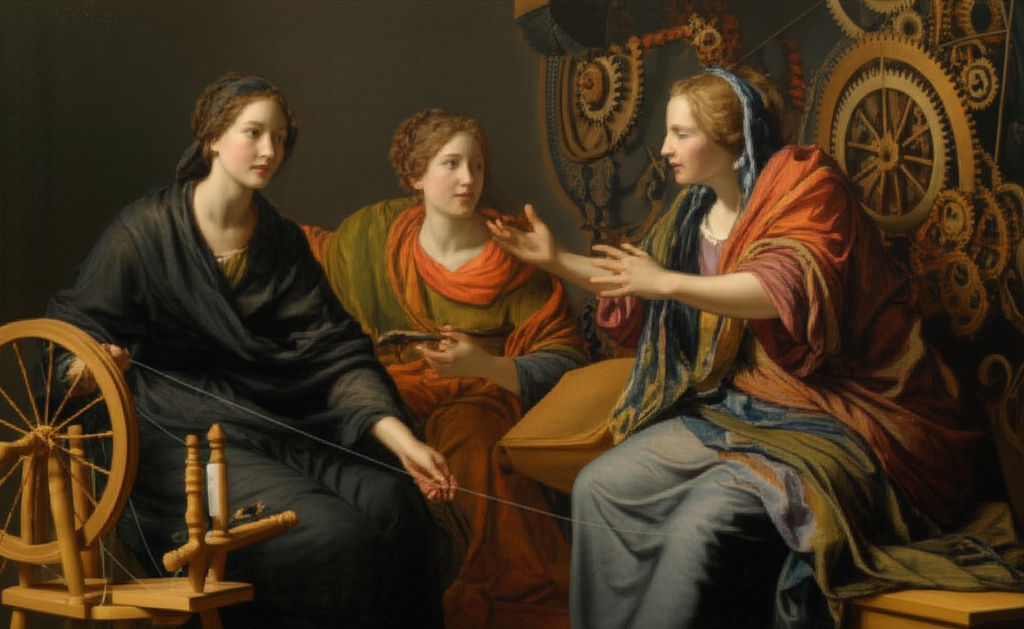
The Web of Causality: Understanding Necessity's Grip
Much of the argument for necessity and against Free Will stems from the concept of cause. In a universe governed by physical laws, every event is seemingly the effect of a preceding cause. If we trace these causes back, it appears that the present moment, and indeed the future, is simply the inevitable outcome of the initial conditions of the universe. This deterministic worldview finds support in classical physics, where, given enough information, the future state of a system could theoretically be predicted with absolute precision. If every decision, every thought, is merely the result of electrochemical processes in the brain, which are themselves products of prior physical causes, then where does Free Will reside?
The Illusion of Choice? Or the Essence of Being?
The implications of either side of the debate are profound:
-
Arguments for Free Will:
- Moral Responsibility: Without Free Will, concepts of praise, blame, reward, and punishment lose their foundation. How can one be held accountable for actions that were unavoidable?
- Subjective Experience: We feel free. Our daily lives are filled with deliberation, choice, and the sense that we could have acted differently.
- Meaning and Purpose: The belief in Free Will imbues our efforts, aspirations, and struggles with significance. If everything is fated, is there any true purpose in striving?
-
Arguments Against Free Will (for Determinism/Necessity):
- Scientific Determinism: The success of science in explaining the world through cause and effect suggests a universe without uncaused events, including human choices.
- Logical Problems: If our choices are uncaused, are they truly "free," or merely random? If they are caused, then they are not free in the sense of being ultimately self-determined.
- Neuroscience: Emerging findings in neuroscience sometimes suggest that brain activity preceding a conscious decision can be observed, raising questions about whether the "decision" is made before we are even aware of it.
Navigating the Paradox: Reconciling the Irreconcilable?
Many philosophers have sought a middle ground, known as compatibilism. This view posits that Free Will and determinism (or necessity) are not mutually exclusive. A person is considered "free" if they act according to their own desires and intentions, even if those desires and intentions are themselves causally determined. Freedom, in this sense, is the absence of external coercion, not the absence of cause.
For compatibilists, the Will is free when it is not constrained. If I desire to lift my arm and successfully do so, I am acting freely, even if the desire itself arose from a chain of causes beyond my immediate control. This perspective attempts to preserve moral responsibility by focusing on the internal source of action, rather than demanding an uncaused Will.
The concept of contingency also plays a vital role. Even if the universe operates largely on necessity, the sheer complexity and unpredictability of interacting causes can create outcomes that feel contingent. The future, while perhaps determined, is practically unknowable to us, preserving a sense of openness and the need for human deliberation.
Conclusion: The Enduring Inquiry
The debate between Fate and Free Will, between Necessity and Contingency, remains one of philosophy's most profound and persistent inquiries. From the Stoic acceptance of destiny to the Cartesian assertion of an unconstrained Will, and the Humean attempt at reconciliation, thinkers throughout the "Great Books of the Western World" have offered compelling, yet often conflicting, perspectives.
There is no simple answer, and perhaps the richness of human experience lies in the very tension of this paradox. Whether we are ultimately bound by an inescapable Fate or are truly the masters of our Will, the contemplation of these ideas compels us to examine the nature of cause, responsibility, and the very meaning of our choices within the vast, intricate tapestry of existence.
YouTube Video Suggestions:
-
📹 Related Video: What is Philosophy?
Video by: The School of Life
💡 Want different videos? Search YouTube for: "Fate vs Free Will Philosophy Crash Course"
2. ## 📹 Related Video: ARISTOTLE ON: The Nicomachean Ethics
Video by: The School of Life
💡 Want different videos? Search YouTube for: "Compatibilism Free Will Determinism Explained"