

The Enduring Nexus: Family Structure and Social Custom
By Henry Montgomery
Summary: The family, far from being a purely biological unit, is profoundly shaped by Custom and Convention, serving as the primary crucible for the formation of the Citizen. Its structure, roles, and responsibilities are not static but evolve under the influence of societal norms and the regulatory power of the State, creating a complex interplay that underpins the very fabric of political and social order.
The human experience is invariably rooted in the family. This foundational unit, seemingly universal in its essence, reveals a remarkable plasticity when viewed through the lens of history and philosophy. It is here, within the intimate confines of the household, that the raw material of humanity is first molded by Custom and Convention, setting the stage for the individual's eventual emergence as a Citizen within the broader framework of the State. To understand the political animal, as Aristotle conceived him, we must first grapple with the intricate dance between the domestic sphere and the societal norms that define it.
The Primal School: Family as the First Society
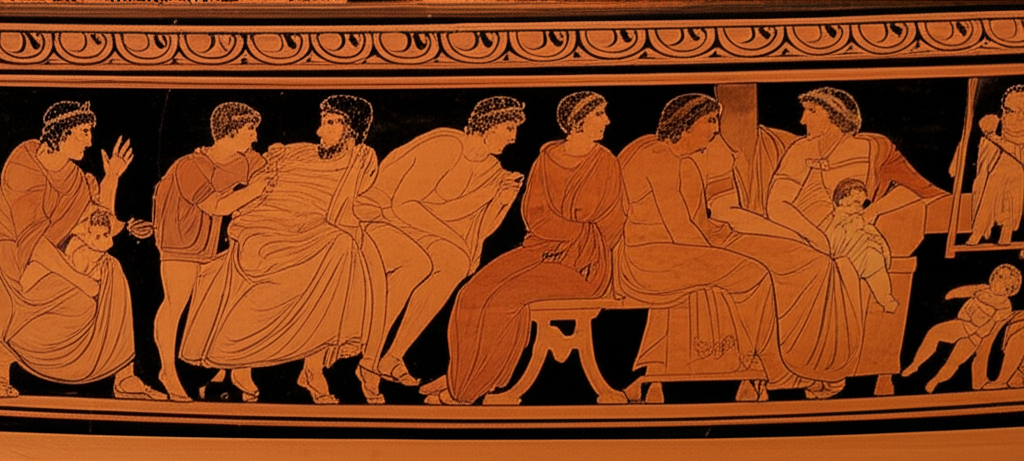
From the earliest philosophical inquiries, thinkers have recognized the family as the bedrock upon which all larger societies are built. Aristotle, in his Politics, posits the household (oikos) as the most basic association, formed for the daily necessities of life. It comprises master and slave, husband and wife, father and children – a structure dictated by both natural inclination and the prevailing customs of his time. This initial grouping, driven by the need for procreation, sustenance, and protection, gradually expands into villages and ultimately, the polis.
Yet, the family is more than just a unit of survival; it is the primary institution for moral and social education. Before the Citizen can engage with the complex demands of the State, they are first initiated into the rules of conduct, the values, and the language of their community within the family. This transmission of heritage, often subtle and unwritten, forms the very bedrock of social cohesion.
Custom and Convention: Architects of Family Diversity
While the biological imperatives of reproduction might seem universal, the structures and roles within a family are anything but. They are, to a profound degree, products of Custom and Convention. Consider the vast array of marital practices, inheritance laws, and gender roles observed across different cultures and epochs, as documented implicitly throughout the Great Books of the Western World.
- Marriage: From monogamy to polygamy, arranged marriages to unions of choice, the institution of marriage—the very definition of a family's beginning—is a social construct par excellence. Its purpose, form, and dissolution are all governed by established customs and legal conventions.
- Kinship: The definition of who belongs to the family, beyond immediate biological ties, varies widely. Patrilinear, matrilinear, or bilateral descent systems dictate lineage, property rights, and social status, all rooted in specific customs.
- Authority: The locus of power within the family—patriarchal, matriarchal, or more egalitarian—is a reflection of deeply ingrained societal norms and expectations, rather than any inherent "natural" order.
These variations underscore that what we perceive as "natural" family structures are often, upon closer examination, deeply conventional. Plato, in his Republic, famously challenges these conventions, proposing a radical reordering of family life for the guardian class, where children are raised communally to foster a stronger loyalty to the State over individual familial ties. This philosophical provocation highlights the profound influence of custom and its potential for re-evaluation.
From Hearth to Polis: The Citizen's Formation
The transition from a family member to a responsible Citizen is mediated by the continuous influence of Custom and Convention. The virtues learned at home – respect for elders, sharing, duty, obedience – are the precursors to civic virtues. The family, through its customs, instills the initial sense of belonging and obligation that gradually extends to the wider community.
John Locke, in his Two Treatises of Government, discusses the family as a "natural society" where children are under the "paternal power" until they reach an age of reason. This period of tutelage, governed by both natural necessity and prevailing custom, prepares individuals for their eventual entry into civil society, where they consent to be governed by the laws of the State. The customs of the family, therefore, lay the psychological and moral groundwork for the social contract.
The State's Imperative: Regulating and Sustaining Family
The State, recognizing the indispensable role of the family in perpetuating itself and maintaining social order, invariably seeks to influence and regulate its structure through law and policy. This is not mere interference but a strategic imperative.
Consider the following ways the State interacts with family and custom:
- Legal Frameworks: Laws governing marriage (age, legality, dissolution), inheritance, child protection, and parental rights are direct interventions by the State to shape family life in accordance with its perceived interests and prevailing customs.
- Economic Policies: Taxation, welfare benefits, and housing policies can significantly impact family size, structure, and economic viability, thereby indirectly influencing customary family practices.
- Education: Public education systems, controlled by the State, often reinforce or challenge existing family customs by transmitting specific values, civic duties, and societal norms to children.
The relationship is reciprocal: while the State regulates the family, the family, through its deeply ingrained customs, informs the moral landscape upon which the State's laws are built. Rousseau, in The Social Contract, grapples with the tension between individual liberty and the general will, implicitly acknowledging that the individual, first formed within the family unit, must ultimately align with the collective good of the State.
📹 Related Video: PLATO ON: The Allegory of the Cave
Video by: The School of Life
💡 Want different videos? Search YouTube for: ""Plato's Republic: Family, Education, and the Ideal State""
📹 Related Video: ARISTOTLE ON: The Nicomachean Ethics
Video by: The School of Life
💡 Want different videos? Search YouTube for: ""Aristotle on the Household and the Polis""
In conclusion, the structure of the family is not a fixed, immutable entity but a dynamic construct, profoundly shaped by the ever-evolving tapestry of Custom and Convention. It is the primary school of humanity, preparing the individual to become a Citizen capable of participating in the life of the State. The philosophical inquiry into this nexus reveals a continuous negotiation between the intimate and the public, the traditional and the conventional, reminding us that the strength of any State is inextricably linked to the vitality and wisdom embedded within its family structures and social customs.