

The family, often perceived as a private sphere, is in fact the foundational unit upon which all complex societies are built, intricately shaped by Custom and Convention, and serving as the primary crucible for the formation of the Citizen and the stability of the State. This article explores the historical and philosophical underpinnings of this relationship, drawing insights from the Great Books of the Western World to illuminate how the structure of family profoundly influences and is influenced by the broader social and political order.
The Foundational Nexus: Family, Custom, and the Polis
The philosophical tradition, from its earliest articulations, has recognized the family as far more than a mere biological or emotional association. It is, rather, the primordial cell of human society, the first school of virtue, and the initial locus of authority and responsibility. Its structure, though seemingly natural, is deeply imbued with the dictates of Custom and Convention, which vary across cultures and epochs, yet consistently serve to bind individuals into a cohesive social fabric.
From Oikos to Polis: The Ancient View
For the ancient Greeks, particularly as articulated by Aristotle in his Politics, the household (oikos) was the basic economic and social unit, preceding the village and the polis (city-state). The oikos encompassed not just the nuclear family, but also servants and property, functioning as a self-sufficient entity. It was within this structure that the first lessons in command and obedience, justice, and the management of resources were learned. The virtues cultivated within the family – loyalty, prudence, and a sense of duty – were considered essential prerequisites for effective participation as a Citizen in the larger political community. Plato, in his Republic, even posited a radical restructuring of traditional family units for the guardian class, demonstrating the profound philosophical conviction that family arrangements directly impact the character and stability of the State.
The Indelible Mark of Custom and Convention
While the biological imperative to procreate is universal, the specific forms that Family takes – who marries whom, how property is inherited, the division of labor, the rearing of children, and the very definition of kinship – are almost entirely products of Custom and Convention. These unwritten rules and established practices are not arbitrary; they evolve over generations, reflecting societal values, economic necessities, and prevailing moral codes. From the patriarchal structures prevalent in ancient Israel and Rome, to the more communal child-rearing practices sometimes observed in specific historical contexts, these conventions solidify family bonds and provide a predictable framework for social interaction, thereby minimizing chaos and fostering collective identity.
Architectures of Kinship: Diverse Forms, Enduring Functions
The historical record, as chronicled in the Great Books, reveals a striking diversity in family structures. Yet, beneath this variety, certain enduring functions persist, crucial for the perpetuation of society and the cultivation of its members.
Patriarchy, Matriarchy, and the Shifting Sands of Time
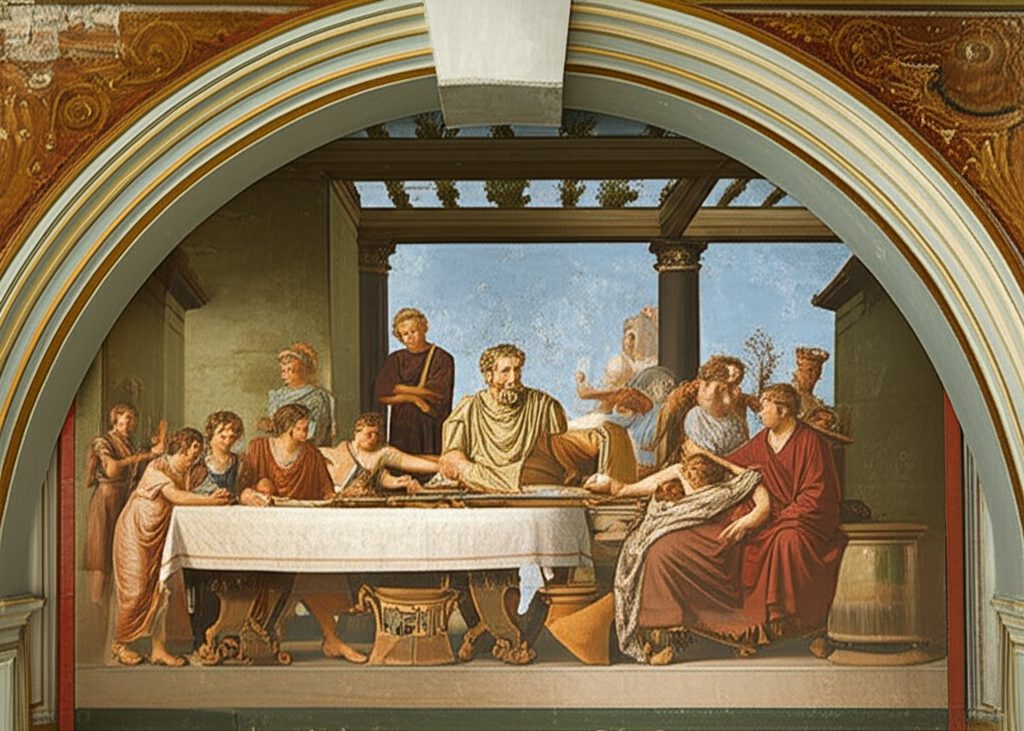
Throughout much of Western history, as depicted in texts from Homer's Odyssey to the narratives of the Old Testament, the patriarchal family model has predominated. In this structure, authority is vested in the eldest male, and lineage is traced through the father. This model shaped not only domestic life but also legal systems, property rights, and political succession. While less common in the historical records emphasized by the Great Books, anthropological studies hint at the existence of matriarchal or matrilinear societies, demonstrating the plasticity of family organization. The shifts from extended families to nuclear families, from agrarian households to urban units, illustrate how economic and social changes continuously reshape these structures, often challenging long-held Customs and Conventions.
The Family as School for the Citizen
Regardless of its specific configuration, the family invariably serves as the primary agent of socialization. It is here that individuals first learn language, moral precepts, social norms, and the responsibilities that come with community membership. For the future Citizen, the family instills values such as respect for authority, the importance of cooperation, and the understanding of rights and duties. John Locke, in his Two Treatises of Government, considered the conjugal society as the first and fundamental form of human association, from which the principles of governance and property ownership could be partially derived, though he carefully distinguished parental power from political power. The discipline and education provided within the family directly impact the capacity of individuals to participate rationally and responsibly in the affairs of the State.
The State's Gaze: Regulating and Relying on the Family
The relationship between the family and the State is reciprocal and complex. The State relies on the family for the reproduction of its populace and the inculcation of civic virtues, yet it also frequently intervenes to regulate family life, reflecting its own values and objectives.
Legal Frameworks and Moral Imperatives
Laws pertaining to marriage, divorce, child custody, inheritance, and domestic violence are all manifestations of the State's attempt to define and control family structure and behavior. These legal frameworks often codify existing Customs and Conventions, giving them the force of law, but they can also be instruments of social change, challenging traditional norms. For instance, the evolution of marriage laws from purely religious or customary unions to state-sanctioned civil contracts highlights the increasing role of the State in defining familial relationships. The State thus acts as both a guardian and an architect of family structures, balancing individual liberty with collective welfare.
When Private Becomes Public: Plato's Radical Vision
Plato's Republic presents a powerful, albeit controversial, example of the State's ultimate intervention in family life. His proposal for the guardian class to share women and children in common was designed to eliminate private affections and loyalties that might compete with allegiance to the State. While extreme, this philosophical thought experiment underscores the deep-seated understanding that the nature of the Family has direct and profound implications for the cohesion and political stability of the State. Even in less radical forms, state-sponsored education, welfare programs, and public health initiatives demonstrate the State's ongoing interest in the well-being and proper functioning of its constituent families.
The Enduring Dialectic: Tradition, Change, and Philosophical Inquiry
The interplay between Family Structure and Social Custom is a dynamic and ongoing dialectic. As societies evolve, so too do the Customs and Conventions that shape family life. Technological advancements, economic shifts, and changing moral landscapes continually challenge traditional notions of family, prompting new philosophical inquiries into the nature of human relationships, the role of the Citizen, and the responsibilities of the State. The Great Books offer not just historical accounts, but enduring frameworks for understanding these transformations, reminding us that the questions surrounding family and its societal role are as old as civilization itself.
Conclusion: The Unfolding Tapestry of Human Connection
The Family, in its myriad forms, remains the fundamental nexus where individual lives intersect with the broader social order. It is a realm profoundly shaped by Custom and Convention, constantly adapting yet retaining its essential functions. The strength and character of a Citizen, and indeed the stability and flourishing of a State, are inextricably linked to the structures and values fostered within its families. To understand the human condition, therefore, one must first grasp the intricate and ever-evolving tapestry woven by Family Structure and Social Custom.
📹 Related Video: PLATO ON: The Allegory of the Cave
Video by: The School of Life
💡 Want different videos? Search YouTube for: ""Plato Aristotle Family State Philosophy""
📹 Related Video: ARISTOTLE ON: The Nicomachean Ethics
Video by: The School of Life
💡 Want different videos? Search YouTube for: ""Social Contract Theory Family Origin""