

The Enduring Nexus: Family, Custom, and the Architecture of the State
This article delves into the profound and often understated relationship between family structures, the evolution of social custom and convention, and their collective impact on the formation and function of the State. Drawing on insights from the Great Books of the Western World, we examine how the family, as the primordial unit of society, shapes the moral fabric and civic identity of the citizen, ultimately influencing the very nature of political order.
The Primacy of the Family in Social Genesis
The intricate tapestry of human society is woven from threads both grand and intimate. Among these, the family stands as the fundamental, irreducible unit, a crucible in which the initial patterns of human interaction are forged. Yet, its influence extends far beyond the domestic sphere, subtly, and sometimes overtly, shaping the broader societal norms, the customs and conventions that govern our collective lives, and indeed, the very structure and purpose of the State. To truly comprehend the genesis and resilience of political order, one must first appreciate the foundational role of these elemental bonds and the traditions they engender.
From the earliest reflections on political philosophy, the family has been recognized as the primary school of virtue and the initial locus of authority. Aristotle, in his Politics, posits the household (oikos) as the natural starting point for the community, a self-sufficient unit that precedes the village and, eventually, the polis. It is within this intimate circle that individuals first learn the rudiments of cooperation, hierarchy, and responsibility.
- Key Functions of the Family in Classical Thought:
- Reproduction and Perpetuation: Ensuring the continuation of the species and the community.
- Economic Provision: A unit of production and consumption, historically.
- Moral Education: Imparting values, ethics, and social norms to the young.
- Identity Formation: Providing a sense of belonging and initial social status.
From Custom to Convention: The Unwritten Laws of Community
The patterns of behavior established within families, when replicated and shared across generations and neighboring households, gradually coalesce into customs. These are the unwritten rules, the habitual practices that lend predictability and stability to social interaction. Over time, these customs can solidify into conventions, more formalized agreements or widely accepted norms that, while not always codified into law, carry significant social weight and expectation.
This progression highlights how the private sphere of the family directly feeds into the public sphere of societal organization. The respect for elders, the division of labor, property rights – many of these fundamental concepts originate in familial arrangements before becoming generalized customs and conventions that bind a larger community.
- The Evolution of Social Norms:
- Habit: Individual or familial recurring actions.
- Custom: Shared habits within a community, passed down through generations.
- Tradition: Enduring customs with historical significance, often celebrated or deeply ingrained.
- Convention: Socially agreed-upon rules or practices, often explicit but not necessarily legal mandates.
- Law: Formally codified rules enforced by the State.
The Citizen, the State, and the Weight of Tradition
The emergence of the State introduces a new layer of complexity. While the family and its attendant customs provide the bedrock of society, the State is tasked with establishing a broader order, ensuring justice, and defending the collective good. The citizen, as a member of both a family and the body politic, navigates these dual allegiances.
Philosophers have debated the ideal relationship between these entities. Plato, in The Republic, famously proposed a radical restructuring of family life for the guardian class, advocating communal rearing to ensure primary loyalty to the State over familial bonds. This highlights an enduring tension: where does ultimate allegiance lie, and how does the State manage or integrate the powerful influence of family and custom?
Conversely, thinkers like John Locke emphasized the natural rights inherent even within familial structures, suggesting that the State arises from a social contract designed to protect these pre-existing rights, rather than supersede them entirely. The customs and conventions concerning property, inheritance, and personal liberty, often rooted in familial practice, thus become crucial considerations for any legitimate State.
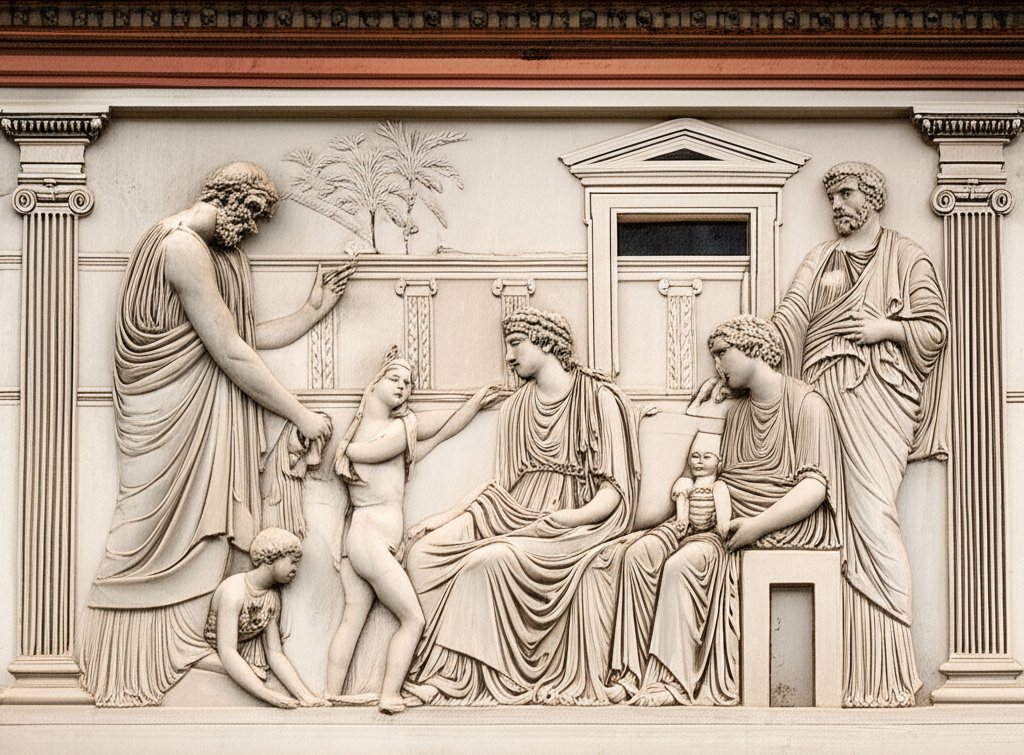
Philosophical Divergences on Family and State Prerogative
The Great Books of the Western World offer a spectrum of views on the philosophical weight given to family versus State.
- Aristotle: Emphasized the natural evolution from household to village to State, viewing the family as fundamental but imperfect, requiring the State to achieve full human flourishing. The citizen finds their highest purpose in the political community.
- Plato: Proposed a more instrumental view of the family for the ruling class, willing to subsume it for the greater good of the State. For the guardians, private family life could be a distraction from civic duty.
- Enlightenment Thinkers (e.g., Locke, Rousseau): While differing on specifics, generally saw the family as a sphere of natural rights and a precursor to civil society. The State was formed to protect these pre-existing rights and customs, not to annihilate them. The citizen enters into a social contract to secure their liberties, often including those related to family.
The interplay between these forces – the intimate bonds of family, the pervasive influence of custom and convention, and the overarching authority of the State – remains a dynamic and often contested terrain in political philosophy. The strength and character of a society's citizens are, in no small part, a reflection of how these foundational elements are understood, respected, and integrated.
YouTube Video Suggestions:
-
📹 Related Video: ARISTOTLE ON: The Nicomachean Ethics
Video by: The School of Life
💡 Want different videos? Search YouTube for: ""Aristotle Politics family household state philosophy""
2. ## 📹 Related Video: PLATO ON: The Allegory of the Cave
Video by: The School of Life
💡 Want different videos? Search YouTube for: ""Plato Republic family property guardians explained""
Conclusion: The Enduring Interdependence
In examining the relationship between family structure and social custom, we uncover a foundational truth about human societies. The family is not merely a private institution; it is the primary forge of character, the first school of citizenship, and the wellspring from which many enduring customs and conventions flow. These unwritten rules, in turn, provide the cultural scaffolding upon which the formal edifice of the State is built. Understanding this profound, reciprocal influence is crucial for any citizen seeking to grasp the deeper currents that shape our collective existence and the enduring philosophical debates surrounding the ideal ordering of human life. The Great Books remind us that the health of the State is inextricably linked to the health of its families and the wisdom embedded in its traditions.