

The Enduring Architecture of Being: Family, Custom, and the Foundations of the State
The human experience, in its most fundamental sense, begins and unfolds within the crucible of the family. This foundational social unit, far from being a mere biological imperative, is inextricably intertwined with the intricate tapestry of custom and convention. This article will explore how these relationships not only define individual lives but also serve as the bedrock upon which the Citizen is formed and the State is ultimately constructed, drawing insights from the enduring philosophical tradition of the Great Books of the Western World. Understanding this interplay is crucial, for the structure of the family, whether consciously chosen or unconsciously inherited, profoundly shapes the character of a society and the nature of its political life.
The Primal Crucible: Family as the First Society
From the earliest philosophical inquiries, the family has been recognized as the primary locus of human existence and the initial training ground for social life. It is here that individuals first encounter authority, responsibility, and the complex dynamics of communal living.
Aristotle's Oikos and the Natural Impulse:
In his seminal work, Politics, Aristotle posits the household (oikos) as the most basic unit of the polis, or city-state. He argues that the association of male and female for procreation, and of ruler and ruled for preservation, is a natural impulse. Within this oikos, distinct relationships—master and slave, husband and wife, parent and child—are formed, each with its own virtues and functions. For Aristotle, the well-ordered household is a prerequisite for a well-ordered State, providing for daily needs and instilling the first principles of justice and hierarchy.
Plato's Radical Challenge in the Republic:
Plato, in his Republic, offers a more radical, albeit hypothetical, challenge to the traditional family structure. For the guardian class in his ideal State, Plato proposes the communalization of women and children, aiming to eliminate private affections and loyalty to individual families in favour of an absolute devotion to the State. This controversial proposition highlights the inherent tension between the private interests and loyalties fostered by the family and the public demands of the polis. Even in this extreme thought experiment, Plato underscores the immense power of the family to shape allegiances, a power he sought to redirect for the greater good of his ideal republic.
- Key Insight: Whether affirmed as natural or challenged as a potential impediment, the philosophical tradition consistently recognizes the family as the initial and most potent force in human socialization.
The Unseen Hand: Custom and Convention in Family Life
While the impulse to form families might be natural, the specific structures and roles within those families are profoundly shaped by custom and convention. These are the unwritten rules, traditions, and societal expectations that dictate how families are formed, how they operate, and how they relate to the broader community.
Defining Custom and Its Influence:
Custom and convention manifest in myriad ways, dictating everything from marriage rituals to child-rearing practices. They provide a framework for stability and continuity, guiding behavior and transmitting values across generations.
- Elements of Custom in Family Life:
- Marriage Rituals: The ceremonies, legal requirements, and social expectations surrounding the union of individuals.
- Child-Rearing Practices: Accepted methods of discipline, education, and the roles of parents and extended family.
- Inheritance Patterns: Rules determining the transfer of property and status, often rooted in long-standing family and community traditions before codified law.
- Gender Roles: Societal expectations regarding the division of labor, authority, and emotional expression within the household.
- Communal Celebrations: Family-centric holidays, rites of passage, and gatherings that reinforce community bonds and shared identity.
The variation in family structures across different cultures and historical periods—from patriarchal extended families to nuclear units, from arranged marriages to individual choice—demonstrates the powerful influence of custom and convention over purely natural inclinations. These conventions are not static; they evolve, sometimes slowly and subtly, sometimes dramatically in response to social, economic, or philosophical shifts.
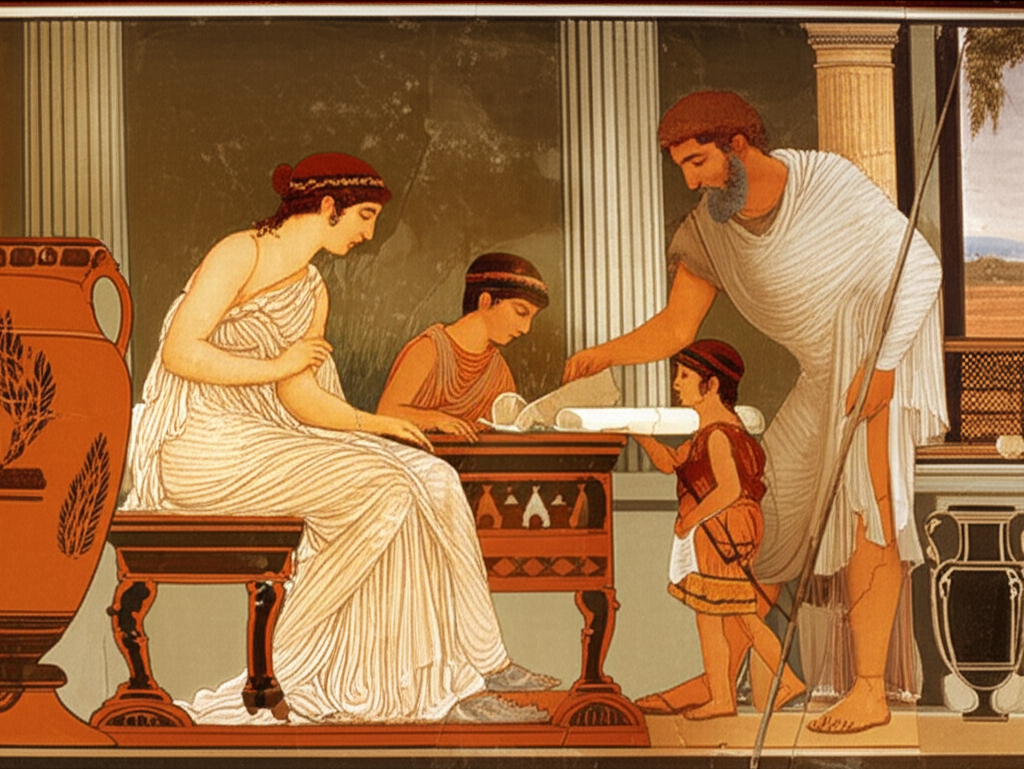
From Hearth to Polis: The Family and the Citizen
The transition from the intimate world of the family to the expansive realm of the State is mediated by the concept of the Citizen. The family, in essence, serves as the primary institution for cultivating the qualities necessary for responsible citizenship.
The Family as the First School:
Before formal education, the family is where an individual learns language, moral precepts, social etiquette, and the fundamental virtues of obedience, respect, and cooperation. These early lessons, deeply embedded through custom and convention, are crucial for an individual to become a functioning member of the larger society. The values instilled within the household directly impact how a person will interact with laws, institutions, and fellow citizens in the State.
Aristotle's Polis and the Good Citizen:
For Aristotle, the polis is a community of families, and the good citizen is one who understands their place within this larger whole. The virtues practiced within the family—justice, temperance, courage—are essential for the flourishing of the State. A well-ordered family thus contributes directly to the stability and ethical character of the political community.
The Social Contract and the Family:
Even thinkers like John Locke, who emphasize individual rights and the social contract as the basis of the State, implicitly acknowledge the family's foundational role. While individuals enter the social contract, they are first nurtured and socialized within a family unit. The family, therefore, is the primary site where individuals develop the capacity for reason and self-governance, which are prerequisites for participation in the political life of the State.
The Dynamic Interplay: Evolution and Enduring Questions
The relationship between family structure, custom and convention, the Citizen, and the State is not a static one but a dynamic interplay, constantly evolving and presenting new philosophical challenges.
Changing Structures and State Influence:
Throughout history, family structures have undergone significant transformations, influenced by economic shifts (e.g., industrialization moving labor out of the home), technological advancements, and changing social values. The State itself plays an active role in regulating and shaping family life through laws concerning marriage, divorce, child protection, inheritance, and social welfare policies. This demonstrates the reciprocal relationship: families shape the State through the citizens they produce, and the State in turn shapes the family through its legal and social frameworks.
Enduring Philosophical Debates:
The ongoing debates surrounding issues like the definition of marriage, parental rights versus state intervention in child-rearing, and the balance between individual autonomy and family obligations highlight the enduring philosophical questions at the heart of this topic. How much should the State dictate family structure? To what extent should custom and convention be preserved or challenged in the name of progress or individual liberty? These are questions that continue to animate philosophical inquiry.
Conclusion
The examination of family structure and social custom transcends mere sociological observation; it delves into the deepest philosophical questions concerning human nature, social organization, and political legitimacy. From the ancient Greek oikos to contemporary debates on family diversity, the family remains the irreducible unit where individuals are formed, values are transmitted, and the seeds of citizenship are sown. The intricate dance between custom and convention and the evolving demands of the State ensures that the philosophical inquiry into this fundamental architecture of being will continue to be a vital and compelling endeavor.
📹 Related Video: PLATO ON: The Allegory of the Cave
Video by: The School of Life
💡 Want different videos? Search YouTube for: ""Aristotle Politics Family State" or "Plato Republic Family Community""