

The Unfolding Tapestry: Evolution, Nature, and the Grand Narrative of Change
A Philosophical Journey Through Life's Transformations
The concept of Evolution stands as one of humanity's most profound intellectual achievements, fundamentally reshaping our understanding of life, Nature, and our place within its grand, ever-unfolding narrative. Far from a mere biological theory, it is a philosophical lens through which we scrutinize the very essence of change, the intricate dance of existence, and the bewildering diversity of the Animal kingdom—including ourselves. This pillar page delves into the philosophical underpinnings and implications of Evolution and the Origin of Species, tracing its intellectual lineage from ancient ponderings on Nature's dynamism to Darwin's revolutionary insights and beyond. We will explore how this powerful idea compels us to reconsider creation, purpose, ethics, and the continuous flux that defines all living things.
Table of Contents
- The Genesis of an Idea: Defining Evolution and Its Precursors
- What is Evolution?
- Ancient Echoes of Change: Before Darwin
- Charles Darwin and On the Origin of Species
- Mechanisms of Transformation: Natural Selection and Common Descent
- The Engine of Change: Natural Selection
- The Web of Life: Common Descent
- Philosophical Quakes: Evolution's Impact on Thought
- Purpose and Teleology Revisited
- The Human Animal in a New Light
- Ethics, Morality, and Evolutionary Perspectives
- Contemporary Crossroads: Modern Evolutionary Philosophy
- Beyond Genes: Culture, Memes, and Social Evolution
- The Ongoing Debate: Science, Philosophy, and Belief
- Reflections on Our Evolving Understanding
- Frequently Asked Questions
- Further Exploration
The Genesis of an Idea: Defining Evolution and Its Precursors
At its heart, Evolution describes the process by which different kinds of living organisms are believed to have developed from earlier forms during the history of the Earth. It is the story of change, relentless and incremental, driven by the interactions between organisms and their environments.
What is Evolution?
More specifically, biological Evolution refers to the cumulative change in the heritable characteristics of biological populations over successive generations. These changes lead to the diversification of life from a common ancestor, giving rise to the astonishing array of Animal and plant forms we observe in Nature. It is a process that has been active since life first stirred on our planet, shaping every leaf, every fin, every thought.
Ancient Echoes of Change: Before Darwin
While Charles Darwin is rightly celebrated for articulating the mechanism of natural selection, the idea that species might change over time is not entirely new. Ancient Greek philosophers, some of whose works are preserved within the Great Books of the Western World, grappled with the dynamism of Nature. Thinkers like Anaximander speculated about life arising from water and humans evolving from fish-like creatures. Aristotle, though a proponent of fixed species, meticulously observed the gradations of life in his scala naturae (ladder of Nature), a concept that, while hierarchical, hinted at a continuum that would later be reinterpreted through an evolutionary lens. These early philosophical inquiries laid a groundwork, albeit often speculative, for understanding the inherent change and fluidity within the natural world.
Charles Darwin and On the Origin of Species
The year 1859 marked a watershed moment with the publication of Charles Darwin's On the Origin of Species by Means of Natural Selection, or the Preservation of Favoured Races in the Struggle for Life. Darwin, building upon decades of observation and the work of others like Alfred Russel Wallace, presented a compelling, evidence-based argument for Evolution through natural selection. His work provided not just the what but the how of biological change, offering a mechanistic explanation for the diversity of life without recourse to supernatural intervention. It was a profound philosophical challenge, shifting the focus from divine creation to natural processes, and placing humanity firmly within the Animal kingdom, subject to the same forces of Nature.
Key Milestones in Evolutionary Thought:
| Era | Key Figures/Concepts | Contribution to Understanding Change in Nature |
|---|---|---|
| Ancient Greece | Anaximander, Empedocles, Aristotle (scala naturae) | Early ideas of life arising from simpler forms; hierarchical organization of nature. |
| Enlightenment | Linnaeus (taxonomy), Buffon (environmental influence) | Systematization of life; recognition of species variability. |
| 19th Century | Lamarck (inheritance of acquired characteristics) | First comprehensive theory of biological evolution (though flawed). |
| 1859 | Charles Darwin (On the Origin of Species) | Natural selection as the primary mechanism for adaptive change. |
| 20th Century | Modern Synthesis (Fisher, Haldane, Wright, Dobzhansky) | Integration of genetics with natural selection. |
Mechanisms of Transformation: Natural Selection and Common Descent
Darwin's genius lay in identifying the primary drivers of evolutionary change.
The Engine of Change: Natural Selection
Natural selection is the differential survival and reproduction of individuals due to differences in phenotype. It is a key mechanism of Evolution, the change in the heritable traits characteristic of a population over generations. Simply put, individuals best adapted to their environment are more likely to survive and reproduce, passing on their advantageous traits. Over vast stretches of time, this process leads to the accumulation of beneficial adaptations, shaping species and driving the diversification of life. It is Nature's relentless sculptor, chiseling away the less fit, refining the more robust, and perpetually transforming the Animal world.
The Web of Life: Common Descent
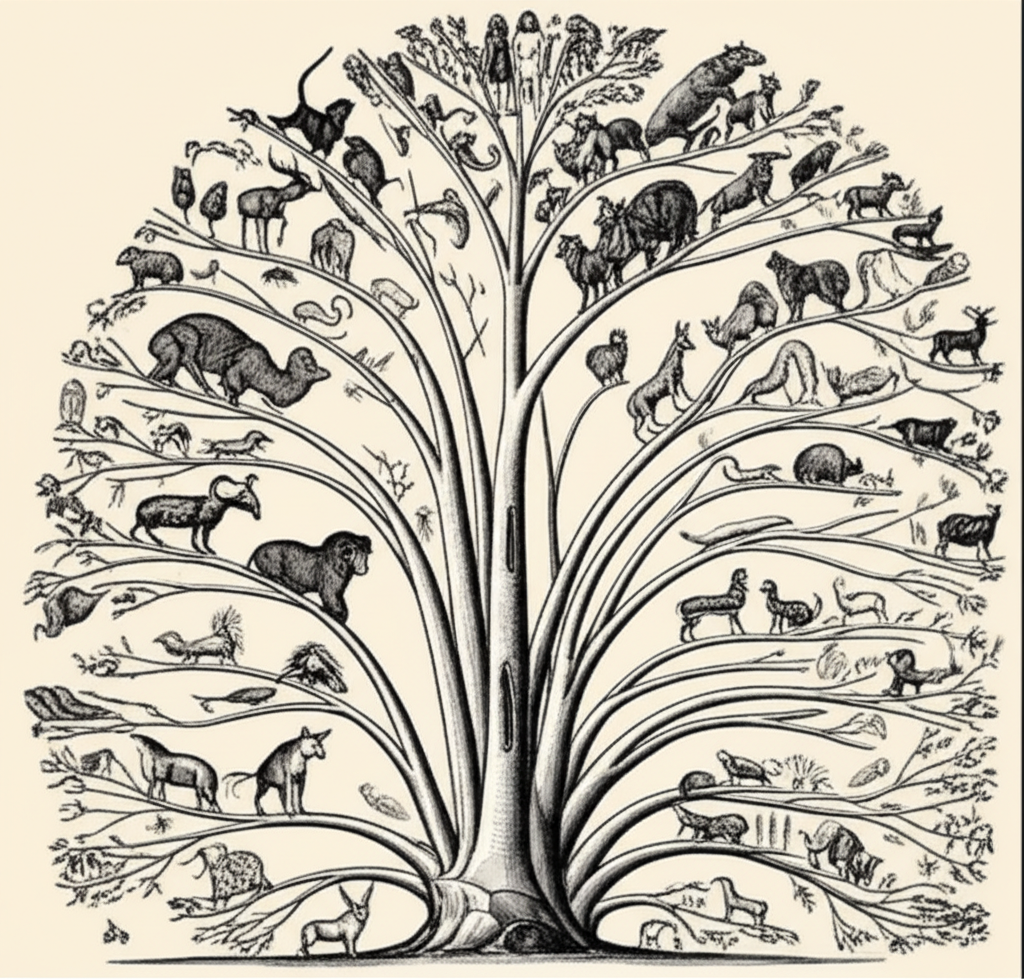
Another cornerstone of Darwinian Evolution is the principle of common descent. This idea posits that all life on Earth shares a common ancestor. From the smallest microbe to the largest whale, every organism is a twig on a vast, intricate tree of life, connected through a shared lineage. This concept profoundly alters our perception of the Animal kingdom, dissolving rigid boundaries and emphasizing the deep, familial connection between all living beings. It means that the similarities between species—anatomical, genetic, developmental—are not coincidental but are echoes of a shared history, a testament to the continuous flow of life's change.
Philosophical Quakes: Evolution's Impact on Thought
The implications of Evolution extend far beyond biology, fundamentally challenging and enriching philosophical discourse.
Purpose and Teleology Revisited
Before Darwin, many philosophical and theological systems posited a teleological view of Nature—that organisms were designed for a specific purpose, reflecting a divine plan. Aristotle, for instance, spoke of final causes, the telos or end goal towards which things strive. Darwinian Evolution offered an alternative: adaptation arises not from foresight or design, but from blind, undirected natural processes. This shift from teleology to mechanism was revolutionary, forcing philosophers to rethink the concept of purpose in a world shaped by change and contingency. Does life still have purpose if it arose by chance and necessity? This question continues to be a fertile ground for philosophical exploration.
The Human Animal in a New Light
Perhaps the most unsettling yet liberating aspect of Evolution for many was its implications for humanity. If all life shares a common ancestor, then humans are not separate creations but an integral part of the Animal kingdom, descended from earlier primate forms. This challenged anthropocentric views and forced a re-evaluation of human exceptionalism. What defines us if not a unique, divine spark? Evolution suggests our intelligence, morality, and consciousness are products of natural selection, refined over eons of change. This perspective has fueled debates about the nature of consciousness, free will, and the very definition of being human, prompting a profound humility and a deeper connection to the rest of Nature.
Ethics, Morality, and Evolutionary Perspectives
If our moral sentiments have an evolutionary origin, how does that change our understanding of ethics? Evolutionary ethics explores how cooperative behaviors, altruism, and a sense of justice might have conferred survival advantages on early human groups. While Evolution describes how morality might have arisen, it does not prescribe what should be. The naturalistic fallacy—the idea that what is natural is necessarily good—is a critical philosophical distinction. However, understanding the biological roots of our moral intuitions can offer valuable insights into human Nature, the challenges of cooperation, and the deep-seated impulses that shape our societies.
Contemporary Crossroads: Modern Evolutionary Philosophy
The dialogue between Evolution and philosophy continues to evolve, reflecting new scientific discoveries and societal shifts.
Beyond Genes: Culture, Memes, and Social Evolution
Modern evolutionary thought extends beyond biological genes to cultural phenomena. Concepts like "memes" (units of cultural information that spread and change through imitation) highlight how ideas, technologies, and social structures also undergo processes analogous to natural selection. This opens new avenues for understanding social change, the Evolution of institutions, and how human societies adapt to their environments, often at a pace far quicker than biological change. The interplay between biological predispositions and cultural innovations remains a rich area of inquiry.
The Ongoing Debate: Science, Philosophy, and Belief
Despite overwhelming scientific consensus, Evolution continues to spark philosophical and theological debates. Questions about irreducible complexity, the existence of a creator, and the compatibility of faith with science persist. Philosophers of science actively engage with these issues, refining our understanding of scientific methodology, the limits of explanation, and the distinct yet sometimes overlapping domains of scientific and metaphysical inquiry. The conversation is less about disproving Evolution and more about understanding its profound implications for our worldview, our values, and our place in the cosmos.
YouTube: Philosophy of Evolution: Crash Course Philosophy #18
YouTube: Does Evolution Explain Human Nature? | Philosophy Tube
Reflections on Our Evolving Understanding
Evolution is not merely a historical account of life's change but a living philosophy that constantly challenges and expands our horizons. It connects us to the vastness of geological time, to the intricate beauty of Nature, and to the shared ancestry of every Animal that has ever lived. It compels us to embrace the dynamism of existence, to understand that everything is in flux, and to find meaning not in fixed states but in the continuous process of becoming. As Benjamin Richmond, I find this journey of understanding to be the most compelling narrative of all, reminding us that even our philosophies are subject to change, adapting and evolving with new insights into the universe.
Frequently Asked Questions
Q: Does evolution imply atheism?
A: Not necessarily. While Evolution provides a naturalistic explanation for the diversity of life without requiring divine intervention, it does not inherently deny the existence of a creator. Many people of faith reconcile their beliefs with evolutionary theory, viewing Evolution as the mechanism through which a creator works. Philosophically, it challenges certain interpretations of creation but leaves room for others.
Q: What is the difference between biological evolution and social evolution?
A: Biological Evolution refers to genetic change in populations over generations, driven by natural selection, genetic drift, etc. Social Evolution (or cultural Evolution) refers to the change in cultural traits, behaviors, and societal structures over time, often driven by learning, imitation, and adaptation to social and environmental pressures. While distinct, they can interact, as human biological predispositions can influence cultural development.
Q: If humans evolved from animals, why are there still monkeys?
A: This question misunderstands common descent. Humans did not evolve from modern monkeys. Rather, humans and monkeys share a common ancestor that lived millions of years ago. Both humans and modern monkeys are descendants of that common ancestor, having followed separate evolutionary paths and undergoing distinct changes over time.
Further Exploration
- Darwin, Charles. On the Origin of Species. (A foundational text in the Great Books of the Western World context).
- Dawkins, Richard. The Selfish Gene. (Explores the gene's-eye view of evolution).
- Dennett, Daniel C. Darwin's Dangerous Idea: Evolution and the Meanings of Life. (A philosophical exploration of evolutionary theory).
- Aristotle. History of Animals and Parts of Animals. (For pre-Darwinian systematic observation of the Animal kingdom).
- Plato. Timaeus. (For ancient Greek cosmological views on the origin and ordering of life).
📹 Related Video: What is Philosophy?
Video by: The School of Life
💡 Want different videos? Search YouTube for: "Evolution and the Origin of Species philosophy"