

The Unfolding Tapestry: Evolution, Philosophy, and the Origin of Species
A Philosophical Voyage Through Biological Change
The publication of Charles Darwin's On the Origin of Species in 1859 stands as a watershed moment, not merely in the annals of biology, but in the grand narrative of Western thought. It introduced a radical new way of understanding life, Nature, and our place within it, challenging millennia of philosophical and theological assumptions about fixity, design, and purpose. This pillar page embarks on a philosophical exploration of Evolution, delving into its core concepts, its profound implications for our understanding of animal life and human nature, and how it forces us to re-evaluate the very essence of change itself. We will uncover how Darwin's insights echo through the "Great Books of the Western World," both challenging and enriching the philosophical discourse that came before and after him.
1. The Genesis of a Paradigm Shift: Darwin's Revolutionary Insight
Before Darwin, the prevailing view, heavily influenced by Platonic forms and Aristotelian essences, held that species were fixed, immutable creations. The Great Books often presented a cosmos where each being had a specific, unchanging nature and a pre-ordained place. Darwin, through meticulous observation and rigorous deduction, proposed a mechanism for biological change that was both elegant and unsettling: natural selection.
Key Concepts of Darwinian Evolution:
- Descent with Modification: All life shares a common ancestor and has diversified over vast stretches of time. Species are not static but continually change.
- Natural Selection: The primary mechanism driving this modification. Individuals with traits better suited to their environment are more likely to survive and reproduce, passing those advantageous traits to their offspring. This leads to a gradual accumulation of beneficial changes over generations.
- Variation: Within any population of organisms, there is inherent variability in traits. This raw material is crucial for natural selection to act upon.
- Struggle for Existence: Resources are limited, leading to competition among individuals, even within the same species.
The philosophical implication was immediate and profound: if species change, then what is the essence of a species? If Nature operates through blind, undirected processes, what becomes of teleology, the idea that the world has inherent purpose or design? This challenged the very foundations of how philosophers from Aristotle to Aquinas had understood the natural world.
2. Echoes in the Ancient Texts: Pre-Darwinian Notions of Nature and Change
While Darwin's specific mechanism was novel, the philosophical contemplation of Nature and change was ancient.
- Heraclitus famously declared, "No man ever steps in the same river twice, for it's not the same river and he's not the same man," emphasizing the constant flux of all things.
- Aristotle, in his Physics and Metaphysics, extensively discussed change (kinesis) and the four causes, including the final cause (telos). While he saw species as having fixed forms, his emphasis on empirical observation and the development from potentiality to actuality laid groundwork for scientific inquiry, even if his conclusions about species differed. The animal kingdom was meticulously cataloged, but without the dynamic, branching tree of life that Darwin would later propose.
- Lucretius, in De rerum natura, presented an atomistic universe where all things arise from the random collision of atoms, a profoundly materialist view of Nature that, while not evolutionary in the modern sense, shared a rejection of divine intervention in the formation of life.
Darwin's work, in a sense, provided a scientific mechanism for the "becoming" that philosophers had long pondered, giving empirical weight to the idea that change is not merely an accident but the fundamental mode of existence for life.
3. The Human Animal: Re-evaluating Our Place in Nature
Perhaps the most contentious and philosophically challenging aspect of Evolution was its implication for humanity. If all life shares a common ancestor, then humans are not separate creations but part of the broader animal kingdom, subject to the same processes of natural selection.
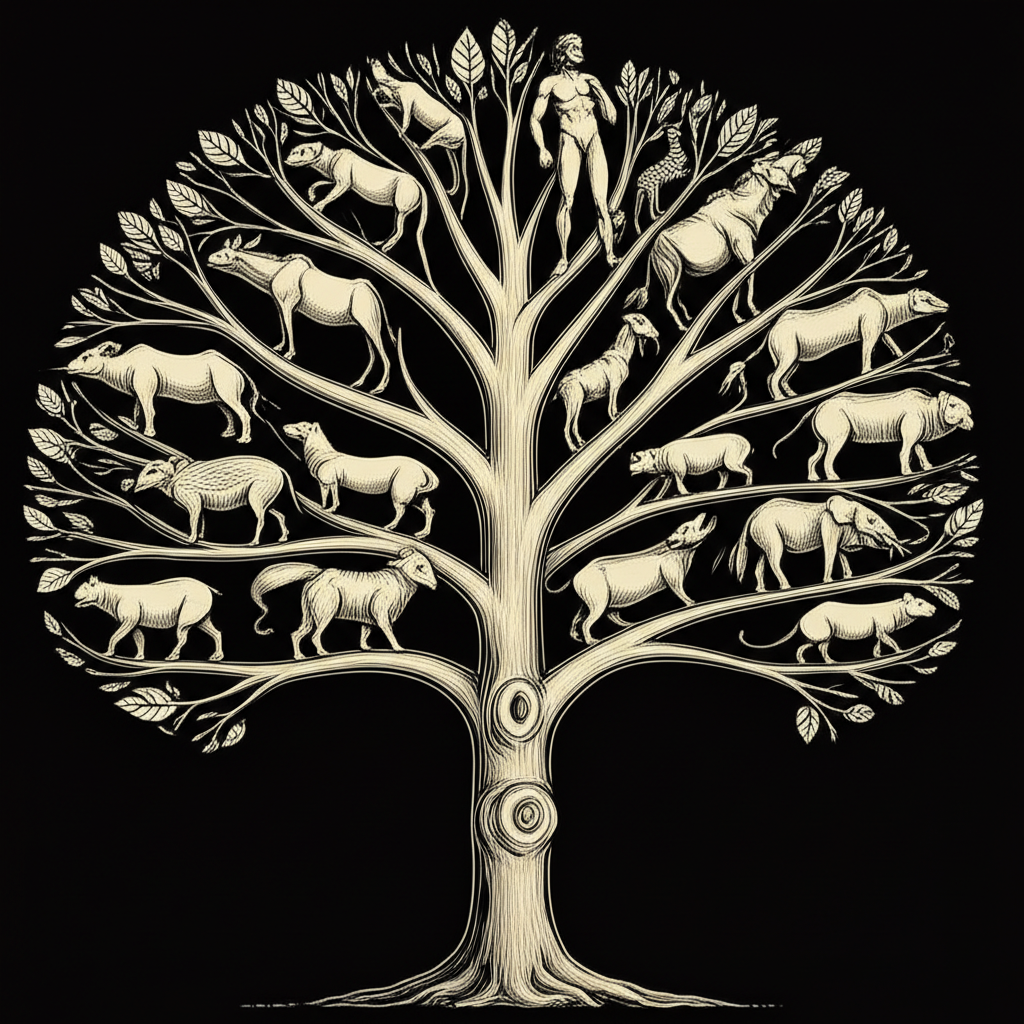
This idea forced a re-evaluation of:
- Human Nature: Is there a fixed human nature? Or is it a product of evolution, constantly adapting and changing? Philosophers from Plato to Locke had debated the essence of humanity; Darwin suggested this essence was dynamic and historically contingent.
- Morality and Ethics: If our moral sentiments are products of evolution (e.g., altruism as a kin-selection strategy), does this undermine their objective validity? Or does it provide a naturalistic foundation for ethics?
- Consciousness and Mind: How did consciousness arise? Is it merely an emergent property of complex biological systems, honed by natural selection for survival? This question continues to bridge philosophy of mind, biology, and cognitive science.
The notion that we are simply a highly evolved animal species, albeit one with unique cognitive abilities, profoundly altered the philosophical landscape, stripping away layers of anthropocentric exceptionalism and demanding a more humble and integrated view of our existence within Nature.
4. Philosophical Implications and Ongoing Debates
The reverberations of Evolution continue to shape philosophical inquiry across various domains:
| Philosophical Domain | Impact of Evolution |
|---|---|
| Metaphysics | Challenges static ontologies. The world is not a collection of fixed essences but a dynamic process of becoming. What is the nature of reality if it is constantly in flux? |
| Epistemology | Evolutionary epistemology explores how our cognitive faculties (perception, reason) are products of evolution, shaped by natural selection for survival. This raises questions about the reliability of our knowledge and its relationship to truth. |
| Ethics | Evolutionary ethics investigates the biological origins of moral behavior. It prompts questions about whether morality is "natural," universal, or culturally constructed upon an evolutionary foundation. Does change in species imply change in moral norms? |
| Philosophy of Mind | Offers a naturalistic framework for understanding the mind and consciousness as emergent properties of complex biological systems, refined by evolution. This contrasts with dualistic or supernatural explanations. |
| Philosophy of Religion | Poses direct challenges to creationist narratives and arguments from design (e.g., Paley's watchmaker analogy). It forces a re-evaluation of the concept of God, divine action, and the relationship between faith and scientific understanding of Nature. |
| Political Philosophy | Misinterpretations led to "Social Darwinism," applying natural selection to human societies, justifying inequality and competition. This highlights the ethical responsibility in interpreting scientific theories and the dangers of conflating biological change with social progress. |
YouTube: Evolutionary Ethics Explained
YouTube: Philosophy of Biology: Darwin and Design
5. Conclusion: A Continuing Dialogue with Nature
Evolution and the Origin of Species is more than a biological theory; it is a profound philosophical statement about the fundamental change that underlies all life. It compels us to see Nature not as a static backdrop, but as an active, creative force, endlessly experimenting and adapting. It demands that we acknowledge our deep interconnectedness with every other animal and plant on this planet, forcing a re-evaluation of human exceptionalism.
The philosophical journey initiated by Darwin continues. We are still grappling with the implications of a universe without inherent teleology, of human nature as a product of continuous evolution, and of the ethical responsibilities that arise from our understanding of life's intricate tapestry. As we reflect on the Great Books, we find that Darwin's work doesn't simply replace old ideas, but rather deepens and transforms the perennial questions about existence, knowledge, and value, inviting us into an ongoing, evolving dialogue with Nature itself. The story of life is one of constant change, and so too is the story of our understanding of it.
📹 Related Video: What is Philosophy?
Video by: The School of Life
💡 Want different videos? Search YouTube for: "Evolution and the Origin of Species philosophy"