

The Unfolding Tapestry of Life: Evolution, Philosophy, and the Origin of Species
Summary: Charles Darwin's On the Origin of Species, published in 1859, stands as a monumental work that irrevocably altered our understanding of life on Earth. This pillar page explores the profound scientific concept of evolution by natural selection, examining its historical development, core mechanisms, and the far-reaching philosophical implications it poses for our comprehension of Nature, the diversity of animal life, and the ceaseless process of change that defines existence itself. It compels us to re-evaluate our place within the grand, interconnected web of life, challenging long-held assumptions about design, purpose, and the very essence of being.
The Grand Narrative of Change: An Ancient Inquiry
For millennia, humanity has gazed upon the bewildering variety of life, pondering its origins and the apparent order of the natural world. From the earliest myths to the most sophisticated philosophical treatises, thinkers have sought to explain why there are so many different kinds of plants and animals, and why they seem so remarkably suited to their environments. The question of change within Nature – whether species are fixed or mutable – has been a persistent undercurrent in this grand inquiry, echoing through the pages of the Great Books of the Western World.
Before Darwin, various explanations were posited. Some adhered to creationist views, positing a divine hand shaping each species individually. Others, like certain ancient Greek philosophers (Anaximander's idea of life emerging from moist elements, or Empedocles' concept of random combinations leading to viable forms), entertained notions of life transforming over vast spans of time. Later, thinkers like Lamarck proposed theories of acquired characteristics, suggesting that organisms could pass on traits developed during their lifetime. These early philosophical and scientific ventures, though lacking the robust evidence and mechanism Darwin would provide, attest to humanity's enduring fascination with the dynamics of life and the inherent change manifest in Nature.
Charles Darwin and the Revolutionary Idea of Natural Selection
It was Charles Darwin, through his meticulous observations during the five-year voyage of HMS Beagle and decades of subsequent research, who synthesized a coherent and compelling explanation for the diversity of life. His magnum opus, On the Origin of Species by Means of Natural Selection, or the Preservation of Favoured Races in the Struggle for Life, introduced a mechanism that elegantly accounted for the adaptation and diversification of species without recourse to supernatural intervention or teleological design.
The Voyage of the Beagle and the Seeds of Insight
Darwin's journey around the world exposed him to an astonishing array of flora and fauna, particularly on the Galápagos Islands. The subtle variations among finches on different islands, each adapted to distinct diets, sparked a profound realization: could species not be static creations, but rather dynamic entities shaped by their environment? This observation laid the groundwork for his theory of evolution.
Natural Selection: The Engine of Change
Darwin's theory of evolution by natural selection rests on several fundamental principles:
- Variation: Within any population of organisms, individuals exhibit natural variation in their traits. No two individuals are exactly alike.
- Inheritance: Many of these variations are heritable, meaning they can be passed from parents to offspring.
- Overproduction: Organisms typically produce more offspring than can survive to reproduce themselves. This leads to a "struggle for existence."
- Differential Survival and Reproduction: Individuals with traits best suited to their environment are more likely to survive, reproduce, and pass on those advantageous traits to their progeny. Over generations, these beneficial traits accumulate, leading to gradual change and the emergence of new species.
This elegant mechanism explained how complex adaptations could arise through blind, undirected processes acting over immense periods of time. It presented Nature not as a static tableau, but as a crucible of continuous, incremental change.
The Philosophical Earthquake: Implications of Evolutionary Thought
The publication of On the Origin of Species sent shockwaves not only through the scientific community but also through philosophy, theology, and society at large. The implications of evolution were, and remain, profound:
- Challenging Anthropocentrism: Evolution decisively placed humanity within the natural order, demonstrating our shared ancestry with all other animals. This challenged the notion of humans as uniquely separate or divinely privileged, instead revealing us as products of the same natural processes that shaped every other living thing.
- The Problem of Design and Purpose: If life arises through natural selection, what then of divine design or inherent purpose (teleology)? Darwin's theory suggested that apparent design is merely the outcome of adaptation to environmental pressures, a retrospective fit rather than a prospective plan. This sparked intense philosophical debates about meaning in a seemingly undirected universe.
- Ethics and Morality: What does an evolutionary understanding of human nature mean for our ethical systems? Do our moral instincts have evolutionary roots? Philosophers grappled with how to reconcile a biologically driven understanding of human behavior with ideals of free will, responsibility, and universal moral truths.
- Knowledge and Truth: If our cognitive faculties themselves are products of evolution, shaped for survival and reproduction, how reliable are they in apprehending objective truth? This question, explored by pragmatists and evolutionary epistemologists, continues to resonate.
- The Continuous Flux of Being: Evolution underscores that nothing in Nature is truly fixed. Species, ecosystems, and even the planet itself are in a constant state of change. This dynamic perspective encourages a re-evaluation of stability, permanence, and the very concept of identity.
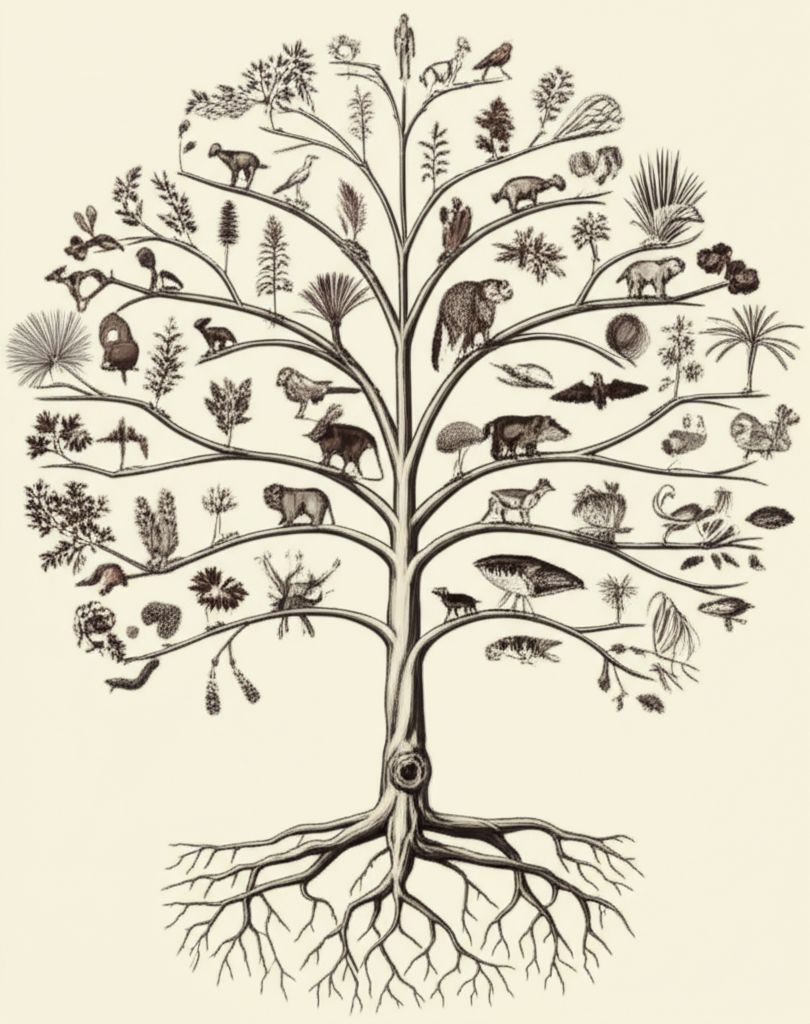
Key Evolutionary Concepts and Their Philosophical Echoes
The core tenets of evolutionary theory provide fertile ground for philosophical inquiry:
- Natural Selection: The mechanism driving adaptation. Philosophical Echo: Challenges teleology, emphasizes the role of chance and necessity in shaping existence, questions inherent purpose.
- Adaptation: Traits that enhance an organism's survival and reproduction in a specific environment. Philosophical Echo: Raises questions about the definition of "good" or "fit," the relativity of perfection, and the continuous struggle for existence.
- Common Descent: The idea that all life shares a common ancestor. Philosophical Echo: Fosters a profound sense of kinship with all life, underscores the unity of Nature, and redefines human identity within a universal biological family.
- Speciation: The process by which new species arise. Philosophical Echo: Highlights the fluid boundaries between categories, the arbitrary nature of classification, and the ongoing dynamism of life's forms.
- Genetic Variation: The raw material for natural selection. Philosophical Echo: Emphasizes the importance of diversity, the role of randomness in creativity, and the potential for unforeseen change.
Evolution in the Modern Era: Beyond Darwin
While Darwin laid the foundational framework, the theory of evolution has itself evolved. The "Modern Synthesis" of the 20th century integrated Darwinian natural selection with Mendelian genetics, providing a robust understanding of the molecular basis of inheritance and variation. Further advancements in molecular biology, genomics, developmental biology, and paleontology continue to refine our understanding, revealing the intricate details of life's history and the mechanisms of change.
Today, evolution remains the cornerstone of modern biology, a powerful explanatory framework that continues to generate new insights into health, disease, behavior, and the very fabric of life. Its philosophical implications are still actively debated, prompting new ethical considerations regarding genetic engineering, biodiversity conservation, and our responsibilities as a species capable of profoundly altering the course of Nature.
The Enduring Philosophical Dialogue
The study of evolution is not merely a scientific pursuit; it is a profound philosophical journey. It compels us to confront fundamental questions about existence, meaning, and our place in the cosmos. It challenges us to embrace the dynamism of Nature, to understand ourselves as products of vast, impersonal forces, yet also as beings capable of reflection, choice, and the creation of meaning.
As we continue to unravel the mysteries of life's origins and its ongoing change, the philosophical dialogue initiated by Darwin's Origin of Species will undoubtedly persist, enriching our understanding of science, ourselves, and the magnificent, evolving tapestry of existence.
📹 Related Video: What is Philosophy?
Video by: The School of Life
💡 Want different videos? Search YouTube for: ""Evolutionary Philosophy" "Philosophical Implications of Darwin's Theory""