

The Unfolding Tapestry of Being: Evolution and the Philosophical Inquiry into Species
The concept of Evolution stands as one of humanity's most profound intellectual achievements, fundamentally altering our understanding of Nature, life, and indeed, ourselves. While primarily a biological theory, its implications resonate deeply within philosophy, forcing us to re-evaluate ancient questions about purpose, morality, and the very essence of being. This pillar page delves into the philosophical journey sparked by Charles Darwin's groundbreaking work, On the Origin of Species, exploring how it challenged established thought and continues to shape our perception of the world and our place within its ever-changing fabric. From the fixed forms of antiquity to the dynamic flux of modern biology, we trace the profound Change in our understanding of the Animal kingdom and the philosophical landscape it has wrought.
The Pre-Darwinian World: Fixed Forms and Divine Order
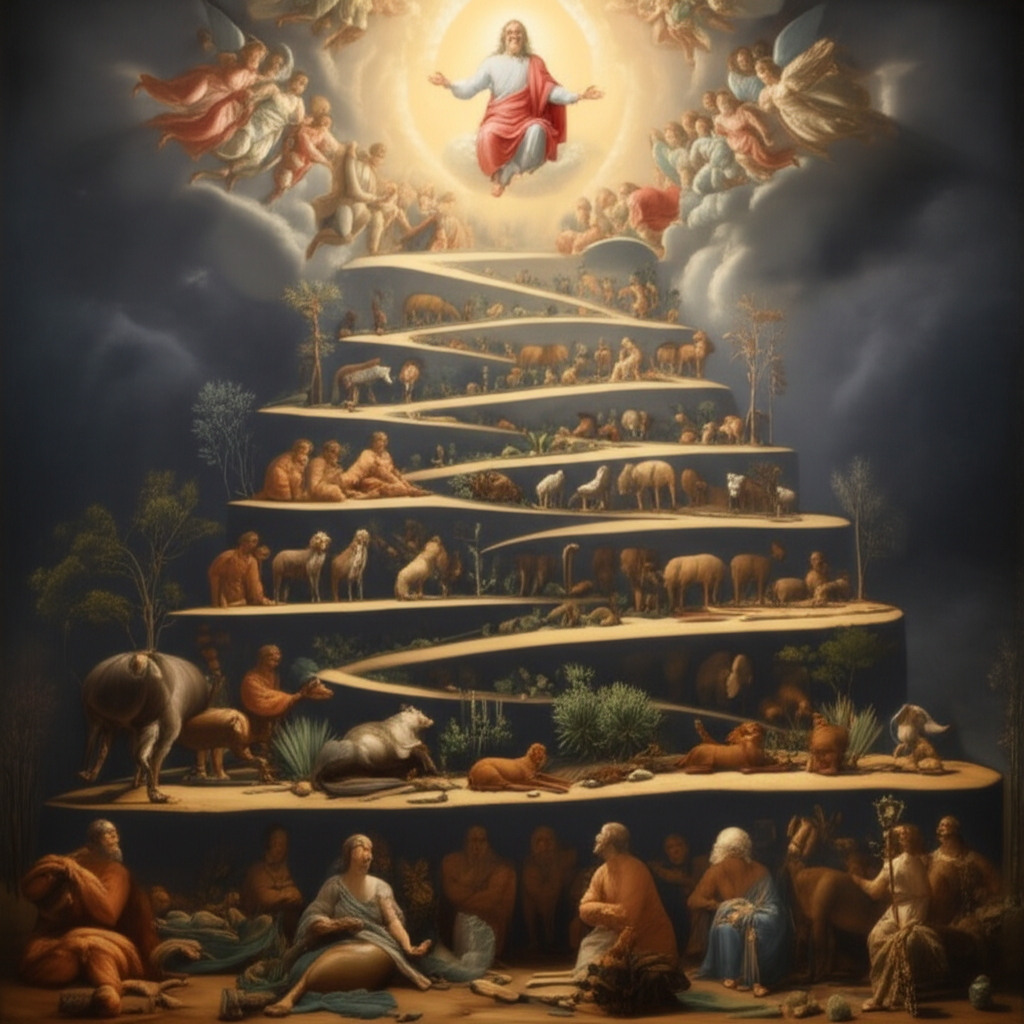
Before the advent of Darwinian Evolution, the prevailing view of Nature was largely static and hierarchical. Species were generally considered immutable, created by divine design, and arranged in a "Great Chain of Being" – a concept popularized and elaborated upon by philosophers throughout the ages.
The Aristotelian Legacy: Essence and Teleology
For thinkers like Aristotle, whose influence permeates the Great Books of the Western World, the natural world was characterized by inherent essences and purposes. In his Metaphysics and On the Parts of Animals, Aristotle meticulously categorized life, believing that each species, each Animal, possessed a distinct eidos or form, a fixed essence that defined its nature and its ultimate purpose (telos). A horse was always a horse, and its form was eternal and unchanging. This teleological view – that things in Nature tend towards an inherent end – provided a coherent framework for understanding the world, one where every organism had its place and function.
Plato's Forms and the Ideal World
Plato, in works such as Timaeus, offered a similar, though more abstract, perspective. He posited an ideal realm of perfect, unchanging Forms, of which the physical world was merely an imperfect shadow. The ideal "form of horse" existed eternally, and all earthly horses were imperfect copies. This philosophical bedrock reinforced the idea of species as fixed categories, divinely or ideally ordained, rather than products of gradual Change.
Darwin's Revolution: The Engine of Change
Charles Darwin's On the Origin of Species by Means of Natural Selection, or the Preservation of Favoured Races in the Struggle for Life (1859), while not part of the Great Books canon itself, delivered a seismic shock to this long-standing philosophical paradigm. His theory of Evolution through natural selection introduced a radical new understanding of how life on Earth developed.
The Mechanism of Natural Selection
Darwin proposed that species are not fixed but undergo gradual Change over vast periods. This Change is driven by natural selection: individuals within a population exhibit variation, some of which are more advantageous for survival and reproduction in a given environment. These advantageous traits are then passed on to offspring, leading to a slow accumulation of adaptations that can eventually result in the formation of new species. This process, operating without conscious design or inherent telos, explained the astonishing diversity and apparent design of Nature through purely naturalistic mechanisms.
Key Tenets of Darwinian Evolution:
- Variation: Individuals within a species are not identical.
- Inheritance: Many variations are heritable.
- Overproduction: Organisms produce more offspring than can survive.
- Differential Survival and Reproduction: Individuals with advantageous traits are more likely to survive and reproduce, passing those traits on.
- Gradual Change: Over geological timescales, these subtle changes accumulate, leading to the diversification of life.
This mechanistic view of Change challenged the very foundations of teleological and essentialist philosophies, particularly concerning the origin and purpose of the Animal kingdom and humanity itself.
Philosophical Aftershocks: Purpose, Morality, and Human Nature
The ramifications of Evolution extended far beyond biology, igniting fervent debates across philosophy, theology, and ethics.
The Crisis of Teleology: Has Nature Lost Its Purpose?
One of the most significant philosophical challenges posed by Evolution was to the concept of teleology. If species arise through blind, undirected natural selection, does Nature still possess an inherent purpose or design?
| Pre-Darwinian View (e.g., Aristotle) | Post-Darwinian View (Philosophical Response) |
|---|---|
| Purpose (Telos): Inherent, intrinsic to an organism's essence. | Purpose: Apparent design is an emergent property of natural selection, not pre-ordained. |
| Species: Fixed, immutable forms. | Species: Dynamic, fluid categories undergoing constant Change. |
| Order: Reflects divine or ideal blueprint. | Order: A product of historical contingency and environmental pressures. |
| Humanity: Distinct, divinely appointed place. | Humanity: An evolved Animal, part of the natural continuum. |
Philosophers like Immanuel Kant, in his Critique of Judgment, grappled with the idea of purpose in Nature, suggesting that while we might perceive purpose, it might be a regulative principle of our understanding rather than an objective reality. Post-Darwin, this debate intensified: could a purposeless process yield such intricate "design"? Some, like Nietzsche, saw Evolution as further evidence of a universe devoid of inherent meaning, where humanity must create its own values.
Re-evaluating Human Nature: The Animal Within
Darwin's theory placed humans firmly within the Animal kingdom, sharing a common ancestry with other species. This was a profound Change from anthropocentric views that often placed humanity as fundamentally separate and superior.
- Moral Foundations: If our moral and social instincts are products of Evolution, how does this affect our understanding of ethics? Is morality merely a strategy for survival, or can it still claim universal validity? Philosophers explored the origins of altruism and cooperation in evolutionary terms, challenging traditional sources of moral authority.
- Mind and Consciousness: The continuity between humans and other Animals raised questions about the uniqueness of human consciousness, reason, and free will. Does Evolution reduce the mind to a mere biological function, or does it offer a new lens through which to understand its emergence?
- The "Noble Savage" to the "Evolved Animal": The view of humanity shifted from a divinely created being, perhaps fallen from grace, to an Animal shaped by millions of years of natural selection, carrying the vestiges of its evolutionary past.
The Challenge to Religious and Metaphysical Beliefs
Perhaps the most public and enduring philosophical impact of Evolution was its challenge to traditional religious narratives of creation. While not inherently atheistic, the theory offered a powerful naturalistic explanation for life's diversity that did not require direct divine intervention. This spurred new theological and philosophical discussions about the compatibility of faith and science, leading to various attempts to reconcile Evolution with religious belief or to embrace it as a cornerstone of a new, secular worldview.
The Ongoing Dialogue: Evolution in Contemporary Philosophy
Evolution continues to be a fertile ground for philosophical inquiry. From the philosophy of biology to ethics, epistemology, and metaphysics, its implications are constantly being re-examined.
- Evolutionary Ethics: Explores the biological roots of moral behavior and how evolutionary theory can inform our ethical frameworks.
- Evolutionary Epistemology: Investigates how our cognitive faculties, shaped by Evolution, influence our ability to acquire knowledge and perceive reality.
- The Nature of Life: What constitutes "life" in an evolutionary context? How do we define species when they are constantly in flux?
- The Anthropocene: Our understanding of Evolution also informs our perspective on humanity's current impact on the planet, prompting ethical considerations about environmental stewardship and the future of life.
The concept of Change – its mechanisms, its direction, and its consequences – remains central to these philosophical discussions, reminding us that the natural world, and our understanding of it, is a perpetually unfolding story.
Conclusion: A Philosophy of Dynamic Being
Evolution and the origin of species represent far more than a scientific theory; they constitute a profound philosophical turning point. They compelled us to confront the dynamic nature of existence, to question long-held beliefs about purpose and design, and to redefine our place within the grand, interconnected tapestry of Nature. From the static forms envisioned by the ancient Greeks to the ever-Changing panorama revealed by modern biology, the philosophical journey of understanding life's origins continues. It is a journey that invites us to embrace uncertainty, to marvel at the intricate dance of natural selection, and to ponder the profound implications of being an Animal shaped by the forces of Evolution, capable of contemplating its own genesis.
YouTube Suggestions:
-
📹 Related Video: PLATO ON: The Allegory of the Cave
Video by: The School of Life
💡 Want different videos? Search YouTube for: ""Philosophical Implications of Darwin's Theory""
2. ## 📹 Related Video: ARISTOTLE ON: The Nicomachean Ethics
Video by: The School of Life
💡 Want different videos? Search YouTube for: ""Evolutionary Ethics and Human Nature Philosophy""