

Evolution and the Origin of Species: A Philosophical Inquiry into Nature's Grand Narrative
By Benjamin Richmond
The publication of Charles Darwin's On the Origin of Species in 1859 stands as a pivotal moment, not merely in the annals of biology, but in the entire history of human thought. It presented a mechanism – natural selection – through which life's astonishing diversity could arise from simple beginnings, challenging millennia of philosophical and theological assumptions about nature, creation, and humanity's unique place within it. This pillar page will delve beyond the scientific tenets of evolution to explore its profound philosophical reverberations, examining how Darwin's insights forced a radical change in our understanding of the animal kingdom, the concept of fixed species, and the very essence of existence. We will trace the intellectual tremors that reshaped our perception of purpose, morality, and the ceaseless flux that defines the living world.
The Darwinian Revolution and its Philosophical Tremors
Before Darwin, the prevailing view, heavily influenced by Platonic and Aristotelian thought as preserved and adapted through the Great Books of the Western World, held that species were fixed essences, immutable and divinely created. Plato's Forms suggested perfect, unchanging archetypes, while Aristotle’s scala naturae depicted a hierarchical ladder of life, each rung stable and distinct. The idea of change on such a grand, transformative scale was largely anathema, or at best, conceived as minor variations within a fixed kind.
Darwin’s theory of evolution through natural selection shattered this static worldview. It proposed that all life shares a common ancestor and has diversified over vast stretches of time through a process of descent with modification. Organisms possessing traits better suited to their environment are more likely to survive and reproduce, passing those advantageous traits to their offspring. This gradual accumulation of change over generations leads to the emergence of new species.
The philosophical implications were immediate and far-reaching:
- From Fixed Essences to Dynamic Processes: The very concept of "species" transformed from an eternal, ideal type to a temporary, evolving population. This challenged the core metaphysical assumption of fixed essences that had underpinned much of Western philosophy.
- The End of Teleology (in the Traditional Sense): Natural selection offered a mechanism for design without a designer. The intricate adaptations of organisms, once cited as irrefutable proof of divine creation, could now be explained by blind, undirected processes. This fundamentally altered discussions on purpose (telos) in nature.
- Continuity over Discontinuity: Darwin's theory emphasized the unbroken chain of life, blurring the sharp distinctions between species, and crucially, between humans and other animals.
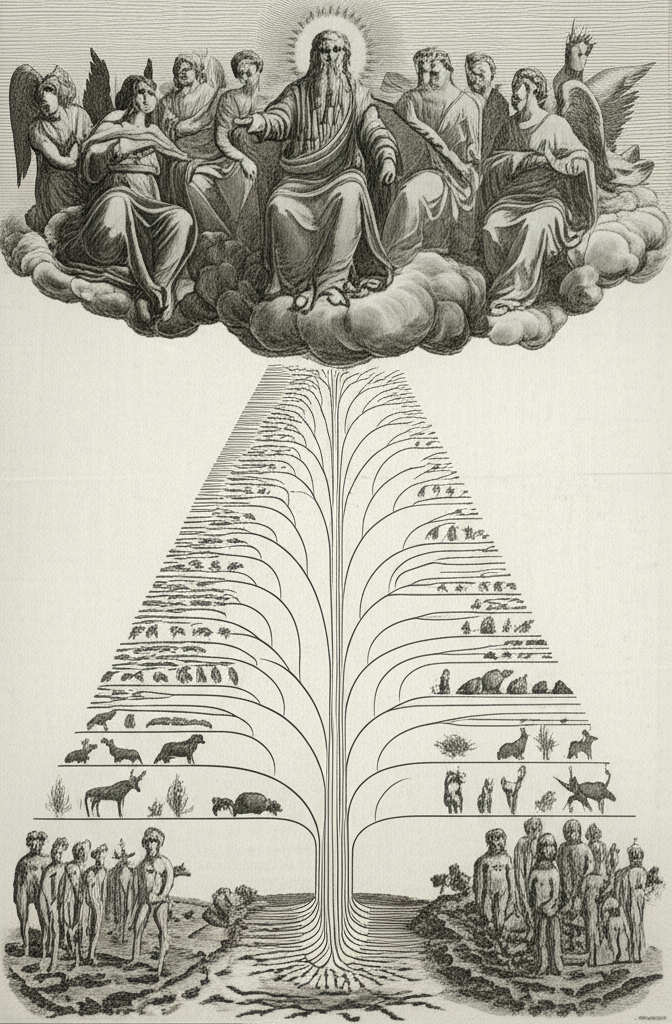
The Mutable Animal: Redefining Species and Self
Perhaps the most unsettling aspect of Darwinian evolution for many was its implications for humanity. If all life is subject to the same processes of change, then humans are not exempt. We are, in essence, another animal, albeit one with unique cognitive and social complexities. This challenged centuries of anthropocentric thought, which often posited humanity as separate from, and superior to, the rest of the animal kingdom, endowed with a divine spark or a uniquely rational soul.
The change in perspective can be summarized:
| Pre-Darwinian View (Often rooted in Great Books) | Post-Darwinian View (Philosophical Implications) |
|---|---|
| Humans are fundamentally distinct from animals. | Humans are part of the animal kingdom, sharing a common ancestor. |
| Species are fixed and unchanging. | Species are dynamic, evolving populations, constantly undergoing change. |
| Human morality is divinely ordained or purely rational. | Morality may have evolutionary roots, shaped by social cooperation and survival. |
| Nature is a hierarchy with humans at the top. | Nature is an interconnected web; hierarchy is an emergent property, not a fixed design. |
This re-evaluation of the human animal has profound consequences for ethics, anthropology, and even epistemology. If our cognitive faculties, our emotions, and our social structures are products of evolution, what does that tell us about the nature of truth, reason, and morality? Are our deepest convictions merely adaptive mechanisms, or do they point to something transcendent? These questions continue to fuel philosophical debate.
Nature's Blind Watchmaker: Purpose, Chance, and Design
The concept of a "blind watchmaker," popularized by Richard Dawkins, encapsulates a core philosophical challenge posed by evolution: the appearance of design in nature without the necessity of a conscious designer. Prior to Darwin, the intricate complexity of an eye or a wing was often cited as irrefutable proof of a benevolent creator. William Paley's watchmaker analogy, for instance, argued that just as a watch implies a watchmaker, so too does the complexity of life imply a divine artificer.
Darwin's mechanism of natural selection, however, offered an alternative explanation. It demonstrated how complex adaptations could arise through a purely mechanistic, undirected process of cumulative change. Small, random variations, when advantageous, are selected for, leading over vast periods to the sophisticated structures we observe. This process is "blind" in that it has no foresight, no ultimate goal, and no conscious intention.
This shift from teleological explanations (explanations based on purpose) to mechanistic ones profoundly impacted metaphysics and the philosophy of religion. It forced a re-evaluation of:
- The Problem of Evil: If nature is shaped by struggle, competition, and extinction, and this is a product of a blind, uncaring process rather than a benevolent designer, it shifts the locus of the problem.
- The Role of Chance: Evolution incorporates an element of randomness (mutation), alongside the deterministic filtering of natural selection. This blend of chance and necessity in shaping life raises questions about free will, determinism, and the predictability of change in the universe.
- The Meaning of Life: If there is no inherent cosmic purpose or divine plan, then meaning must be constructed, chosen, or found within the existential reality of our own lives.
Evolution and the Human Condition: Morality, Knowledge, and the Future
The philosophical implications of evolution extend deeply into the human condition, challenging our understanding of morality, knowledge, and our place in the ongoing drama of life.
Evolutionary Ethics
If human beings are products of evolution, then our moral intuitions and behaviors might also have an evolutionary basis. Evolutionary ethics explores how traits like altruism, cooperation, and empathy could have evolved because they conferred survival advantages on individuals or groups. While this doesn't necessarily dictate what is moral, it offers a powerful explanation for why we have moral sentiments at all. This perspective challenges purely rationalist or purely divinely revealed accounts of ethics, suggesting that our moral compass is, in part, a product of our biological heritage and the long history of change that shaped our species.
The Evolution of Knowledge
Our capacity for knowledge, reason, and scientific inquiry itself can be viewed through an evolutionary lens. The human brain, with its unparalleled complexity, is the product of millions of years of evolutionary change. Our cognitive biases, our ways of perceiving the world, and even the very structures of our thought might be adaptations that enhanced our ancestors' survival. This raises fascinating questions for epistemology: To what extent do our evolutionary origins constrain or shape our ability to grasp objective truth? Are our categories of thought merely adaptive fictions, or do they genuinely reflect reality?
The Future of Humanity and Nature
Finally, evolution compels us to consider the future. We are not static beings; change is our constant companion. Humanity itself is still evolving, albeit now influenced by cultural, technological, and ethical choices in unprecedented ways. Our understanding of evolution also places a profound responsibility upon us regarding the nature we inhabit and the other species with whom we share the planet. Recognizing our deep interconnectedness and the fragility of ecosystems becomes paramount. The philosophical challenge is to integrate this scientific understanding into a coherent worldview that guides our actions and defines our place in the unfolding narrative of life.
YouTube Suggestions:
-
📹 Related Video: PLATO ON: The Allegory of the Cave
Video by: The School of Life
💡 Want different videos? Search YouTube for: ""Philosophical Implications of Darwin's Theory""
2. ## 📹 Related Video: ARISTOTLE ON: The Nicomachean Ethics
Video by: The School of Life
💡 Want different videos? Search YouTube for: ""Evolutionary Ethics and Human Morality""