

Evolution and the Origin of Species: A Philosophical Journey Through Nature's Unfolding Tapestry
The concept of Evolution stands as one of the most profound intellectual revolutions in human history, fundamentally altering our understanding of Nature, life, and our place within the vast Animal kingdom. Far from being a mere biological theory, it presents a rich philosophical tapestry, challenging ancient assumptions and sparking new inquiries into the very fabric of existence. This pillar page delves into the philosophical underpinnings and implications of evolutionary thought, tracing its conceptual Change from ancient musings to Darwin's groundbreaking insights, and examining its enduring impact on our perception of reality, purpose, and human Nature. We will explore how this grand narrative of biological Change compels us to reconsider our oldest questions, from the genesis of life to the ethical responsibilities that arise from our shared ancestry.
I. Unpacking Evolution: More Than Just Biology
At its core, Evolution refers to the gradual Change in the heritable characteristics of biological populations over successive generations. While often synonymous with Charles Darwin's theory of natural selection, the idea that species are not fixed but undergo transformation has a much longer, albeit less formalized, history. From a philosophical vantage point, Evolution is not just about how Animal forms morph over eons; it's about the very Nature of existence – whether the world is static or dynamic, designed or emergent, purposeful or indifferent. It forces us to confront the reality of contingency and the relentless march of Change as a fundamental aspect of the cosmos.
II. Echoes of Change: Pre-Darwinian Speculations on Nature
Long before Darwin set sail on the HMS Beagle, thinkers throughout history grappled with the apparent diversity and interconnectedness of life. The "Great Books of the Western World" reveal a fascinating intellectual lineage where ideas about the Change and fixity of species were hotly debated.
- Ancient Greek Philosophers: Figures like Anaximander speculated that life originated in water and that humans evolved from fish-like creatures. Empedocles proposed a form of natural selection where only the "fit" combinations of body parts survived. Aristotle, while a meticulous observer of Animal life, largely adhered to the idea of fixed species arranged in a "scala naturae" or Great Chain of Being, a hierarchical order from simple to complex, with humans at the apex. Yet, even his detailed classifications hinted at relationships.
- Roman Thinkers: Lucretius, in De Rerum Natura, presented a materialistic view where the universe, including life, arose from the random collision of atoms, and that early life forms struggled for survival, with only the most adapted flourishing – a remarkable premonition of natural selection.
- Enlightenment Era: The 18th century saw a burgeoning interest in natural history, with thinkers like Buffon and Lamarck proposing more systematic theories of species Change. Lamarck, in particular, posited the inheritance of acquired characteristics – the idea that traits developed during an Animal's lifetime could be passed to offspring. While ultimately disproven in its mechanism, Lamarck's work was crucial in establishing the concept of biological Evolution as a process driven by environmental interaction.
The table below illustrates the conceptual Change in understanding species over time:
| Era/Thinker | Core Idea on Species | Role of Change | View of Nature |
|---|---|---|---|
| Ancient Greece | Fixed forms (Plato), Scala Naturae (Aristotle) | Limited or cyclical, not transformative between species | Teleological, ordered, purposeful |
| Lucretius | Emergent from atomic combinations | Struggle and adaptation for survival | Materialistic, mechanistic, random |
| Lamarck (18th C.) | Transformative, driven by environmental need | Inheritance of acquired characteristics | Dynamic, responsive, driving progress |
| Darwin (19th C.) | Evolving through natural selection from common ancestors | Gradual, undirected, based on variation and selection | Impersonal, emergent, without inherent purpose or direction |
III. Darwin's Revolution: The Origin of Species and the Unfolding of Nature
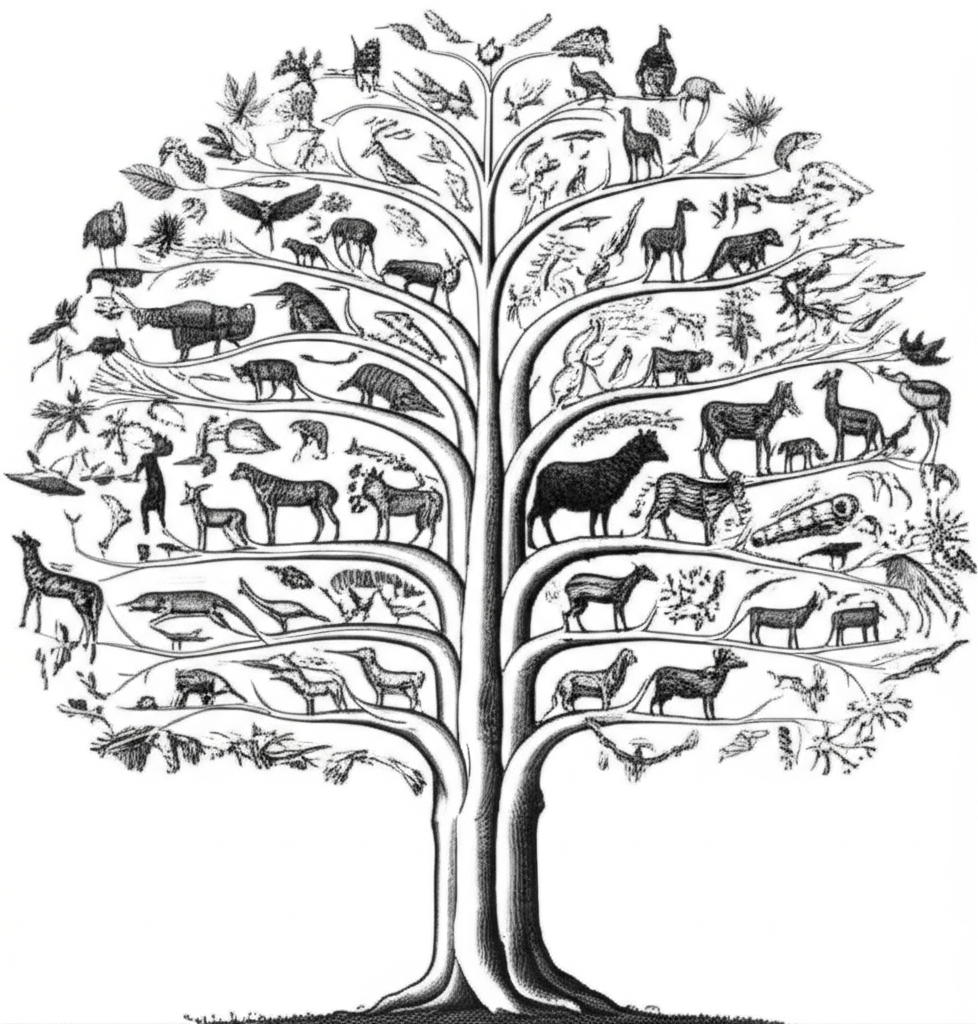
In 1859, Charles Darwin published On the Origin of Species by Means of Natural Selection, or the Preservation of Favoured Races in the Struggle for Life. This monumental work provided a coherent, evidence-based mechanism for Evolution: natural selection. Darwin proposed that within any population of Animal life, individuals exhibit variation. Those with traits better suited to their environment are more likely to survive and reproduce, passing these advantageous traits to their offspring. Over vast stretches of time, this process leads to the gradual Change of species and the diversification of life from common ancestors.
Darwin's theory was revolutionary because it:
- Provided a Mechanism: Unlike previous theories, natural selection offered a plausible, observable mechanism for Change, grounded in empirical evidence gathered from his global voyages.
- Challenged Teleology: It suggested that the intricate design of Nature was not the result of divine foresight but rather the blind, undirected process of adaptation to environmental pressures. There was no inherent goal or progress embedded in the evolutionary process.
- Unified Life: By proposing common descent, Darwin provided a powerful framework for understanding the deep relatedness of all life forms, from bacteria to humans, placing humanity firmly within the Animal kingdom and subject to the same natural laws.
IV. Philosophical Ripples: Evolution's Impact on Thought
The implications of Darwinian Evolution extend far beyond biology, profoundly influencing philosophy, theology, ethics, and our understanding of human Nature.
- Metaphysics and Teleology: Evolution dealt a significant blow to teleological views of the universe, which posited inherent purpose or design. If Nature operates through undirected variation and selection, then the apparent 'design' is an emergent property, not a pre-ordained plan. This shifted philosophical inquiry from "what is the purpose of life?" to "how did life come to be as it is?"
- Human Nature and the Animal Kingdom: Darwin's work irrevocably linked humans to the Animal world, challenging anthropocentric views that placed humanity in a separate, superior category. This sparked debates about human dignity, consciousness, morality, and whether these traits are unique or merely highly developed forms found in other species. Philosophers like Nietzsche grappled with the implications for human self-understanding in a world without divine guarantees.
- Ethics and Morality: If morality is not divinely commanded or rationally derived from fixed principles, could it be an evolved trait, a product of social cooperation for survival? This question led to the development of evolutionary ethics, exploring the biological roots of altruism, empathy, and justice, while also raising concerns about justifying social hierarchies (e.g., Social Darwinism, a misapplication of Darwin's ideas).
- Epistemology: Evolutionary theory also influenced how we understand knowledge itself. If our cognitive faculties are products of Evolution, adapted for survival, then how reliable are they for discerning objective truth? This line of questioning connects to pragmatist philosophies that emphasize the practical utility of beliefs.
V. Evolution in the 21st Century: Continuous Change
Modern evolutionary biology has expanded far beyond Darwin's initial insights, integrating genetics (the "Modern Synthesis"), developmental biology (evo-devo), and ecology. We now understand the molecular mechanisms of heredity, the role of genetic drift, epigenetics, and the complex interplay between genes, organisms, and environments.
Key contemporary questions include:
- The Pace of Evolution: Is Evolution always gradual, or are there periods of rapid Change (punctuated equilibrium)?
- The Role of Cooperation: Beyond competition, what role does cooperation play in shaping evolutionary trajectories?
- Human-Driven Evolution: How are human activities (e.g., climate Change, genetic engineering) influencing the Evolution of other species and even our own?
- The Definition of "Species": The concept of a fixed species continues to be refined, recognizing the dynamic and often blurry lines between populations.
The ongoing scientific discoveries continue to fuel philosophical inquiry, reminding us that our understanding of Nature is itself subject to Change and refinement.
Conclusion: The Enduring Legacy of an Evolving Idea
The theory of Evolution and the Origin of Species represents not just a scientific breakthrough but a profound philosophical turning point. It compels us to view Nature not as a static backdrop but as a dynamic, ever-changing process, and ourselves not as separate from the Animal kingdom but as an integral, albeit complex, part of it. From ancient philosophical debates about Change and purpose to modern ethical dilemmas concerning our responsibility to the planet, evolutionary thought continues to shape our worldview, pushing us to ask deeper questions about life's origins, its unfolding tapestry, and our place within its grand, evolving narrative. The journey of understanding Evolution is, in essence, a journey into understanding ourselves and the magnificent, indifferent, and always changing Nature that surrounds us.
YouTube: "Philosophy of Evolution: Crash Course Philosophy #20"
YouTube: "What Darwin Got Wrong - Philosopher Jerry Fodor on Evolution"
📹 Related Video: What is Philosophy?
Video by: The School of Life
💡 Want different videos? Search YouTube for: "Evolution and the Origin of Species philosophy"