

The Shifting Sands of Being: Evolution and the Philosophical Origin of Species
The publication of Charles Darwin’s On the Origin of Species in 1859 sent ripples through not just the scientific community, but the very foundations of philosophical thought. Far from being a mere biological treatise, Darwin’s theory of Evolution by natural selection profoundly challenged long-held beliefs about the Nature of reality, the origin of life, the place of humanity in the Animal kingdom, and the very concept of immutable forms. This pillar page delves into the philosophical earthquake that Darwin initiated, exploring how his insights compelled a radical Change in our understanding of metaphysics, epistemology, and ethics, urging us to reconsider what it means to be, to know, and to act in a world defined by constant transformation.
1. The Darwinian Earthquake: A Philosophical Precedent
Before Darwin, the prevailing view, heavily influenced by classical thought and religious doctrine, posited a largely static and divinely ordered Nature. Species were often seen as fixed, immutable types, much like Plato’s Forms or Aristotle’s essential natures, created independently and existing in a hierarchical Scala Naturae.
1.1. Pre-Darwinian Notions of Species and Change
- Platonic Forms & Aristotelian Essences: For much of Western thought, the idea of a "species" was tied to an eternal, unchanging essence. An individual Animal was a mere instantiation of a perfect, ideal form.
- Linnaean Taxonomy: While providing a systematic classification, Linnaeus's system still implicitly reinforced the idea of distinct, created categories.
- Lamarckian Transformism: Jean-Baptiste Lamarck offered an earlier theory of biological Change, suggesting that acquired characteristics could be inherited. Though ultimately disproven in its mechanism, it represented an important step towards acknowledging the mutability of life.
1.2. Darwin's Radical Departure: Nature in Flux
Darwin's meticulous observations and logical deductions presented a compelling alternative. He proposed that species were not fixed entities but rather populations that undergo gradual Change over vast stretches of time, driven by a process he called natural selection.
Key Tenets of Darwinian Evolution:
- Variation: Individuals within a species exhibit natural variation.
- Inheritance: Some of this variation is heritable.
- Struggle for Existence: Organisms produce more offspring than can survive.
- Differential Survival and Reproduction: Individuals with advantageous variations are more likely to survive and reproduce, passing on those traits.
- Common Descent: All life shares a common ancestor, forming a vast, branching tree of life.
This vision fundamentally reoriented our understanding of Nature, moving from a static tableau to a dynamic, ever-evolving process. The very concept of "species" became less a rigid category and more a snapshot in an ongoing continuum of Change.
2. Metaphysics: The Unfolding Tapestry of Being
Darwin's theory struck at the heart of metaphysical assumptions, forcing philosophers to reconsider the fundamental Nature of reality, existence, and purpose.
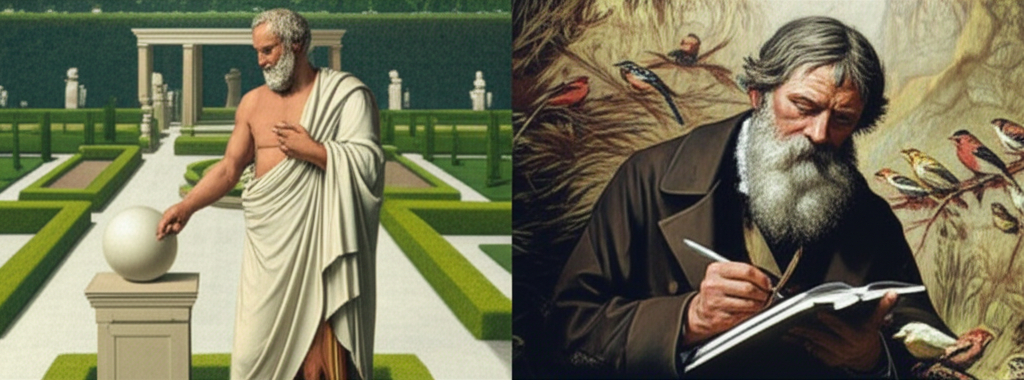
2.1. The Mutable Nature of Forms and Essences
If species are not fixed but evolve, what then becomes of the concept of essential forms?
- From Fixed Essences to Dynamic Populations: Darwin suggested that species are not defined by an unchanging essence but by a population of individuals sharing a common ancestry and a propensity for Change. This challenged the very notion of a static "type."
- The Problem of Definition: Where does one species end and another begin if Evolution is a continuous process? This question forced a re-evaluation of how we categorize and understand natural phenomena.
2.2. Teleology vs. Chance: Purpose in Nature
Perhaps the most profound metaphysical challenge was to teleology – the idea that Nature has an inherent purpose or design.
- Design Without a Designer: Darwin showed how complex adaptations, once seen as irrefutable proof of a divine creator, could arise through blind, undirected natural selection. The intricate eye, the powerful wing, the cunning predatory instinct of an Animal – all could be explained without recourse to an intelligent designer.
- The Role of Contingency: Evolution highlights the role of contingency and chance. Mutations are random; environmental pressures are unpredictable. This suggested a universe less governed by a predetermined plan and more by a dynamic interplay of possibility and necessity.
- Image:
2.3. Materialism and the Human Animal
Evolution strongly reinforced a materialist worldview, suggesting that life, including human life, could be explained through natural processes without recourse to supernatural intervention.
- Continuity of Life: The concept of common descent placed humanity firmly within the Animal kingdom, challenging anthropocentric views that posited humans as fundamentally separate or divinely created.
- Implications for Mind and Consciousness: If humans evolved from other animals, then our cognitive abilities, emotions, and even consciousness itself might be understood as products of Evolution, rather than gifts from an external source.
3. Epistemology: Knowing a World in Flux
Darwin's theory not only changed what we know but also how we know, influencing the philosophy of science itself.
3.1. The Power of Observation and Inference
Darwin's method was a triumph of empirical observation and logical inference, demonstrating the power of the scientific method to unravel complex natural phenomena without direct observation of the entire process.
- Indirect Evidence: The vastness of geological time and the slow pace of Evolution meant Darwin relied heavily on indirect evidence: fossils, comparative anatomy, embryology, and biogeography. This validated the strength of inferential reasoning in scientific inquiry.
- Falsifiability: Like any robust scientific theory, Evolution presented predictions that could, in principle, be falsified. This aligned with Karl Popper's later emphasis on falsifiability as a hallmark of true science.
3.2. Truth as Provisional and Evolving
The very idea of Evolution suggests that our understanding of the world, like the world itself, is subject to Change and refinement.
- Scientific Progress: Evolution exemplifies how scientific understanding progresses not by finding ultimate, immutable truths, but by developing increasingly accurate and comprehensive models that explain phenomena.
- The Dynamic Nature of Knowledge: Just as species adapt and evolve, so too does our knowledge, constantly being tested, revised, and expanded by new evidence and insights.
4. Ethics: Navigating the Moral Landscape of Change
The philosophical implications of Evolution extended deeply into ethics, raising challenging questions about morality, human value, and societal organization.
4.1. The Misguided Path of Social Darwinism
One of the most unfortunate and dangerous misinterpretations of Evolution was "Social Darwinism," which applied the concept of "survival of the fittest" to human societies.
- Justification for Inequality: Social Darwinists used evolutionary theory to justify economic inequality, racism, and imperialism, arguing that these were natural outcomes of the struggle for existence.
- The Naturalistic Fallacy: Philosophers quickly pointed out the "naturalistic fallacy" inherent in such arguments: deriving "ought" from "is." Just because something occurs in Nature does not mean it is morally good or ought to be replicated in human society.
- Distinction between Biological and Ethical Evolution: Ethical systems are products of human culture and reasoning, not merely direct reflections of biological competition.
4.2. Evolutionary Explanations for Altruism and Cooperation
Paradoxically, Evolution also provided insights into the origins of seemingly selfless behaviors.
- Kin Selection and Reciprocal Altruism: Evolutionary biologists have proposed mechanisms like kin selection (favoring relatives) and reciprocal altruism (mutual exchange of favors) to explain why cooperation and altruism can evolve even in a competitive Nature.
- The Social Animal: Humans, like many other Animal species, are profoundly social, and our capacity for empathy and cooperation may have deep evolutionary roots, crucial for group survival.
4.3. Humanity's Place: From Pinnacle to Product of Evolution
The greatest ethical challenge was the re-evaluation of humanity's unique status.
- Loss of Anthropocentric Privilege: If humans are merely another product of Evolution, sharing common ancestry with all other life, then our claim to unique moral status or cosmic significance becomes less self-evident.
- Responsibility Towards Nature: This understanding also fosters a sense of interconnectedness with all life, potentially leading to a greater ethical responsibility towards the environment and other species.
5. Interdisciplinary Reverberations
The philosophical impact of Evolution continues to resonate across various disciplines, fostering ongoing dialogue and new fields of inquiry.
- Modern Synthesis and Genetics: The integration of Darwinian natural selection with Mendelian genetics in the 20th century provided a robust scientific foundation, further cementing Evolution as the central organizing principle of biology.
- Evolutionary Psychology and Sociobiology: These fields explore how human behaviors, cognitive structures, and social organizations may have been shaped by Evolution.
- Theology and Religion: For many, Evolution presented a direct conflict with religious dogma. For others, it prompted a reinterpretation of creation narratives, viewing Evolution as the very mechanism of creation, a testament to the dynamic Nature of the divine.
6. Conclusion: The Enduring Philosophical Legacy of Change
Darwin's theory of Evolution represents one of the most significant intellectual shifts in human history, profoundly altering not only our scientific understanding of life but also our deepest philosophical convictions. It compelled us to embrace Change as an inherent feature of Nature, to question fixed essences, to reconsider purpose, and to redefine humanity's place within the vast, interconnected web of the Animal kingdom.
The philosophical journey initiated by On the Origin of Species is far from over. It continues to challenge us to grapple with fundamental questions: What is the Nature of reality in a constantly evolving universe? How do we construct ethical frameworks in light of our evolutionary heritage? How do we reconcile our drive for meaning with a world shaped by undirected processes? Darwin's legacy is not just a scientific theory; it is a profound philosophical invitation to forever re-examine the shifting sands of being.
YouTube: "Philosophy of Evolution"
YouTube: "Darwin's Impact on Western Thought"
📹 Related Video: What is Philosophy?
Video by: The School of Life
💡 Want different videos? Search YouTube for: "Evolution and the Origin of Species philosophy"