

Desire as the Genesis of Transgression: A Philosophical Inquiry
Desire, in its myriad forms, stands as a fundamental force within the human psyche. Yet, for centuries, philosophers and theologians alike have grappled with its darker potential, often positing desire as the very cause of sin. This article delves into the profound philosophical tradition, primarily drawing from the intellectual bedrock of the Great Books of the Western World, to explore how unbridled or misdirected desire can corrupt the Will, leading humanity astray from virtue and into transgression. We shall examine the intricate relationship between our innate longings and our moral failings, asserting that while desire itself is neutral, its improper orientation, unchecked by reason and a rightly ordered Will, is the fertile ground from which sin emerges.
The Intrinsic Nature of Desire and Its Moral Ambiguity
To understand desire's role in sin, we must first confront its nature. Desire is not inherently evil; it is the engine of life, driving us towards sustenance, love, knowledge, and beauty. From the most basic biological urges to the loftiest aspirations, desire propels human action. However, the classical philosophical tradition, from Plato to Augustine, recognized a critical distinction between desires that align with reason and those that pull us towards irrational or destructive ends.
Key Philosophical Perspectives on Desire:
- Plato's Tripartite Soul: In The Republic, Plato posits a soul divided into three parts:
- Reason (Logistikon): Seeks truth and wisdom.
- Spirit (Thymoeides): Seeks honor and glory.
- Appetite (Epithymetikon): Seeks bodily pleasures and material goods.
When appetite dominates reason, the soul is out of harmony, leading to injustice and moral failing – a clear precursor to what we understand as sin. The desire for sensual gratification, if unchecked, can lead to actions contrary to the good.
- Aristotle's Ethics of Virtue: For Aristotle, desire (orexis) is an impulse towards an object, which can be either rational or irrational. In works like the Nicomachean Ethics, he argues that virtue lies in finding the "mean" between excess and deficiency. Desire itself is not the problem, but rather the excessive or deficient pursuit of it, unsupported by practical wisdom (phronesis). Sin, in this view, is a failure to act virtuously, often swayed by desires that exceed rational bounds. The Will (prohairesis, or deliberate choice) is crucial here, as it is the faculty that chooses how to act upon these desires.
The Will's Predicament: Desire as the Instigator of Sin
The pivotal moment in the trajectory from desire to sin occurs within the human Will. It is the Will that mediates between our desires and our actions, possessing the capacity to consent to or resist the urges that arise within us. Many philosophers, particularly those with a theological bent, identify the corruption of the Will as the direct mechanism through which desire culminates in sin.
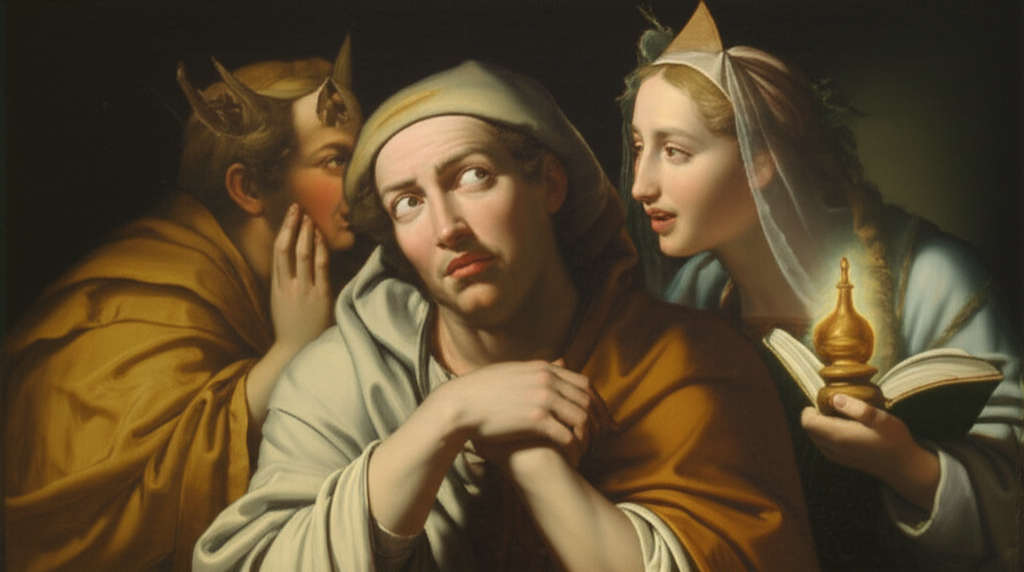
Augustine on the Disordered Will and Concupiscence
Perhaps no thinker has explored the relationship between desire, the Will, and sin with greater depth than St. Augustine of Hippo. In his Confessions and City of God, Augustine posits that sin is fundamentally a turning away from God, the highest good, towards lesser goods. This turning is driven by concupiscence, a disordered form of desire.
Augustine distinguishes between a rightly ordered Will that seeks God and a fallen Will that is enslaved by earthly desires. He argues that humanity's original sin resulted in a fundamental disordering of our desires, making us prone to transgression. The Will, though still free, finds itself weakened and easily swayed by the allure of temporal pleasures and power.
Augustine's Chain of Sin:
- The Allure of a Lesser Good: An object of desire presents itself, promising pleasure or satisfaction.
- The Will's Consent: Instead of directing this desire towards a higher purpose or resisting it, the Will chooses to pursue the lesser good for its own sake, effectively turning away from the greater good (God).
- The Act of Sin: The Will then directs the body or mind to act upon this disordered desire, resulting in a transgression.
For Augustine, the cause of sin is not simply desire itself, but the Will's misdirection of desire, its failure to remain steadfastly oriented towards the divine. This is a profound shift: sin isn't merely an action but a condition of the heart, originating in a disordered love or longing.
The Mechanism of Causation: How Desire Becomes Sin's Root
The journey from a mere desire to an act of sin is a complex interplay of internal faculties. Desire acts as the initial impulse, the spark. However, it requires the Will to fan this spark into a flame of action.
Steps in Desire's Causal Path to Sin:
- Arousal of Desire: An external stimulus or internal thought awakens an appetite or longing (e.g., for food, wealth, power, recognition).
- Consideration by Reason: The rational faculty assesses the desire. Is it good? Is it appropriate? Does it align with moral principles?
- The Will's Deliberation (or Lack Thereof): The Will enters the arena. It can:
- Resist: Choose to deny the desire if it is deemed harmful or immoral.
- Direct: Choose to pursue the desire in a virtuous and balanced way.
- Consent: Choose to succumb to the desire, even if reason warns against it. This is where the cause of sin truly takes root.
- Execution of Action: Once the Will consents, it directs the individual to act upon the desire, leading to the sinful act.
Thus, desire is often the antecedent or instigator, but the Will is the proximate cause of sin. It is the Will's choice to either govern or be governed by desire that determines the moral outcome.
Conclusion: Mastering Desire Through a Rightly Ordered Will
In the grand tapestry of Western thought, the idea of desire as a fundamental cause of sin is a recurring thread, woven through the philosophies of Plato, Aristotle, and most profoundly, Augustine. These thinkers, drawing from the Great Books of the Western World, illuminate a crucial distinction: desire, in its essence, is a neutral force. It is the orientation and governance of desire by the human Will that determines its moral valence.
When our desires are untempered by reason, when the Appetitive part of the soul overwhelms the Rational, or when our Will deliberately turns away from higher goods towards lesser, temporal satisfactions, then desire becomes the fertile ground for transgression. The path to virtue, therefore, lies not in the eradication of desire—an impossible and perhaps undesirable feat—but in its mastery. It is through a disciplined and rightly ordered Will, guided by wisdom and a clear understanding of the good, that humanity can navigate the powerful currents of desire and avoid the pitfalls of sin, striving instead for a life of flourishing and moral rectitude.
📹 Related Video: ARISTOTLE ON: The Nicomachean Ethics
Video by: The School of Life
💡 Want different videos? Search YouTube for: "Augustine on Sin and Free Will"
📹 Related Video: PLATO ON: The Allegory of the Cave
Video by: The School of Life
💡 Want different videos? Search YouTube for: "Plato Tripartite Soul Explained"