

The Enduring Enigma: Defining the One and the Many
A Journey Through Metaphysical Foundations
Summary: The Primal Question of Existence
At the very bedrock of philosophical inquiry lies the profound and persistent question of the One and the Many. This ancient problem, central to Metaphysics, seeks to understand the fundamental relation between unity and plurality, identity and difference, the universal and the particular. Is reality ultimately a single, unified whole, or is it composed of countless distinct entities? How do we reconcile the apparent multiplicity of our experiences with an underlying coherence, or conversely, find unity amidst overwhelming diversity? This article delves into the historical definition of these terms and explores their enduring significance in shaping our understanding of existence itself, drawing deeply from the intellectual currents of the Great Books of the Western World.
Introduction: A Philosophical Crossroads
From the earliest stirrings of systematic thought, philosophers have grappled with the perplexing interplay between what appears to be singular and what appears to be manifold. It is not merely an abstract intellectual exercise; our very perception of the world, our understanding of self, and our attempts to construct coherent systems of knowledge hinge upon how we conceive this fundamental dichotomy. Do we prioritize the unchanging, indivisible One, or the dynamic, diverse Many? The answers, or indeed the very framing of the question, have profound implications for ontology, ethics, and epistemology.
The Ancient Roots: Heraclitus, Parmenides, and the Dawn of Metaphysics
The pre-Socratic thinkers of ancient Greece were among the first to articulate the problem of the One and the Many with striking clarity. Their diverse perspectives laid the groundwork for millennia of philosophical debate.
- Heraclitus of Ephesus (c. 535 – c. 475 BC): The Primacy of the Many
- Famously declared, "Panta rhei" – "Everything flows." For Heraclitus, reality was characterized by constant change, flux, and the dynamic interplay of opposites. The Many was primary; unity was merely a temporary, ever-shifting balance of diverse forces. He saw the world as an eternal fire, always becoming, never static.
- Parmenides of Elea (c. 515 – c. 450 BC): The Indivisible One
- In stark contrast, Parmenides argued for an eternal, unchanging, and indivisible One. Change, motion, and multiplicity were mere illusions of the senses. True Being, accessible only through reason, was singular, complete, and utterly undifferentiated. To speak of "many" was to speak of "not-being," which was logically impossible.
This foundational tension between Heraclitus's world of flux and Parmenides's immutable Being established the central challenge for subsequent philosophers: how to reconcile these seemingly irreconcilable visions.
Plato and Aristotle: Seeking Harmony in Definition and Relation
The towering figures of Plato and Aristotle, both deeply informed by their predecessors, offered sophisticated solutions that continue to resonate today. Their approaches sought to understand the definition and relation between the One and the Many in a more nuanced manner.
Plato's Forms: The One as Archetype
Plato, deeply influenced by Parmenides's emphasis on unchanging truth, proposed his theory of Forms. For Plato:
- The One: Resides in the realm of perfect, eternal, and unchanging Forms (e.g., the Form of Beauty, the Form of Justice, the Form of the Good). These Forms are the ultimate realities, singular and perfect archetypes.
- The Many: Consists of the particular, sensible objects we encounter in the world. These particulars participate in or imitate the Forms. A beautiful flower is beautiful because it participates in the Form of Beauty.
Thus, for Plato, the Many derives its reality and intelligibility from the One (the Forms), establishing a hierarchical relation where the universal (One) is prior to the particular (Many).
Aristotle's Substance: Unity in Diversity
Aristotle, Plato's student, offered a different, more immanent approach. Rejecting the separate realm of Forms, Aristotle located the One and the Many within the concrete world itself.
- The One: For Aristotle, the primary One is the individual substance (e.g., a specific horse, Socrates). Each substance is a unified whole, a combination of form and matter. This individual substance is numerically one.
- The Many: Arises from the various qualities, accidents, and categories that can be predicated of a substance, or from the collection of many individual substances sharing a common form (e.g., "all horses").
Aristotle's Metaphysics sought to understand how unity (the individual substance, its form) could be found within diversity (its matter, its accidents, the plurality of similar substances). He emphasized the concept of potentiality and actuality, showing how a single substance could embody both the potential for many changes and the actuality of its current state.
Defining the Terms: What Do We Mean?
To properly engage with the problem, we must clarify our definition of "One" and "Many." These terms are not as straightforward as they might seem, possessing numerical, ontological, and qualitative dimensions.
| Aspect of Definition | The "One" | The "Many" |
|---|---|---|
| Numerical | A single, indivisible unit (e.g., 1 apple) | A plurality, more than one (e.g., 3 apples) |
| Ontological | A unified being; ultimate reality; a universal | Distinct entities; particulars; diverse phenomena |
| Qualitative | Coherence, identity, simplicity, essence | Difference, distinction, complexity, multiplicity |
| Relational | Source, ground, archetype, unifying principle | Manifestation, instance, participant, diverse parts |
The challenge lies in how these different aspects of the One and the Many interrelate and whether one holds ontological priority over the other. Is the universe a collection of fundamentally separate "ones" that we group into "manys," or is it a fundamental "One" that manifests as "manys"?
The Metaphysical Relation: Unity and Plurality in Reality
The relation between the One and the Many is the very core of Metaphysics. It probes the fundamental structure of reality.
- Monism: Positions that assert the ultimate reality is One. Examples include Parmenides, Spinoza (God or Nature as the single substance), some forms of idealism.
- Pluralism: Positions that assert ultimate reality is Many. Examples include atomists (reality composed of many indivisible particles), some forms of empiricism.
- Dualism: Positions that assert ultimate reality is composed of two fundamental kinds of things (a specific form of pluralism, e.g., mind and body).
The question isn't just about counting. It's about how the One relates to the Many, and vice versa. Is the Many an emanation of the One? Is the One an emergent property of the Many? Or are they co-eternal and interdependent?
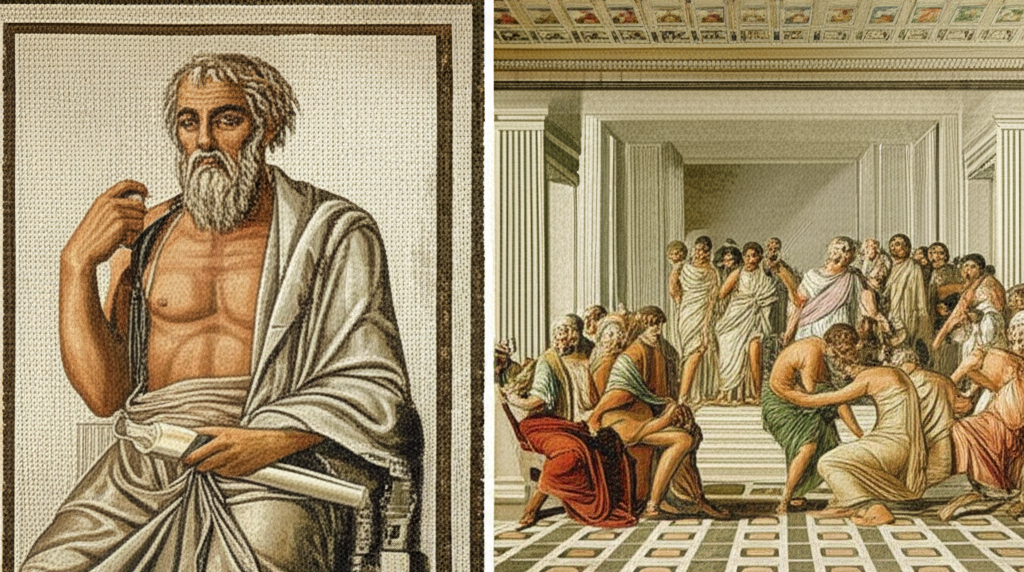 stands in a minimalist, ordered landscape, symbolizing unity and unchanging truth. On the right, a bustling marketplace or a battle scene, filled with multiple, distinct, and dynamic figures, representing diversity, change, and the multitude of particulars. A subtle, intertwining design element connects the two halves, suggesting their inherent relationship.)
Continuing Relevance: Echoes in Modern Thought
The problem of the One and the Many is not confined to ancient texts. It continues to inform contemporary philosophical, scientific, and even theological debates.
- Science: The search for a "theory of everything" (a fundamental One) that explains the diverse phenomena of the universe (Many). The debate between reductionism (explaining complex systems by their simpler parts) and emergentism (new properties arising from complex interactions).
- Mind-Body Problem: Is consciousness a single, unified entity (One) or an emergent property of many neural processes (Many)?
- Ethics and Politics: The tension between individual rights (Many) and the common good (One).
- Identity: How can an individual remain the One self over time, despite the Many changes in their physical and mental states?
These are all modern guises of the same ancient, profound inquiry.
Conclusion: The Unending Dialogue
The problem of Defining the One and the Many remains one of philosophy's most enduring and fertile grounds for exploration. From the stark contrasts of Parmenides and Heraclitus to the sophisticated syntheses of Plato and Aristotle, and through countless subsequent thinkers, the quest to understand the fundamental relation between unity and plurality has driven the very engine of Metaphysics. It reminds us that beneath the surface of our everyday experiences lies a deeper, more profound reality whose structure we are forever compelled to unravel. The Great Books offer not answers, but rather the essential tools and frameworks for continuing this vital, human endeavor.
📹 Related Video: What is Philosophy?
Video by: The School of Life
💡 Want different videos? Search YouTube for: ""Parmenides vs Heraclitus One and Many philosophy""
📹 Related Video: PLATO ON: The Allegory of the Cave
Video by: The School of Life
💡 Want different videos? Search YouTube for: ""Plato's Theory of Forms explained" or "Aristotle Metaphysics Substance""