

Defining the One and the Many
The philosophical problem of the One and Many stands as a foundational question in Metaphysics, probing the very nature of existence. At its core, it asks how unity and multiplicity can coexist, how individual things relate to universal concepts, and whether reality is fundamentally singular or plural. This enduring inquiry, explored by thinkers from the pre-Socratics to contemporary philosophers, seeks to provide a coherent Definition of the world's structure, grappling with the profound Relation between the singular and the composite. Understanding this dilemma is not merely an academic exercise; it's an attempt to grasp the fabric of reality itself.
The Enduring Riddle of Existence: Unpacking the Paradox
From the moment we perceive the world, we are confronted with a paradox: we see individual trees, yet speak of "the forest"; we encounter distinct humans, yet conceive of "humanity." How do these separate entities combine to form a coherent whole, and conversely, how does a whole differentiate into its constituent parts? This is the heart of the One and Many problem. It forces us to question whether reality is fundamentally a unified, indivisible whole, or a collection of discrete, independent elements, and how these seemingly contradictory aspects can be reconciled. The answers, or lack thereof, have shaped entire philosophical systems, influencing our understanding of everything from personal identity to the cosmos.
Ancient Echoes: The Genesis of the Problem
The earliest Western philosophers, whose works are often preserved and analyzed within the Great Books of the Western World, were acutely aware of this tension.
- Parmenides of Elea (c. 5th century BCE) famously argued for the absolute unity of being. For Parmenides, change and multiplicity were illusions of the senses. Reality, "the One," is eternal, unmoving, and indivisible. Any talk of "the Many" was, by his rigorous logic, a contradiction.
- Heraclitus of Ephesus (c. 5th century BCE), in stark contrast, championed the idea of constant flux and change. His famous dictum, "You cannot step into the same river twice," underscored the ceaseless transformation of all things. For Heraclitus, the world was fundamentally "the Many," a dynamic interplay of opposing forces, with unity being merely a temporary, ever-shifting balance.
- Plato, building upon these predecessors, sought to bridge the chasm. His theory of Forms posits an eternal, unchanging realm of perfect, singular Forms (the One) that serve as the archetypes for the imperfect, changing particulars we perceive in the sensory world (the Many). A particular chair (Many) participates in the Form of Chairness (One). This provided a Definition of how the ideal and the material could be related.
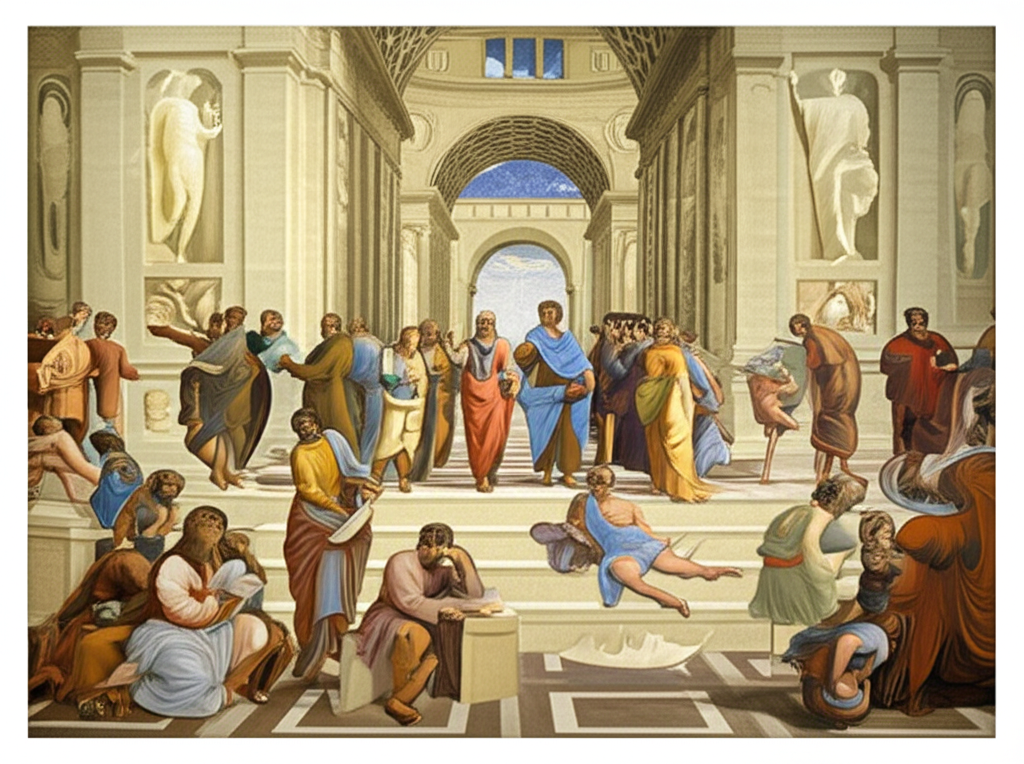
Aristotle's Empiricism: Substance and Predication
Aristotle, Plato's most famous student, offered a different approach, moving the Definition of the One and Many closer to empirical observation. Instead of positing a separate realm of Forms, Aristotle focused on substance as the primary reality.
- Primary Substance: For Aristotle, the individual particular (e.g., this horse, this human) is the primary substance – the fundamental "One." These are the things that exist independently.
- Secondary Substance/Universals: Genera and species (e.g., "horse," "humanity") are secondary substances, existing only in the primary substances. They represent the "Many" aspects or predicates that can be attributed to individual things.
Aristotle's framework provided a powerful way to understand the Relation between individual entities and the universal concepts we use to describe them, rooting the One firmly in the concrete particular and deriving the Many from it.
Medieval and Modern Interpretations: From God to Monads
The problem continued to vex philosophers through the ages:
| Era | Key Philosophical Approaches to the One and Many
- Medieval Philosophers: The problem of universals became central. Are universals (like "horseness") real, existing outside the mind (realism), or merely names/concepts (nominalism/conceptualism)? This deeply affected the Definition of our knowledge and the nature of reality. The concept of God as the ultimate "One" from which all "Many" derive was also a significant theological Relation.
- Early Modern Thought:
- Descartes wrestled with the Relation between the singular, thinking "I" (mind) and the extended, divisible "Many" (body/matter).
- Spinoza proposed a radical monism, arguing that there is only one substance – God or Nature – of which everything else is merely a mode or attribute. Here, "the One" truly subsumes "the Many."
- Leibniz offered a pluralistic view with his monads – simple, indivisible, mind-like substances, each a unique "One" reflecting the entire universe. The challenge then became explaining the apparent unity and harmony among these countless distinct monads.
The Contemporary Conundrum: Metaphysics in a Fragmented World
In the 20th and 21st centuries, the One and Many problem persists, albeit often framed in new terminology, particularly within the realm of Metaphysics and philosophy of science.
- Part-Whole Relations: How do parts constitute a whole? Is a whole merely the sum of its parts, or does it possess emergent properties? This is crucial for understanding complex systems in biology, physics, and social sciences.
- Identity and Individuation: What makes a particular object or person one distinct entity, and how does it maintain its identity over time despite changes in its "Many" properties or parts?
- Composition and Mereology: These fields of Metaphysics directly study the Relation between parts and wholes, attempting to provide a rigorous logical and ontological Definition of how things compose other things.
The rise of quantum mechanics, with its wave-particle duality and entanglement, also presents fascinating new dimensions to the One and Many, blurring the lines between discrete entities and interconnected fields.
The Enduring Significance of the Relation
Why does this ancient problem continue to matter? Because every attempt to provide a Definition for the One and Many is an attempt to define reality itself.
- It shapes our understanding of causality: Does a singular cause produce a singular effect, or a multitude of effects?
- It impacts our epistemology: How can we know universal truths if we only experience particulars, and vice-versa?
- It influences our ethics: Are we fundamentally individual agents, or inextricably linked parts of a larger collective?
The philosophical journey through the One and Many is a testament to humanity's relentless pursuit of coherence in a world that often appears contradictory. It's about finding the underlying order, or accepting the beautiful chaos, of existence.
An Unending Inquiry
Ultimately, "Defining the One and the Many" is not about finding a single, definitive answer, but about appreciating the depth and complexity of the question itself. It is a fundamental Metaphysics problem that compels us to scrutinize our assumptions about unity, diversity, identity, and Relation. As we navigate the world, we are constantly, perhaps unconsciously, making choices about how we frame the interplay between the singular and the plural. This ancient philosophical riddle remains as vibrant and essential as ever, reminding us that the deepest questions often have the most profound implications.
YouTube Video Suggestions:
-
📹 Related Video: What is Philosophy?
Video by: The School of Life
💡 Want different videos? Search YouTube for: ""The Problem of the One and the Many Philosophy Explained""
-
📹 Related Video: PLATO ON: The Allegory of the Cave
Video by: The School of Life
💡 Want different videos? Search YouTube for: ""Plato Theory of Forms vs Aristotle Metaphysics Universals""