

Defining Beauty in Abstract Art: A Philosophical Inquiry
The quest to define beauty has occupied philosophers for millennia, yet the advent of abstract art presents a unique and compelling challenge to our traditional aesthetic frameworks. This article explores how abstract art compels us to re-evaluate our understanding of beauty, pushing beyond mimetic representation to find aesthetic value in pure form, line, color, and composition. We will delve into philosophical perspectives, drawing from the wisdom contained within the Great Books of the Western World, to navigate the complexities of defining beauty when the subject matter itself is absent, leaving us with an appreciation for the intrinsic qualities of art itself.
The Elusive Nature of Beauty: A Modern Conundrum
For centuries, our understanding of beauty in art was often tethered to concepts of mimesis—the accurate representation of nature or an idealized human form. Symmetry, proportion, and recognizable narrative were hallmarks of what was deemed beautiful. However, abstract art, with its deliberate departure from objective reality, shatters these conventions. It forces us to ask: If there is no discernible object to admire, where does the beauty lie? This profound shift demands a philosophical definition that transcends mere imitation, inviting us to explore the inherent aesthetic power of form.
Challenging Traditional Definitions of Beauty
Abstract art fundamentally reorients our perception. Here are some ways it challenges established notions:
- Absence of Recognizable Subject: Unlike representational art, abstract works do not depict people, landscapes, or objects, removing a common anchor for aesthetic judgment.
- Emphasis on Pure Form: Beauty is found in the arrangement of lines, shapes, colors, and textures, rather than in what these elements represent.
- Subjective Interpretation: Viewers are often left to derive personal meaning and emotional response, making the experience of beauty highly individualized.
- Focus on the Artist's Inner World: Abstract art can be seen as an expression of internal states, emotions, or philosophical concepts, rather than external reality.
I. Echoes of Ancient Forms: Beauty Beyond Representation
Even as abstract art seems utterly modern, its roots can be traced back to ancient philosophical inquiries into beauty and form. Plato, in works like the Symposium and Republic, posits that true beauty resides not in earthly objects, which are mere shadows, but in the eternal, unchanging Forms themselves. Could abstract art, by stripping away the particular, somehow gesture towards these universal Forms of harmony, balance, or order?
Aristotle, while valuing mimesis, also emphasized the importance of order, symmetry, and definiteness in beautiful objects (as discussed in Poetics and Metaphysics). In abstract art, while the subject is absent, these principles of order and spatial relationships remain paramount. A well-composed abstract piece still exhibits internal coherence, a deliberate arrangement of elements that, through their form, achieve a kind of visual equilibrium. The beauty, then, might be in the structure itself, the inherent logic of its visual organization.
II. The Subjective Turn: Kant and the Aesthetic Judgment
The Enlightenment philosopher Immanuel Kant, in his Critique of Judgment, offered a pivotal definition of beauty as a "disinterested pleasure." For Kant, our judgment of beauty is not based on a concept or a practical interest, but on a free play of our cognitive faculties. This perspective is particularly pertinent to abstract art. When we encounter a Rothko or a Mondrian, we are not judging its accuracy or its utility, but rather experiencing a pure, contemplative pleasure derived from its form and color.
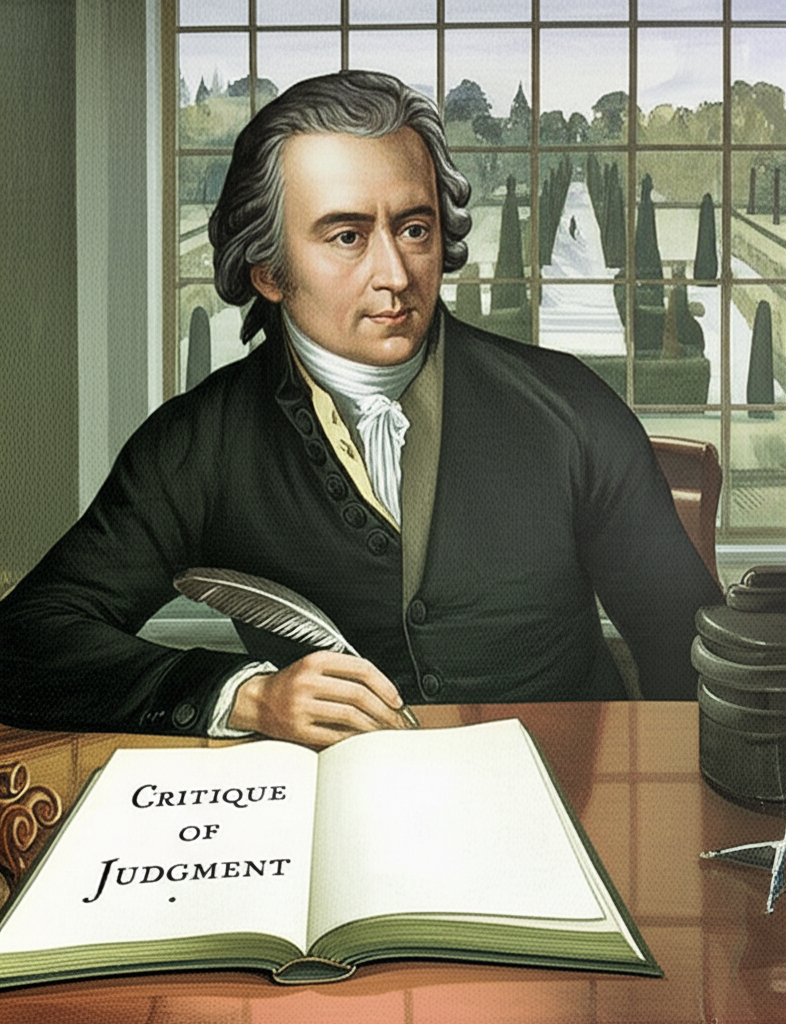
Kant suggests that while the judgment of beauty is subjective, it nonetheless carries a "claim to universal validity." When we say something is beautiful, we expect others to agree, even if we cannot prove it conceptually. Abstract art often evokes precisely this: a deeply personal response that feels, for the individual, universally valid, compelling them to share their experience of its beauty.
III. Hegel's Idea and the Evolution of Artistic Expression
Georg Wilhelm Friedrich Hegel, a towering figure in idealism, viewed art as the sensible manifestation of the Absolute Idea. In his Aesthetics, he proposed a historical progression of art forms, moving from symbolic to classical to romantic. One might interpret abstract art as a further evolution, where the Idea seeks expression in increasingly less concrete, more purely conceptual or emotional forms.
For Hegel, beauty is the shining of the Idea through its material manifestation. Abstract art, by shedding external representation, might be seen as an attempt to reveal the Idea more directly, through the raw power of form and color, rather than through a mediated image. The definition of beauty, in this light, becomes dynamic, adapting as human consciousness and its artistic expressions evolve.
IV. Deconstructing Form: The Language of Abstract Beauty
If beauty in abstract art isn't about what it depicts, then it must be about how it's depicted. Here, form becomes the primary language. The interplay of line, shape, color, texture, and composition are not merely incidental; they are the art.
- Line: Can convey energy, tension, calm, or direction.
- Shape: Geometric or organic, evoking stability, dynamism, or fluidity.
- Color: Evokes emotion, creates depth, or establishes mood.
- Texture: Adds tactile interest and visual weight.
- Composition: The arrangement of all elements, creating balance, imbalance, rhythm, or harmony.
It is through the masterful manipulation of these elements that abstract artists construct their visual arguments, inviting the viewer to engage with the form directly. The beauty emerges from this engagement, from the successful communication of an aesthetic experience through non-representational means.
V. The Challenge of Definition: A Pluralistic Perspective
Ultimately, arriving at a singular, universally accepted definition of beauty in abstract art may be as elusive as defining beauty itself. Perhaps its very strength lies in its resistance to rigid categorization. Abstract art demands a pluralistic approach, one that acknowledges the subjective experience of the viewer, the philosophical underpinnings of form, and the evolving nature of art itself.
The beauty in abstract art is not a static quality to be discovered, but an active process of perception and interpretation. It invites us to:
- Feel: Respond emotionally to color and texture.
- Think: Ponder the spatial relationships and compositional choices.
- Connect: Find personal meaning in non-representational forms.
This ongoing dialogue between artwork and observer is where its profound beauty often resides.
Conclusion: An Ever-Unfolding Canvas
Defining beauty in abstract art is not a matter of finding a simple answer, but rather of embarking on a richer philosophical journey. It compels us to look beyond the superficial, to engage with form as a carrier of meaning and emotion, and to reconsider our deepest assumptions about art itself. The Great Books of the Western World provide the foundational tools for this inquiry, reminding us that the conversation about beauty is as timeless as it is ever-evolving. Abstract art ensures that this canvas of philosophical exploration remains vibrant, challenging, and endlessly beautiful.
YouTube Video Suggestions:
-
📹 Related Video: KANT ON: What is Enlightenment?
Video by: The School of Life
💡 Want different videos? Search YouTube for: ""Kant's Aesthetics and the Judgment of Taste Explained""
2. ## 📹 Related Video: PLATO ON: The Allegory of the Cave
Video by: The School of Life
💡 Want different videos? Search YouTube for: ""Plato's Theory of Forms Explained Visually""