

Defining Beauty in Abstract Art: A Shifting Canvas of Perception
The pursuit of Beauty has captivated philosophers and artists for millennia, often serving as a cornerstone of aesthetic Definition. Yet, when confronted with the boundless realm of Abstract Art, our inherited notions of what constitutes the beautiful are profoundly challenged, compelling us to re-evaluate the very essence of Form and meaning. This article delves into the intricate task of defining beauty within the non-representational, exploring how abstract works compel us to transcend conventional frameworks and embrace a more expansive, subjective, and intellectually engaging appreciation. We shall see that beauty in abstraction is not merely found but actively constructed, a dynamic interplay between the Art itself, the artist's intention, and the viewer's contemplative engagement.
The Enduring Quest for Beauty's Definition
For centuries, the Definition of Beauty in Art was largely tethered to principles of harmony, proportion, and mimesis – the faithful imitation of nature. Philosophers from Plato, who posited an ideal Form of Beauty existing independently of the physical world, to Aristotle, who considered Art beautiful when it skillfully represented reality, laid the groundwork for an aesthetic tradition deeply rooted in objective criteria. The Great Books of the Western World are replete with treatises that laud symmetry, balance, and the accurate portrayal of the human Form or natural landscape as hallmarks of artistic excellence.
However, the advent of Abstract Art in the early 20th century shattered these established paradigms. Suddenly, canvases no longer sought to mirror the visible world. Lines, colors, and shapes asserted their independence, demanding that we look at them rather than through them to a recognizable subject. This radical departure necessitated a fundamental re-evaluation: if beauty was no longer found in perfect resemblance, where then did it reside?
Abstract Art's Challenge to Conventional Form
The initial encounter with Abstract Art can be disorienting precisely because it strips away familiar Forms. There is no landscape to identify, no portrait to recognize, no narrative to follow in a traditional sense. This absence forces the viewer to confront the raw elements of Art itself: the texture of the paint, the vibrance of a color field, the tension of intersecting lines, the rhythm of a composition.
- Breaking the Mimetic Chain: Abstract artists deliberately moved away from representation, arguing that Art could express deeper truths or evoke purer emotions without the mediation of recognizable objects. This wasn't a rejection of Beauty, but rather a rejection of a narrow Definition of it.
- Emphasis on Internal Logic: The beauty in an abstract piece often lies in its internal coherence, its self-referential structure. The Form is not derived from external reality but from the artist's intuitive or intellectual organization of elements.
Redefining Beauty: New Dimensions in Abstraction
To truly appreciate Beauty in Abstract Art, we must expand our aesthetic vocabulary. It is here that the subjective experience gains paramount importance, yet it is not without its own internal logic and shared human responses.
Here are some dimensions through which beauty in abstract art can be understood:
- Emotional Resonance: Abstract works can evoke powerful feelings – joy, melancholy, serenity, agitation – through color, movement, and composition, bypassing the intellectual interpretation of a narrative. The Beauty lies in the sheer power of this emotional connection.
- Intellectual Stimulation: The challenge of "understanding" an abstract piece can be a source of Beauty itself. The mind grapples with the arrangement, seeking patterns, rhythms, and relationships, leading to a profound intellectual satisfaction.
- Sensory Experience: The pure visual pleasure derived from color harmonies, textural richness, dynamic lines, and the interplay of light and shadow often forms the core of an abstract work's Beauty. It appeals directly to our visual and haptic senses.
- The Artist's Intent and Process: Understanding the philosophical underpinnings or the creative process behind an abstract work can deepen its Definition of Beauty. The artist's courage to innovate, their mastery of materials, or the purity of their vision can be profoundly beautiful.
- The Viewer's Subjective Interpretation: Perhaps most critically, Beauty in abstract Art is often a co-creation. The viewer brings their own experiences, emotions, and intellectual frameworks to the piece, completing its meaning and finding personal resonance.
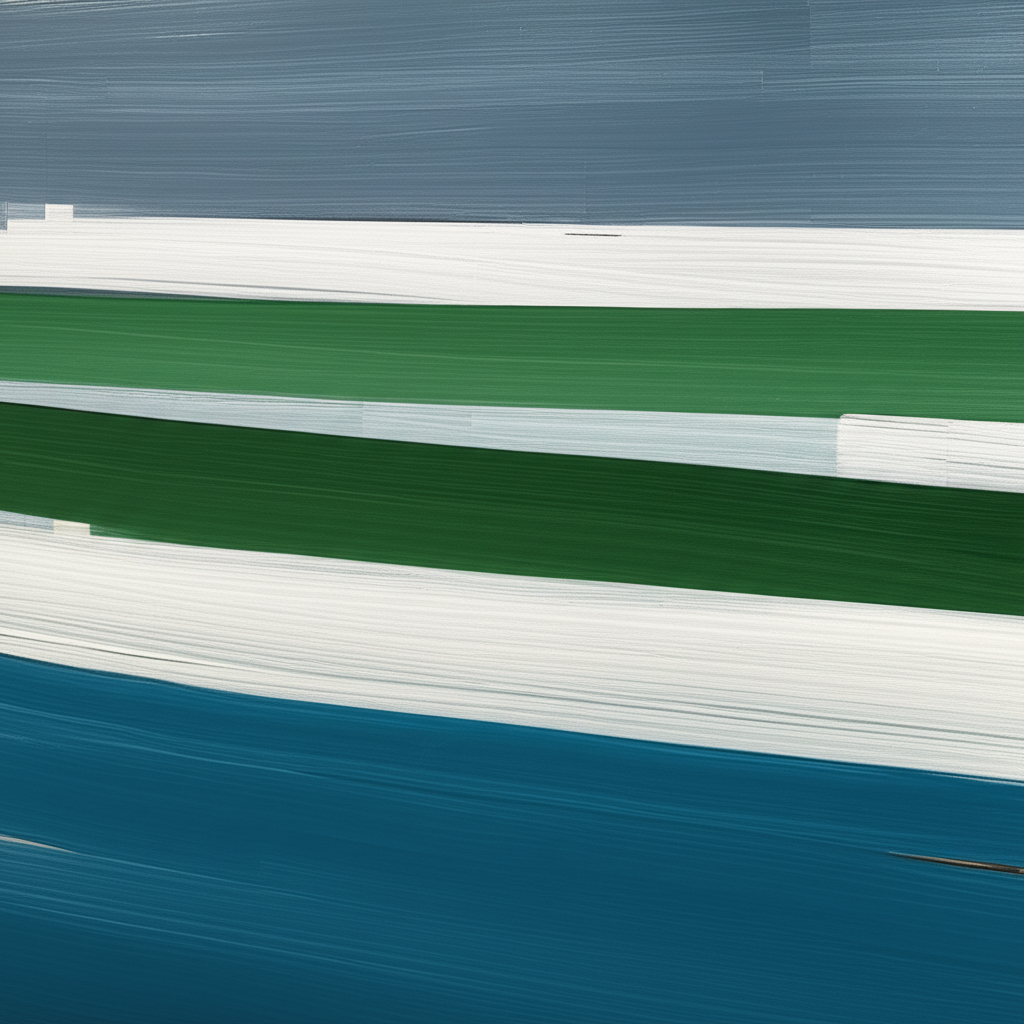 " from 1957. The image focuses on the subtle, luminous interaction of the soft-edged rectangular color fields. One can discern the delicate layering of paint, the faint brushstrokes, and the slight bleeding of colors at their indistinct boundaries, creating a profound sense of atmospheric depth and quiet contemplation. The greens appear to glow against the deeper blue, while hints of white provide an ethereal lift, inviting a meditative engagement with color and light.)
The Enduring Significance of Form in Abstract Beauty
Even in the most non-objective Art, Form remains crucial, though its Definition has evolved. It is no longer about replicating a pre-existing Form, but about creating new ones, or revealing the inherent Forms within the artistic elements themselves.
- Composition as Form: The arrangement of elements – lines, shapes, colors – creates a new kind of Form. The balance, tension, rhythm, and overall structure of an abstract painting or sculpture are its Form, and its Beauty can be found in the elegance or power of this composition.
- The Form of Expression: In abstract expressionism, for instance, the Form often lies in the gesture, the raw energy, or the emotional outpouring of the artist. The beauty is in the unmediated expression itself.
Ultimately, defining Beauty in Abstract Art is not about finding a single, universal rule, but about acknowledging a spectrum of aesthetic experiences. It challenges us to look beyond the immediate and the recognizable, to engage with the Art on its own terms, and to discover Beauty in the interplay of pure Form, color, texture, and the profound depths of human perception and emotion. It is a testament to the enduring power of Art to continually redefine our understanding of what it means to be beautiful.
YouTube Video Suggestions:
- YouTube: "What is Abstract Art? The Philosophy of Non-Objective Painting"
- YouTube: "Plato, Aristotle, and Kant on Beauty: Crash Course Philosophy"
📹 Related Video: What is Philosophy?
Video by: The School of Life
💡 Want different videos? Search YouTube for: "Defining Beauty in Abstract Art philosophy"