

Defining Beauty in Abstract Art
Summary:
The concept of Beauty, long considered a cornerstone of aesthetic judgment, faces its most profound challenge in the realm of Abstract Art. Where classical Art often sought to mirror an ideal Form or harmonious proportion, abstract works deliberately eschew representational fidelity, compelling us to reconsider our very Definition of what makes something beautiful. This article delves into the philosophical journey of understanding Beauty when the familiar anchors of imitation and discernible subject matter are removed, exploring how Form, emotion, and intellectual engagement become the new frontiers of aesthetic appreciation.
The Elusive Nature of Beauty: From Mimesis to Modernity
For centuries, the Definition of Beauty in Art was tethered to discernible qualities: symmetry, proportion, harmony, and a faithful, often idealized, representation of reality. Thinkers from Plato, with his emphasis on the eternal Forms, to Aristotle, who explored the principles of mimesis and catharsis, laid foundations that suggested Beauty resided in an artwork's ability to reveal an underlying order or truth. Classical sculptures, Renaissance paintings—these works often derived their aesthetic power from their mastery of naturalistic Form and their alignment with established ideals of human and divine perfection.
However, the dawn of the 20th century, with its radical shifts in philosophy, science, and societal structure, ushered in a revolutionary approach to Art: abstraction. Artists began to dismantle the traditional reliance on objective representation, opting instead for a language of color, line, shape, and texture. This paradigm shift left many viewers and critics grappling with a fundamental question: if Art no longer imitates, where does its Beauty reside? The conventional Definitions seemed suddenly inadequate, forcing a re-evaluation of aesthetic principles themselves.
Abstract Art and the Redefinition of Form
Abstract Art does not abandon Form; rather, it redefines it. Instead of depicting the Form of a human figure or a landscape, it presents Form for its own sake. A vibrant splash of color, a jagged line, a swirling vortex of shapes – these elements become the primary conveyors of meaning and aesthetic appeal. The Beauty here is often found in the interplay of these non-representational elements, in their composition, their tension, their balance, or their deliberate imbalance.
Consider the work of a Rothko or a Kandinsky. Their canvases do not show us a "beautiful" object in the traditional sense, but rather invite us into a direct experience of color and Form. The viewer is no longer merely recognizing a depicted reality but is instead immersed in a sensory and emotional landscape. This requires a different mode of engagement, one that moves beyond intellectual identification to a more intuitive, perhaps even spiritual, resonance.
Key Characteristics of Beauty in Abstract Form:
- Compositional Harmony/Discord: The arrangement of elements, even if non-representational, can evoke a sense of balance or dynamic tension.
- Color Theory: The emotional and psychological impact of colors, their saturation, hue, and juxtaposition.
- Texture and Surface: The tactile qualities of the paint, the brushstrokes, or the medium itself.
- Expressive Line and Shape: The energy, movement, or stillness conveyed by lines and geometric or organic shapes.
- Intellectual Engagement: The challenge or stimulation provided by the work, prompting new ways of seeing or thinking.
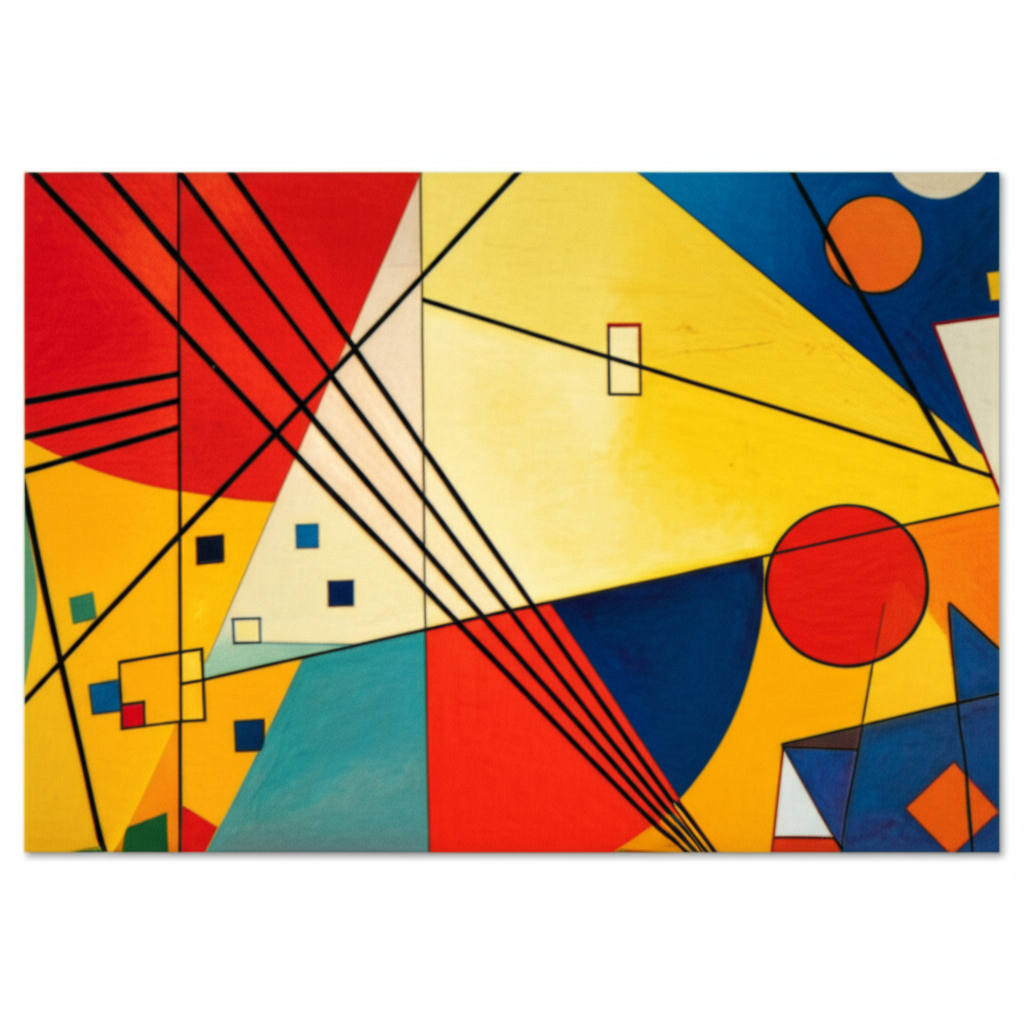 , and a dynamic use of primary and secondary colors against a light background, highlighting the intricate balance of forms and the energetic composition without depicting any recognizable object.)
Finding Beauty Beyond Representation: A Subjective and Objective Dialogue
The perception of Beauty in abstract Art often oscillates between the subjective and the objective. Immanuel Kant, in his Critique of Judgment, posited that aesthetic judgment, while subjective, aims at a kind of universal validity, suggesting a "disinterested pleasure" that is not contingent on personal desire or the utility of the object. In abstract Art, this "disinterestedness" might find its purest expression. We are not judging the accuracy of a portrayal, but the intrinsic qualities of the Art itself—its Form, its color, its composition—and the feelings or thoughts it evokes.
However, the subjective experience remains paramount. What one person finds beautiful in a chaotic splattering of paint, another might dismiss as meaningless. This divergence highlights the ongoing philosophical debate: Is Beauty an inherent quality of the object, or is it entirely "in the eye of the beholder"? In abstract Art, the dialogue between the artwork's inherent Form and the viewer's interpretation becomes particularly rich and complex. The Art serves as a catalyst, prompting an internal experience that defines Beauty for that individual in that moment.
The Philosophical Nexus of Beauty and Art: A Continuous Definition
Ultimately, defining Beauty in abstract Art is not about finding a new, rigid set of rules, but about expanding our understanding of Beauty itself. It pushes us beyond the comfortable confines of traditional aesthetics and into a realm where Beauty can be found in the raw expression, the bold experiment, the emotional resonance, or the sheer intellectual daring of the artist.
The "Great Books" tradition teaches us to question, to analyze, and to seek deeper truths. Abstract Art, in its deliberate ambiguity and refusal to conform, serves as a powerful philosophical tool, compelling us to:
- Re-evaluate our preconceived notions of Beauty: Challenging us to look beyond superficial appearances.
- Engage with Form on a fundamental level: Appreciating the elements of Art for their intrinsic qualities, not just their depictive power.
- Explore the interplay between emotion and intellect: Recognizing how abstract Art can stir feelings without explicit narrative.
- Acknowledge the role of interpretation: Understanding that the viewer is an active participant in the creation of meaning and Beauty.
In this light, abstract Art does not negate Beauty; it liberates it, revealing that Beauty is not solely a property of ideal representation but a dynamic, multifaceted concept that continually evolves with human perception and artistic expression. It forces us to acknowledge that the Definition of Beauty in Art is an ongoing philosophical inquiry, forever open to new interpretations and profound discoveries.
📹 Related Video: PLATO ON: The Allegory of the Cave
Video by: The School of Life
💡 Want different videos? Search YouTube for: ""Kandinsky abstract art meaning" for an exploration of the philosophical underpinnings of early abstract art."
📹 Related Video: KANT ON: What is Enlightenment?
Video by: The School of Life
💡 Want different videos? Search YouTube for: ""Kant's Aesthetics Explained" for a discussion on disinterested judgment and the sublime in philosophical aesthetics."