

Christ Makes Good Cookie
Possession is Critical for Mass
Setting: A tranquil, boundless space, bathed in a soft, internal light. Three figures sit in comfortable chairs: SOPHIA, the timeless embodiment of wisdom, JOHN, a thoughtful man with a clear, analytical gaze, and SCOTT, whose eyes hold a restless, creative fire.
Sophia: Gentlemen, let us consider a proposition together. I have been contemplating a principle that seems to govern both the mind and the world: Possession is Critical for Mass. What does that stir in you, John?
Reading furnishes the mind only with materials of knowledge; it is thinking that makes what we read ours.
— John Locke (1632-1704)
John: It resonates deeply, Sophia. I have long held that the mind can be much like a vast library, filled to the rafters with books. A person can spend a lifetime acquiring volumes, lining every shelf with the works of others. But this collection, however impressive, is merely a storehouse of materials. The wood, stone, and glass are all there, but no house has been built. They remain foreign objects on a shelf.
Sophia: So, the simple act of gathering information does not grant ownership?
John: Precisely. The materials of knowledge are inert until they are acted upon. It is the quiet, deliberate work of contemplation—of turning an idea over and over, of testing its strength and finding its place among the other things one knows—that forges it into a part of the self. That is the moment of true possession. Until you have engaged in that internal labor, the knowledge is not truly yours. It is merely borrowed lumber.
Scott: (Nodding, a wry smile on his face) And a house built of borrowed lumber is just a temporary shelter, not a home. I see this from the other side of the process, not the taking in, but the putting out.
Sophia: Please, elaborate, Scott.
Scott: People often mistake the reason for creation. They believe they must build something—a story, a novel—and so they go searching for materials, for something to say. They scavenge for emotions and ideas, hoping to assemble them into a meaningful structure. But that is simply decoration. It lacks… weight. It has no core.
Sophia: Because it is not truly possessed?
Scott: Exactly. The drive to write, to truly create, does not come from a desire to find a voice. It comes from the overwhelming, undeniable fact that you are already full of something that is demanding release. It is a pressure from within. The story exists inside you, fully formed in its essence, long before you set the first word to paper. The writing is not an act of invention, but of transcription. It is the necessary release of something that has already become so much a part of you that its silence is an impossibility.
You don't write because you want to say something; you write because you have something to say.
— F. Scott Fitzgerald (1896-1940)
Sophia: (Smiling, she brings her hands together) And here, we find the beautiful synthesis. John, you describe the process by which we create internal mass. Through the labor of thinking, we transform the external 'material' of knowledge into the internal 'substance' of understanding. We take possession of it, and in doing so, we give it weight within ourselves.
She turns her gaze to Scott.
Sophia: And Scott, you describe the consequence of that mass reaching a critical point. When the substance of an idea, a truth, or a story becomes so dense within a person, it develops its own gravity. It can no longer be contained. It exerts a force, demanding expression. It is no longer a choice to say something; it becomes a necessity because you are something.
John: So my act of thinking is not just for comprehension, but for the forging of this internal substance.
Scott: And my art is not an act of will, but an unavoidable consequence of the weight carried within.
Sophia: Precisely. A thought, an idea, or a work of art that lacks this genuine possession is hollow. It is massless. It drifts without impact. But one that is born of this internal gravity can bend the light around it. It can change minds, shape cultures, and endure through time. This is why possession is the essential prerequisite for mass. First, you must make it your own. Only then can it truly matter.
The planksip Writers' Cooperative is proud to sponsor an exciting article rewriting competition where you can win part of over $750,000 in available prize money.
Figures of Speech Collection Personified
Our editorial instructions for your contest submission are simple: incorporate the quotes and imagery from the above article into your submission.
What emerges is entirely up to you!
Winners receive $500 per winning entry multiplied by the article's featured quotes. Our largest prize is $8,000 for rewriting the following article;
 Heraclitus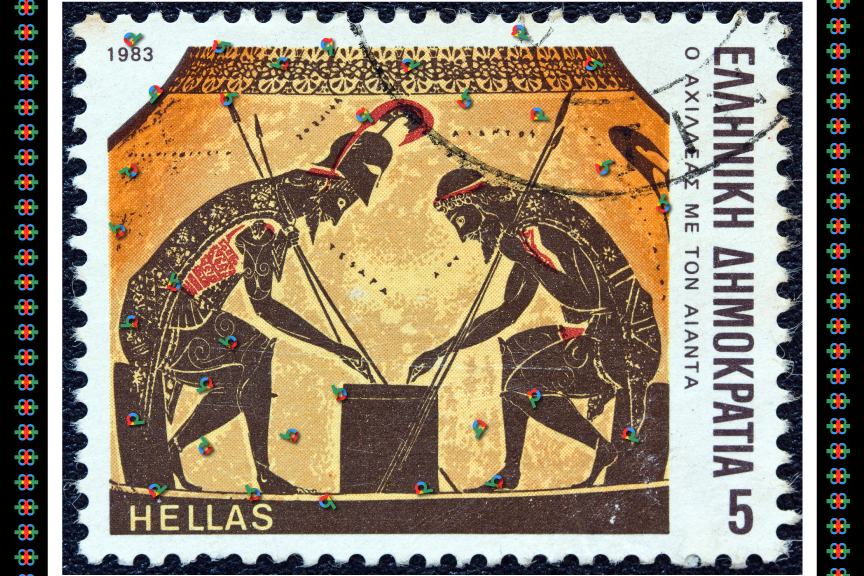
At planksip, we believe in changing the way people engage—at least, that's the Idea (ἰδέα). By becoming a member of our thought-provoking community, you'll have the chance to win incredible prizes and access our extensive network of media outlets, which will amplify your voice as a thought leader. Your membership truly matters!