

The Unseen Threads: Causality in Physics and Metaphysics
Unraveling the Fundamental Link Between Events
From the smallest subatomic flutter to the grandest cosmic dance, our universe is a tapestry woven with causes and effects. But what exactly is a cause? Is it merely a predictable sequence of events, or does it imply a deeper, perhaps even necessary, connection? This article delves into the profound concept of causality, exploring its distinct interpretations within the rigorous frameworks of physics and the speculative realms of metaphysics. We'll journey through scientific laws and philosophical debates, examining how thinkers have grappled with the notions of necessity and contingency in the causal chain, ultimately revealing the multifaceted nature of this cornerstone of understanding.
Understanding the Causal Impulse
At its heart, causality is the relationship between an event (the cause) and a second event (the effect), where the second event is understood as a consequence of the first. It's a concept so fundamental that we rarely pause to question it in our daily lives. Drop a glass, and it breaks – a clear cause and effect. But when we peer closer, through the lenses of scientific inquiry and philosophical reflection, the simplicity dissolves into a fascinating complexity.
The Scientific Lens: Causality in Physics
In the realm of physics, causality is often approached with a focus on predictability, reproducible phenomena, and the formulation of universal laws. Here, a cause is typically an antecedent event or condition that, under specific circumstances, reliably leads to a consequent effect.
From Classical Determinism to Quantum Uncertainty
- Newtonian Mechanics: For centuries, classical physics championed a largely deterministic view. Isaac Newton's laws of motion and universal gravitation described a universe where every event was the inevitable outcome of prior conditions. If one knew the initial state of a system, its future could, in principle, be perfectly predicted. The cause here is the force applied, the initial velocity, the mass – all quantifiable factors leading to a precise effect. This perspective fostered a strong sense of necessity in the causal chain; given the cause, the effect must follow.
- Thermodynamics and Statistical Mechanics: While still deterministic at a fundamental level, the introduction of thermodynamics brought concepts like entropy, where predicting individual particle behavior becomes impossible. Here, causality shifts to statistical probabilities and macroscopic laws governing averages. The cause might be a temperature difference, leading to the effect of heat transfer, but the exact path of every molecule is not determined.
- Quantum Mechanics: The 20th century shattered the classical deterministic dream. Quantum mechanics, particularly interpretations like the Copenhagen interpretation, introduced inherent randomness. Events at the subatomic level, such as radioactive decay or the precise moment an electron jumps energy levels, are often described as probabilistic, not strictly determined by prior causes. While the probability of an event can be calculated (a form of cause), the event itself appears contingent – it might happen, or it might not, even with all preceding conditions identical. This challenged the very notion of a strictly necessary causal link in the fundamental fabric of reality.
Key Characteristics of Causality in Physics:
- Temporal Precedence: The cause generally precedes the effect in time.
- Contiguity: Causes and effects are often spatially or temporally linked (though fields and quantum entanglement complicate this).
- Reproducibility: A given cause should reliably produce the same effect under the same conditions.
- Laws and Equations: Causality is often expressed through mathematical laws that describe relationships between physical quantities.
The Philosophical Depths: Causality in Metaphysics
While physics seeks to describe how things happen, metaphysics probes the deeper question of what causality fundamentally is. It explores the nature of the connection between cause and effect, asking whether it is an inherent feature of reality or a construct of our minds.
Aristotle's Four Causes: A Foundational Framework
One of the earliest and most enduring metaphysical analyses of cause comes from Aristotle, whose framework remains profoundly influential. He identified four types of causes, offering a comprehensive way to understand why anything exists or changes:
- Material Cause: That out of which a thing comes to be and which persists. (e.g., the bronze of a statue)
- Formal Cause: The form or the archetype; that is, the statement of the essence, and the genera of that essence. (e.g., the shape of the statue, its design)
- Efficient Cause: The primary source of the change or rest. (e.g., the sculptor who makes the statue)
- Final Cause: The end, that for the sake of which a thing is done. (e.g., the purpose of the statue – to honor a hero, to be beautiful)
Aristotle's system highlights that understanding an event or object requires looking beyond just the immediate "trigger" (efficient cause) to its underlying substance, form, and purpose. This holistic view offers a rich tapestry for philosophical inquiry into the nature of being and becoming.
Hume's Skeptical Challenge: Constant Conjunction
Centuries later, David Hume, a giant of Enlightenment philosophy, launched a radical critique of causality. He argued that we never actually perceive a necessary connection between cause and effect. What we observe, he claimed, is merely:
- Contiguity: The cause and effect are close in space and time.
- Temporal Priority: The cause always comes before the effect.
- Constant Conjunction: The same cause is always followed by the same effect.
From repeated observations of constant conjunction, Hume argued, our minds develop a habit or expectation that the effect will follow the cause. But this expectation, he maintained, is a psychological phenomenon, not an inherent feature of reality. He famously stated that "all events seem entirely loose and separate." For Hume, the idea of necessity in causality is a human projection, not an empirical truth. This profoundly challenged the metaphysical underpinnings of scientific certainty.
Kant's Transcendental Response: Causality as a Category of Understanding
Immanuel Kant, deeply influenced by Hume, sought to rescue causality from pure skepticism. He agreed with Hume that we don't empirically perceive necessity. However, Kant argued that causality is not merely a psychological habit, but a fundamental category of understanding – an innate structure of the human mind that we impose on our experience to make sense of the world.
For Kant, we cannot but perceive the world causally. The mind actively organizes raw sensory data into a coherent experience, and the principle of cause and effect is one of the essential tools it uses. Therefore, causality is objectively valid for all human experience, even if it doesn't describe an "in-itself" reality independent of our minds. This restores a form of necessity to causality, not as an external force, but as an indispensable condition for our knowledge of the world.
Causality: Physics vs. Metaphysics
Let's summarize the distinct, yet often intersecting, approaches:
| Feature | Causality in Physics | Causality in Metaphysics |
|---|---|---|
| Primary Focus | Prediction, explanation of how events occur. | Nature of the connection, what causality fundamentally is. |
| Methodology | Empirical observation, experimentation, mathematical laws. | Conceptual analysis, logical argumentation, thought experiments. |
| "Cause" Defined as | Antecedent event/condition reliably leading to an effect. | Deeper philosophical relations (e.g., Aristotle's causes), or a mental construct (e.g., Hume, Kant). |
| Role of Necessity | Often assumed in classical models; challenged by quantum. | Central debate: Is the connection inherently necessary (rationalists) or merely contingent (empiricists)? |
| Ultimate Goal | To build predictive models and technological applications. | To understand the fundamental structure of reality and human knowledge. |
Necessity and Contingency: The Philosophical Stakes
The distinction between necessity and contingency is crucial in understanding causality.
- Necessity: An event is necessary if it must happen, given its causes. There is no other possibility. (e.g., 2+2 necessarily equals 4; an unsupported object necessarily falls due to gravity in a vacuum).
- Contingency: An event is contingent if it might happen, or it might not, even with the same preceding conditions. Its occurrence is not inevitable. (e.g., you contingently chose to read this article; a coin flip contingently lands on heads).
The debate over whether causal connections are necessary or contingent has profound implications:
- Free Will: If all actions are causally necessary, dictated by prior events, how can we have free will?
- Moral Responsibility: Can we be held morally responsible for actions if they were necessary outcomes?
- The Nature of Reality: Is the universe a deterministic machine, or does it contain genuine possibilities and open futures?
- Scientific Laws: Are scientific laws descriptions of necessary connections, or merely highly probable regularities?
Bridging the Divide?
While physics and metaphysics approach causality from different angles, they are not entirely separate. Physics relies on metaphysical assumptions (e.g., the existence of an ordered, intelligible universe), and metaphysical theories must ultimately account for scientific observations.
Many contemporary philosophers of science seek to integrate these perspectives, exploring how quantum indeterminacy impacts our understanding of free will, or how our cognitive structures (as Kant suggested) shape our scientific theories. The ongoing dialogue reminds us that the question of cause is not just about understanding events, but about understanding our place within the grand unfolding of existence.
Conclusion: The Enduring Mystery of the Link
The concept of causality remains one of the most intellectually stimulating and challenging topics in both physics and metaphysics. From Aristotle's comprehensive framework to Hume's penetrating skepticism and Kant's transcendental synthesis, thinkers have endlessly grappled with the nature of the link between events. Whether we view causes as necessary physical antecedents, fundamental ontological principles, or even categories of our own understanding, the quest to comprehend the unseen threads that weave our reality continues to drive both scientific discovery and philosophical introspection. It is a testament to the depth of this concept that, even in our technologically advanced age, the simple question "why?" still opens doors to the most profound inquiries.
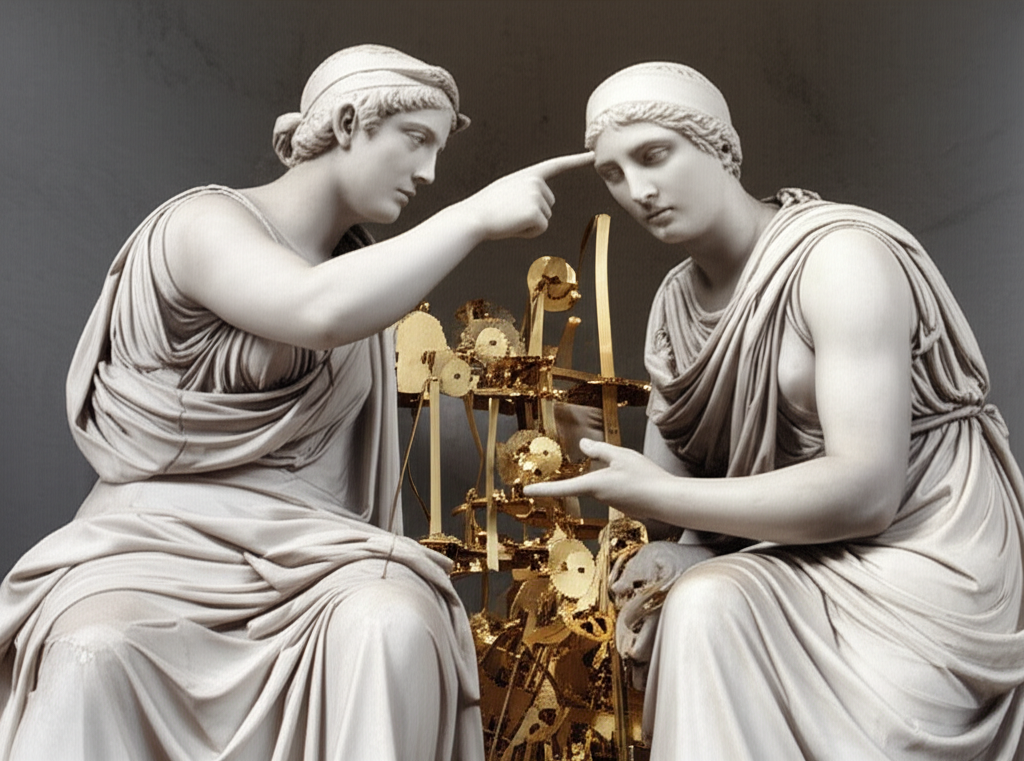 and the other gazing intently at a swirling, ethereal vortex (representing metaphysics). The background is divided, with a starry, cosmic vista on one side and an ancient library filled with scrolls and texts on the other.)
📹 Related Video: What is Philosophy?
Video by: The School of Life
💡 Want different videos? Search YouTube for: ""Hume on Causality Explained" and "Quantum Mechanics and Determinism Philosophy""