

The Unseen Threads: Causality in Physics and Metaphysics
Summary: Causality, the fundamental principle that every event has a cause, underpins both our scientific understanding of the universe and our philosophical inquiries into existence. While physics seeks to describe and predict events through observable laws and forces, often embracing a deterministic view (or grappling with quantum indeterminacy), metaphysics delves deeper, questioning the ultimate nature of cause, exploring concepts like Necessity and Contingency, agent causation, and the very possibility of a first cause. This article explores the distinct yet interconnected perspectives on causality, highlighting how each discipline enriches our comprehension of why things happen.
The Enduring Question: Why Do Things Happen?
From the simplest falling apple to the most complex cosmic dance, our universe is a tapestry woven with threads of cause and effect. As curious beings, we are inherently driven to understand why things occur. This fundamental inquiry forms the bedrock of both scientific exploration and philosophical contemplation, leading us down two distinct, yet often convergent, paths: the empirical realm of physics and the abstract domain of metaphysics. Through the lens of the "Great Books of the Western World," we find this dialogue on causality echoing across centuries, reminding us of its profound and persistent relevance.
Causality in the Realm of Physics: Laws, Predictability, and the Fabric of Reality
In physics, causality is primarily understood through the lens of observable phenomena and predictable laws. Here, a cause is typically an event or condition that, under specific circumstances, reliably produces another event or condition—the effect.
- Classical Mechanics and Determinism: For centuries, classical physics, exemplified by Newton's laws of motion, painted a picture of a deterministic universe. Given the initial conditions and forces acting upon a system, its future state could, in principle, be precisely predicted. Every effect had a prior, identifiable physical cause. This view fostered a strong belief in the ordered, law-governed nature of reality.
- Relativity and Spacetime: Einstein's theories of relativity further refined our understanding, embedding causality within the structure of spacetime. Events are causally connected only if they lie within each other's light cones, meaning information or influence cannot travel faster than light. This sets precise limits on what can cause what.
- Quantum Indeterminacy: The advent of quantum physics, however, introduced a profound challenge to classical determinism. At the subatomic level, events often appear probabilistic rather than strictly deterministic. While the equations of quantum mechanics can predict the probability of an outcome, the exact outcome of a single event (like the decay of a radioactive atom) seems inherently unpredictable. This raises complex questions about the nature of cause at the most fundamental level, leading some to question whether true randomness exists, or if there are hidden variables yet to be discovered.
Key Characteristics of Causality in Physics:
| Aspect | Description |
|---|---|
| Focus | Observable, measurable events and their relationships |
| Methodology | Experimentation, mathematical modeling, empirical verification |
| Nature of Cause | Prior event or condition that reliably precedes and produces an effect |
| Predictability | High in classical systems; probabilistic in quantum systems |
| Scope | Explains how physical systems operate |
Causality in Metaphysics: The Deeper Why and the Nature of Being
While physics seeks to explain how the universe operates, metaphysics probes the deeper questions of why anything exists at all, and what constitutes the ultimate nature of cause. This philosophical inquiry transcends empirical observation, grappling with concepts that shape our most fundamental worldview.
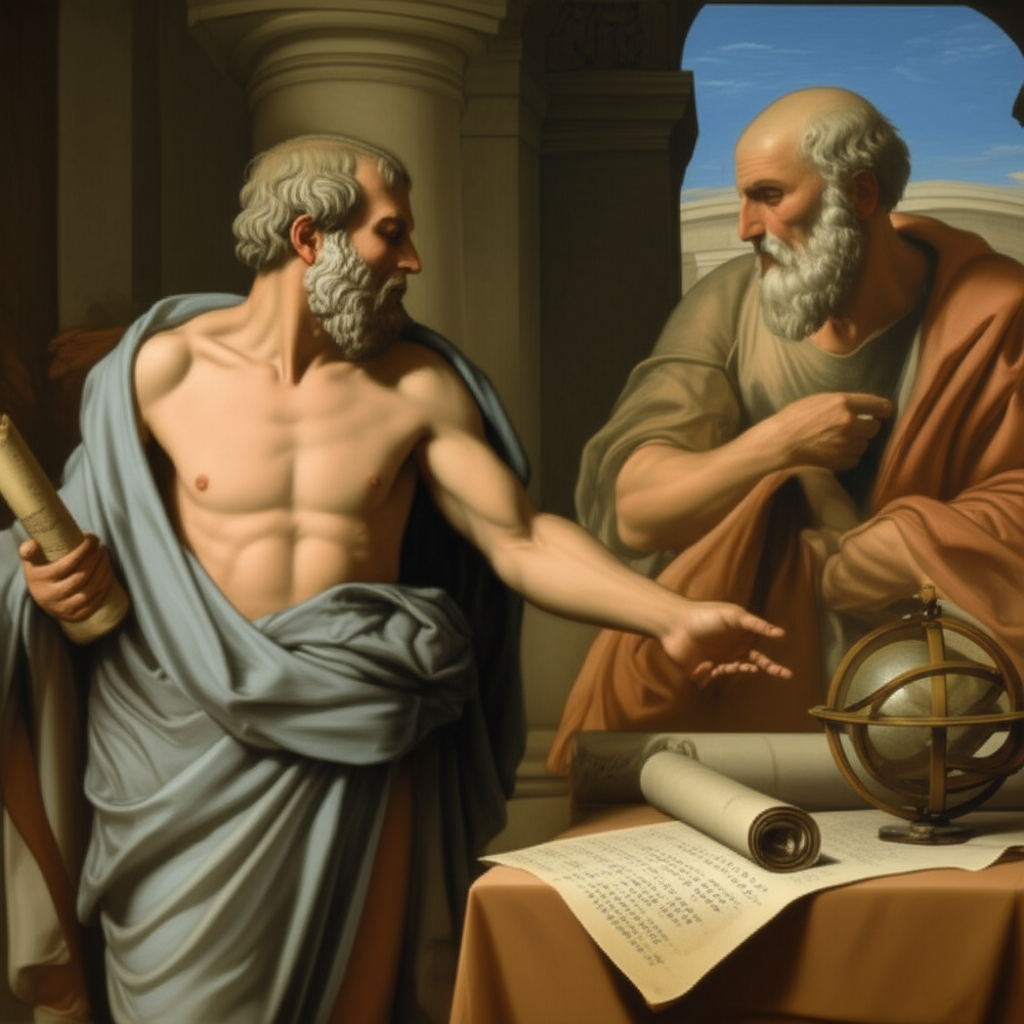 , while the other points towards the heavens (metaphysical ideas), symbolizing the dual pursuit of understanding the concrete and the abstract. The lighting is dramatic, highlighting their thoughtful expressions.)
-
Aristotle's Four Causes: A cornerstone of metaphysical inquiry into cause comes from Aristotle, who posited four distinct types of causes, offering a comprehensive framework for understanding existence:
- Material Cause: That out of which something is made (e.g., the bronze of a statue).
- Formal Cause: The essence or form of a thing (e.g., the shape of the statue).
- Efficient Cause: The primary agent or source of change (e.g., the sculptor).
- Final Cause: The purpose or end for which a thing exists (e.g., the statue's purpose to commemorate).
Aristotle's framework, explored extensively in the "Great Books," moves beyond mere sequence to question the inherent purpose and essence of things, a perspective often less central to modern physics.
-
Necessity and Contingency: Central to metaphysical discussions of causality are the concepts of Necessity and Contingency.
- Necessity: A necessary truth or event is one that must be the case; its opposite is impossible. For example, some argue that the laws of logic are necessary. In a causal chain, if A necessarily causes B, then B cannot fail to follow A.
- Contingency: A contingent truth or event is one that happens to be the case but could have been otherwise; its opposite is possible. Most events in our daily lives are contingent—I could have chosen a different path to work today.
Metaphysicians ponder whether the entire universe, including its initial cause, is necessary or contingent. Does anything exist by its own Necessity? Or is everything ultimately contingent upon something else?
-
The Problem of the First Cause: If every event has a cause, does this chain extend infinitely backward, or must there be an uncaused first cause? This question has profound theological and philosophical implications, explored by thinkers from Aquinas to Leibniz. Is this first cause a necessary being, or something beyond our comprehension?
-
Hume's Skepticism: David Hume famously challenged the very idea of a "necessary connection" between cause and effect. He argued that we only observe constant conjunction (B always follows A), not an inherent force or power compelling B to occur. Our belief in causality, he suggested, is a habit of mind, not a direct perception of reality. This skeptical view remains a potent force in contemporary discussions.
Bridging the Divide: Intersections and Enduring Questions
While physics and metaphysics approach causality from different angles, they are not entirely separate. Physics relies on the metaphysical assumption that the universe is orderly and that causes exist, even if it doesn't explicitly define their ultimate nature. Conversely, metaphysical theories must, to some extent, be compatible with our scientific understanding of the world.
- The Nature of Laws: Are the laws of physics merely descriptive summaries of regularities, or do they represent necessary truths about the universe? This is a profoundly metaphysical question.
- Emergence and Reduction: Can all complex phenomena be reduced to simpler physical causes, or do genuinely new causal powers emerge at higher levels of organization (e.g., consciousness)?
- Free Will: The concept of free will often hinges on a particular understanding of agent causation, where an individual can initiate a cause without being fully determined by prior physical events. This puts Necessity and Contingency into a very personal light.
The ongoing dialogue between these fields is crucial. Physics provides the detailed map of how the universe operates, while metaphysics offers the conceptual framework for understanding the deeper why. Together, they strive to unravel the intricate, often mysterious, threads of causality that bind our existence.
Further Exploration
YouTube:
- "Aristotle's Four Causes Explained"
- "Hume on Causation and Induction"
📹 Related Video: What is Philosophy?
Video by: The School of Life
💡 Want different videos? Search YouTube for: "Causality in Physics and Metaphysics philosophy"