

The Unseen Threads: Causality in Physics and Metaphysics
From the simplest falling apple to the most complex quantum entanglement, the concept of cause underpins our understanding of reality. This article delves into the multifaceted nature of causality, exploring its bedrock role in both Physics and Metaphysics. We'll journey from ancient philosophical insights to the cutting edge of scientific inquiry, examining how our understanding of cause shapes our perception of necessity and contingency, and ultimately, the very fabric of existence. While physics seeks to describe how things happen through observable relationships, metaphysics grapples with why anything happens at all, probing the fundamental nature of causal connection itself.
The Ancient Roots of Causation: Aristotle's Enduring Legacy
The quest to understand cause is as old as philosophy itself. Among the most influential early thinkers was Aristotle, whose work, preserved within the Great Books of the Western World, laid a foundational framework that continues to resonate. For Aristotle, to fully understand something was to grasp its four causes:
- Material Cause: That out of which something is made (e.g., the bronze of a statue).
- Formal Cause: The essence or form of a thing (e.g., the shape of the statue).
- Efficient Cause: The primary agent or source of change (e.g., the sculptor who makes the statue). This is often what we typically mean by "cause."
- Final Cause: The purpose or end for which a thing exists (e.g., the statue's purpose to commemorate).
Aristotle's comprehensive approach highlights that causation isn't a monolithic concept. His efficient cause aligns most closely with modern scientific inquiry, focusing on the antecedent events that bring about a consequent. Yet, the inclusion of formal and final causes points to a deeper, metaphysical quest for meaning and purpose that physics, by its very nature, often sets aside.
Causality Under the Microscope: Physics and the Laws of Nature
In the realm of Physics, causality is often treated as a fundamental principle, an axiom upon which the edifice of scientific understanding is built. The universe, from a classical perspective, is a grand clockwork mechanism where every effect has a preceding cause.
Classical Physics: Determinism and Predictability
Newtonian mechanics epitomizes this deterministic view. Given the initial conditions and forces acting upon a system, the future state can, in principle, be predicted with absolute necessity. A billiard ball strikes another, and its subsequent motion is a direct, unavoidable consequence. Here, the link between cause and effect is robust, predictable, and seemingly absolute. There's little room for contingency in this tightly woven causal chain; events unfold as they must.
Relativity: Spacetime and Causal Structure
Einstein's theories of relativity profoundly reshaped our understanding of space and time, but they reinforced the principle of causality. While simultaneity became relative and the speed of light an ultimate limit, the concept of a "causal cone" emerged. Events within an object's past light cone can cause events in its future light cone, ensuring that effects do not precede their causes. This preserves a fundamental ordering of events, even as the fabric of spacetime becomes more dynamic.
Quantum Mechanics: Probability and Contingency
The advent of quantum mechanics, however, introduced a radical challenge to this classical determinism. At the subatomic level, events often appear probabilistic rather than absolutely determined. Consider the decay of a radioactive atom: we can predict its half-life, but not precisely when any individual atom will decay. This introduces an element of contingency that seems to defy the strict cause-and-effect relationships of classical physics.
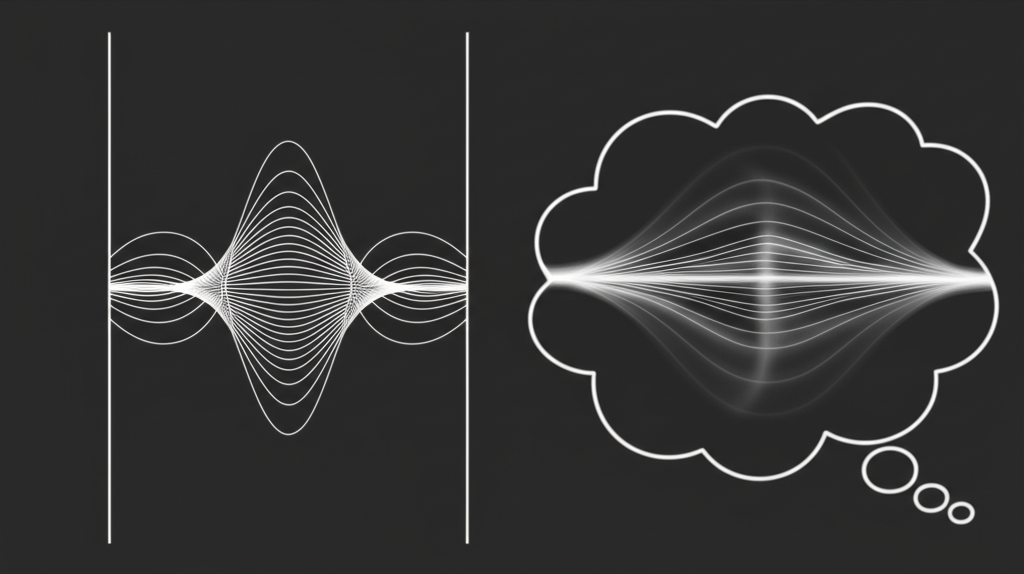
The measurement problem in quantum mechanics further blurs the lines. Does the act of observation cause a wave function to collapse into a definite state, or is there a deeper, hidden cause we simply haven't discovered? This question forces physicists to grapple with deeply metaphysical implications.
The Metaphysical Labyrinth: What Is a Causal Connection?
While physics describes the patterns of cause and effect, Metaphysics delves into the very nature of that connection. What does it mean for one event to cause another? Is it an inherent property of reality, or a construct of our minds?
Hume's Skeptical Challenge: Constant Conjunction vs. Necessary Connection
David Hume, another titan from the Great Books tradition, famously challenged the notion of a necessary connection between cause and effect. He argued that we never actually observe causation itself, only a "constant conjunction" of events. We see event A consistently followed by event B, and from this repeated experience, our minds form an expectation that A will cause B.
Hume's critique introduced a profound skepticism about the necessity of causal links. For him, the belief in causation is more a psychological habit than an objective feature of the world. This raises questions about whether future events are truly necessary or merely contingent on our past observations.
Kant's Transcendental Response: Causality as a Category of Understanding
Immanuel Kant, in response to Hume, argued that causality is not merely an empirical observation but a fundamental "category of understanding" that our minds impose upon experience. We cannot experience the world without structuring it causally. For Kant, causality is a synthetic a priori truth—it's necessary for experience to be intelligible, yet not derivable purely from logic. Our minds necessitate a causal structure to make sense of the contingent stream of sensory input.
Contemporary Metaphysical Debates
Modern metaphysics continues to wrestle with causality:
- Counterfactuals: Many contemporary theories define causation in terms of counterfactuals: "If event A had not occurred, then event B would not have occurred."
- Interventionism: This view suggests that causation involves the ability to manipulate one variable to change another.
- Downward Causation: In complex systems (like biological organisms or minds), do higher-level properties cause changes in lower-level components? This question is particularly relevant when considering emergent properties.
The debate over free will, for instance, hinges entirely on the nature of causality. If all actions are strictly determined by prior physical causes, where does human contingency or choice reside?
Bridging the Divide: Where Physics and Metaphysics Intersect
The journey through cause reveals a dynamic interplay between Physics and Metaphysics. While physics describes the mechanisms, metaphysics probes the underlying reality.
| Aspect of Causality | Physics' Approach | Metaphysics' Approach | Intersecting Questions |
|---|---|---|---|
| Nature of Link | Observable sequence, mathematical laws. | Necessary connection, constant conjunction, mental construct. | Is the causal link inherent in reality or imposed by mind? |
| Determinism/Probability | Classical: Deterministic. Quantum: Probabilistic. | Is reality fundamentally deterministic or contingent? | Does quantum contingency imply true randomness or hidden causes? |
| Time | Causal cones, irreversible processes. | Directionality of time, retrocausality. | Can effects ever precede causes, even theoretically? |
| Consciousness | Epiphenomenal, emergent, or brain states. | Free will, mental causation, mind-body problem. | Can consciousness itself be a cause of physical events? |
The probabilistic nature of quantum mechanics has reopened deeply metaphysical questions about determinism, necessity and contingency, and the very fabric of reality that classical physics seemed to have settled. Are quantum events truly uncaused in a fundamental sense, or are there underlying causes beyond our current empirical reach? The answers to these questions are not merely academic; they shape our understanding of free will, moral responsibility, and our place in the cosmos.
Conclusion: The Enduring Mystery of Cause
The concept of cause remains one of the most profound and challenging subjects at the intersection of Physics and Metaphysics. From Aristotle's four causes to the quantum realm's inherent contingency, our understanding has evolved, yet the fundamental questions persist. Physics meticulously maps the "how," while metaphysics relentlessly questions the "what" and "why" of causal connections. As we continue to push the boundaries of scientific discovery, particularly in areas like quantum gravity and the nature of consciousness, the philosophical underpinnings of necessity and contingency in causation will undoubtedly remain at the forefront of human inquiry, reminding us that the most profound threads of reality are often the least seen.
📹 Related Video: What is Philosophy?
Video by: The School of Life
💡 Want different videos? Search YouTube for: ""David Hume on Causality - Crash Course Philosophy" and "Quantum Causality and the Nature of Reality""