

Astronomy and the Concept of the World: A Journey Through Cosmic Understanding
From the earliest stargazers to the modern astrophysicist, astronomy has consistently reshaped humanity's understanding of the World. This article explores how our evolving comprehension of celestial mechanics and cosmic scale has profoundly influenced philosophical thought, challenging our notions of Space, Time, and our place within the universe. What we perceive as 'the world' is not merely a physical location but a dynamic concept, continually redefined by the revelations from above.
The Cosmos as a Mirror to the Self: An Enduring Fascination
Since antiquity, the night sky has served as both a canvas for myth and a laboratory for reason. Long before telescopes, ancient philosophers and astronomers observed the heavens, seeking patterns, order, and meaning. Their observations birthed cosmology, the study of the World as an ordered whole, inextricably linking the physical universe with philosophical inquiry into existence, purpose, and the nature of reality. The Great Books of the Western World are replete with such reflections, from Plato's Timaeus to Aristotle's Metaphysics, where the celestial spheres were seen as the epitome of perfection and eternal motion, defining the very boundaries and character of our World.
From Geocentric Order to Cosmic Immensity: A Shifting Worldview
The history of astronomy is, in essence, a chronicle of humanity's changing concept of the World. Each major discovery has not only expanded our knowledge of the cosmos but also forced a re-evaluation of our philosophical frameworks.
The Ptolemaic Universe: A Human-Centred World
For millennia, the prevailing view, codified by Ptolemy and rooted in Aristotelian physics, placed Earth firmly at the centre of the universe. This geocentric model was more than just a scientific theory; it was a deeply ingrained worldview. It offered a finite, comprehensible World, neatly ordered into concentric spheres, with humanity at its spatial and, often, spiritual apex. This model provided a comforting sense of cosmic purpose and stability, where the divine had a clear hierarchy and Space was bounded and knowable. Time unfolded within this contained system, a linear progression within a fixed cosmic backdrop.
The Copernican Revolution and the Infinite Horizon
The 16th and 17th centuries witnessed a seismic shift with the advent of the heliocentric model proposed by Copernicus and championed by Galileo and Kepler. Suddenly, Earth was demoted from the cosmic centre to merely one planet orbiting the Sun. This was not just a change in astronomical models; it was a profound philosophical crisis. The World was no longer a human-centric stage. The implications for our understanding of Space were immense: if the Earth moved, and if the stars were not fixed on a crystalline sphere but perhaps vast distances away, then the universe might be far larger, even infinite. Thinkers like Giordano Bruno dared to imagine infinite worlds, shattering the comfortable, finite cosmos and opening up terrifying yet exhilarating vistas of boundless Space.
Newtonian Mechanics: The Universe as a Clockwork
Isaac Newton's universal law of gravitation provided a unifying framework, explaining both the fall of an apple and the orbits of planets. The universe, or the World, was now perceived as a vast, intricate machine, governed by precise, predictable laws. This mechanistic worldview influenced Enlightenment philosophy, suggesting a deterministic universe where Time flowed uniformly and absolutely, independent of events. The World became a grand clockwork, its movements calculable, its Space an infinite, absolute stage upon which cosmic events unfolded.
Modern Astronomy: Expanding the Boundaries of Space and Time
The 20th century brought further revolutions, pushing the boundaries of our cosmic understanding beyond anything previously imagined.
Beyond the Milky Way: Galaxies and Cosmic Evolution
Edwin Hubble's discovery of galaxies beyond our own, and the subsequent realization that the universe is expanding, dramatically reshaped our concept of Space. The World was no longer confined to our galaxy but encompassed billions of island universes, each containing billions of stars. This immense scale introduced new questions about the origin and fate of the cosmos. The Big Bang theory posited a beginning for the universe, and thus for Time itself, fundamentally altering our understanding of cosmic evolution and the dynamic nature of the World.
Relativity and Quantum Mechanics: Redefining Space and Time
Albert Einstein's theories of relativity inextricably linked Space and Time into a single entity: spacetime. This radical idea demonstrated that Space and Time are not absolute and independent but are relative to the observer and affected by gravity. The World became a dynamic, interwoven fabric, where mass and energy warp spacetime, challenging our intuitive grasp of reality. Simultaneously, quantum mechanics revealed a universe at its most fundamental level that is probabilistic and often counter-intuitive, further complicating our deterministic models of the World.
A List of Epochal Shifts in Our Concept of the World (Driven by Astronomy):
- Geocentric Certainty: Earth at the fixed center, a finite, divinely ordered cosmos.
- Heliocentric Dislocation: Sun at the center, Earth as a moving planet, opening to larger, potentially infinite Space.
- Newtonian Mechanism: Universe as a predictable machine, governed by universal laws, implying deterministic Time.
- Cosmic Expansion: Galaxies beyond our own, an expanding universe, a beginning for Time (Big Bang), vast, evolving Space.
- Relativistic Spacetime: Space and Time interwoven and relative, challenging objective reality, the World as dynamic and observer-dependent.
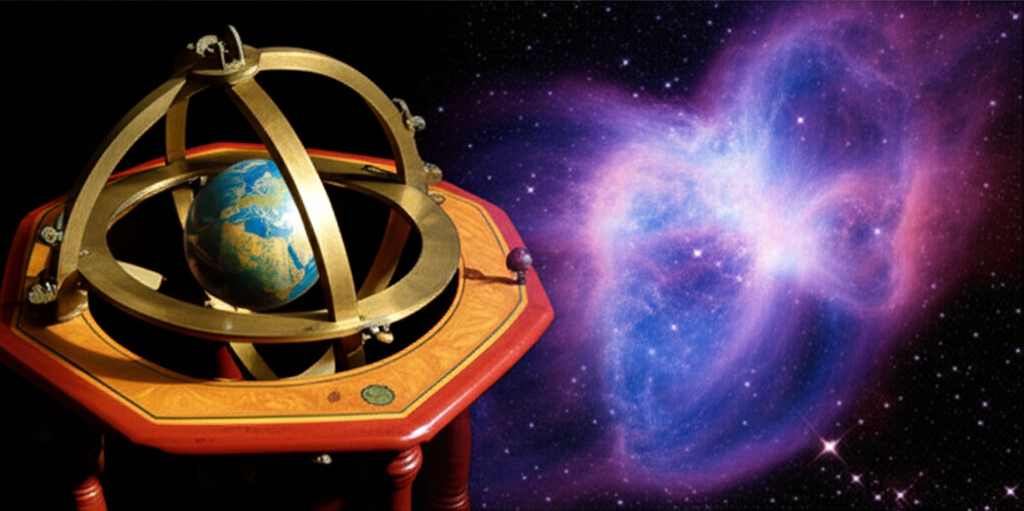
The Philosophical Resonance: What is Our World?
The revelations of astronomy have consistently challenged philosophers to redefine humanity's place and purpose.
The Question of Meaning in a Vast Cosmos
In the face of an ever-expanding universe, the traditional anchors of meaning, often tied to a unique, central human position, have been displaced. How do we find meaning when our planet is but a speck in an unimaginable expanse of Space and our existence a fleeting moment in cosmic Time? This existential dilemma has spurred profound philosophical introspection, from the contemplation of cosmic insignificance to the celebration of consciousness itself as a rare and precious phenomenon capable of comprehending such grandeur. The World becomes not just a physical reality but a stage for our ongoing quest for significance.
The World as a Human Construct
Ultimately, our 'concept of the world' is as much a product of our minds as it is of empirical observation. The World we inhabit is filtered through our senses, interpreted by our reason, and shaped by our philosophical frameworks. Astronomy provides the data, but philosophy provides the narrative, the framework within which we understand our relationship to the stars, the galaxies, and the very fabric of Space and Time. Is the World the Earth, our solar system, our galaxy, or the entire observable universe? The definition changes with our knowledge and our capacity for imagination.
Conclusion: A Continuing Dialogue
Astronomy continues to be a frontier science, constantly pushing the boundaries of our knowledge. Each new discovery, from exoplanets to gravitational waves, forces us to reconsider the fundamental nature of the World, Space, and Time. This ongoing dialogue between scientific revelation and philosophical interpretation ensures that our concept of the World remains vibrant, dynamic, and endlessly fascinating. The heavens continue to challenge us, inviting us to look beyond our immediate horizons and ponder the deepest questions of existence.
📹 Related Video: What is Philosophy?
Video by: The School of Life
💡 Want different videos? Search YouTube for: ""philosophy of space and time in modern physics""
📹 Related Video: What is Philosophy?
Video by: The School of Life
💡 Want different videos? Search YouTube for: ""cosmic perspective existential philosophy""