

Astronomy and the Concept of the World: A Philosophical Odyssey
Summary: The history of astronomy is, in essence, the history of humanity's evolving understanding of "the World" itself. From ancient, finite geocentric models to the vast, expanding universe revealed by modern cosmology, astronomical discoveries have consistently challenged and reshaped our philosophical notions of Space, Time, and our place within the grand tapestry of existence. This article explores how our celestial observations have profoundly influenced our concept of the World, transforming it from a contained sphere into an ever-unfolding mystery, drawing insights from the enduring wisdom contained within the Great Books of the Western World.
The Celestial Canvas: Painting Our Philosophical Reality
For millennia, the night sky has served as humanity's most profound and accessible laboratory. Before telescopes pierced the veil of distance, the rhythmic dance of the planets and the steadfast twinkle of the stars were not merely subjects of scientific inquiry but fundamental pillars upon which entire worldviews were constructed. Astronomy, in its earliest forms, was inseparable from philosophy, theology, and the very definition of what constituted "the World."
The journey from a contained, Earth-centric kosmos to an incomprehensibly vast, dynamic universe is a testament to both human ingenuity and our insatiable drive to understand our surroundings. Each major astronomical paradigm shift has not only revised our maps of the heavens but has also necessitated a complete re-evaluation of fundamental philosophical questions concerning reality, knowledge, and meaning.
I. The Ancient Cosmos: A Finite, Ordered World
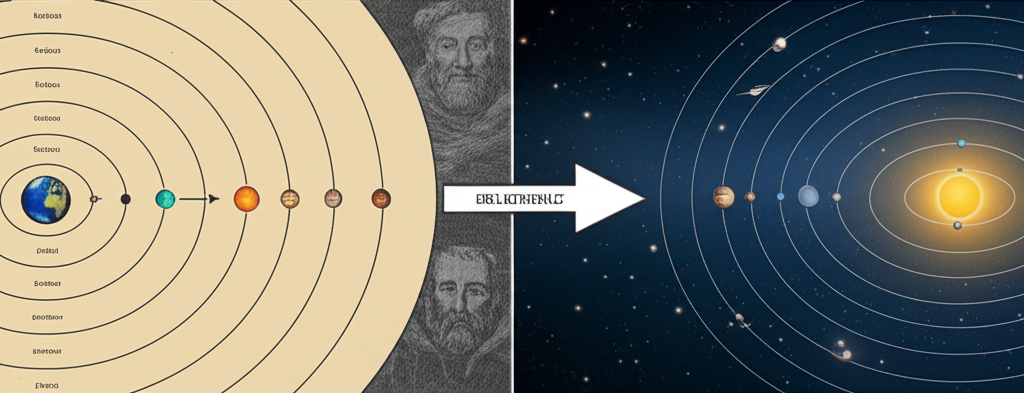
In the classical era, as documented extensively in the Great Books, the World was largely conceived as a finite, ordered, and geocentric system. Philosophers like Plato and Aristotle, building upon earlier traditions, articulated a universe where Earth lay at the unmoving center, encircled by crystalline spheres carrying the moon, sun, planets, and fixed stars. This was a World of clear boundaries, hierarchical structure, and inherent purpose.
- Aristotelian Cosmology: The universe was divided into terrestrial and celestial realms. The terrestrial, imperfect and mutable; the celestial, perfect and eternal, composed of a divine aether. This view of the World was not just a scientific model but a moral and metaphysical framework. Space was bounded, a series of concentric spheres, and Time was often viewed as cyclical or eternal within this immutable structure.
- Ptolemaic System: Refined Aristotle's model, providing a complex mathematical framework of epicycles and deferents to accurately predict planetary motions. This system, dominant for over 1,400 years, solidified the idea of a knowable, comprehensible World with humanity at its heart.
This finite World deeply influenced philosophy, theology, and human self-perception. Our existence was central, our observations foundational, and the heavens a direct manifestation of divine order. The concept of the World was synonymous with this contained, harmonious kosmos.
II. The Copernican Revolution: Shifting Perspectives and Expanding Horizons
The 16th and 17th centuries witnessed a radical upheaval that irrevocably shattered the ancient consensus. Nicolaus Copernicus's heliocentric model, later championed and observed by Galileo Galilei and mathematically refined by Johannes Kepler, began to dislodge Earth from its privileged position. This was more than a mere scientific adjustment; it was a profound philosophical challenge.
- Heliocentrism's Impact: The realization that Earth was but one planet orbiting the sun was a significant blow to anthropocentric views. It forced humanity to reconsider its unique status and central role. The World was no longer simply our world, but a part of a larger, sun-centered system.
- Galileo's Telescope: By turning his telescope to the heavens, Galileo revealed imperfections on the moon, countless previously unseen stars, and the phases of Venus – all evidence contradicting the Aristotelian perfect, unchanging celestial spheres. The World suddenly seemed much larger, more diverse, and less "perfect" in the classical sense.
- Bruno's Vision: Giordano Bruno, preceding Galileo, went further, speculating about infinite worlds and an infinite universe, a notion that challenged the very boundaries of the World and the concept of Space as previously understood.
This period began to introduce the idea of an expanding, perhaps infinite, Space, and implicitly, a Time that stretched beyond the immediate cyclical observations of Earth. The World was no longer a cozy, contained home but a single vessel adrift in a vast ocean.
III. Newton and the Mechanical Universe: A World Governed by Law
Isaac Newton's Principia Mathematica (1687), another cornerstone of the Great Books, provided the mathematical and physical framework for the Copernican universe. His laws of motion and universal gravitation explained both the apple falling to Earth and the planets orbiting the sun with a single, elegant system.
- The Clockwork Universe: Newton's work solidified the concept of the World as a vast, predictable machine, governed by immutable laws. This worldview profoundly influenced the Enlightenment, fostering ideas of rational inquiry and a universe comprehensible through reason. Space was absolute, an infinite, unchanging container, and Time was equally absolute, flowing uniformly and independently of events.
- Philosophical Implications: This mechanical World raised questions about determinism versus free will, the role of a divine clockmaker, and the limits of human knowledge. The Astronomy of Newton provided a framework that supported a scientific, rather than purely theological, understanding of the cosmos.
IV. From Kant to Contemporary Thought: The Subjective and Objective World
The 18th century brought Immanuel Kant, who, in his Critique of Pure Reason, fundamentally altered the philosophical landscape by suggesting that Space and Time are not merely objective properties of the World but are a priori forms of human intuition – structures through which we experience reality. This meant our perception of the World was inherently shaped by our cognitive faculties.
Key Developments and Their Impact:
- Kant's Copernican Revolution in Philosophy: He argued that objects conform to our knowledge, rather than our knowledge conforming to objects. This introduced a subjective element to our understanding of the World, even as Astronomy continued to reveal its objective vastness.
- Einstein's Relativity: The 20th century saw Albert Einstein's theories of relativity shatter Newton's absolute Space and Time. Instead, Space-Time became a unified, dynamic fabric, influenced by mass and energy. The World was no longer a static stage but an active participant in the cosmic drama. This concept, though highly scientific, has deep philosophical implications for causality, simultaneity, and the very nature of reality.
- Big Bang Cosmology: Modern Astronomy has painted a picture of an evolving World with a finite beginning – the Big Bang – and a potential future of expansion or collapse. This reintroduces questions about creation, ultimate destiny, and the meaning of Time on a cosmic scale. The World is no longer static but a dynamic, evolving entity spanning billions of years and light-years.
- The Multiverse Concept: Current theoretical physics even entertains the idea of a "multiverse," where our World is just one of many, pushing the boundaries of Space and Time beyond any conceivable human intuition.
V. The Enduring Philosophical Questions
The ongoing dialogue between Astronomy and philosophy continues to fuel humanity's deepest inquiries:
- Our Place in the Cosmos: Are we significant in an indifferent, vast universe?
- The Nature of Reality: Is the World fundamentally mathematical, material, or something else entirely?
- Meaning and Purpose: Can meaning be found in a cosmos that appears to have no inherent purpose?
- Limits of Knowledge: How much of the World can we truly comprehend, given our limited perception and finite existence within immense Space and Time?
From the ancient observation of planetary movements to the detection of gravitational waves and the mapping of the cosmic microwave background, Astronomy consistently provides new data points for these timeless philosophical debates. The World we inhabit, in its scientific and philosophical dimensions, remains a profound and captivating mystery.
YouTube Video Suggestions:
-
📹 Related Video: What is Philosophy?
Video by: The School of Life
💡 Want different videos? Search YouTube for: ""Cosmology and Philosophy: The Universe and Human Meaning""
2. ## 📹 Related Video: What is Philosophy?
Video by: The School of Life
💡 Want different videos? Search YouTube for: ""Great Books of the Western World Astronomy Philosophy""