

Astronomy and the Shifting Concept of the World
Our understanding of the "world"—that grand, overarching framework within which we exist—has been perpetually reshaped by the revelations of astronomy. From the earliest stargazers to the sophisticated instruments probing the farthest reaches of the cosmos, the study of celestial bodies has consistently challenged and expanded our philosophical horizons. This article delves into how astronomy has fundamentally altered our conception of space, time, and the very nature of the world itself, tracing this intellectual journey through the lens of the Great Books of the Western World. It is a story of human curiosity pushing against the perceived limits of reality, constantly redefining our place within an ever-expanding universe.
The Ancient Cosmos: A Geocentric World
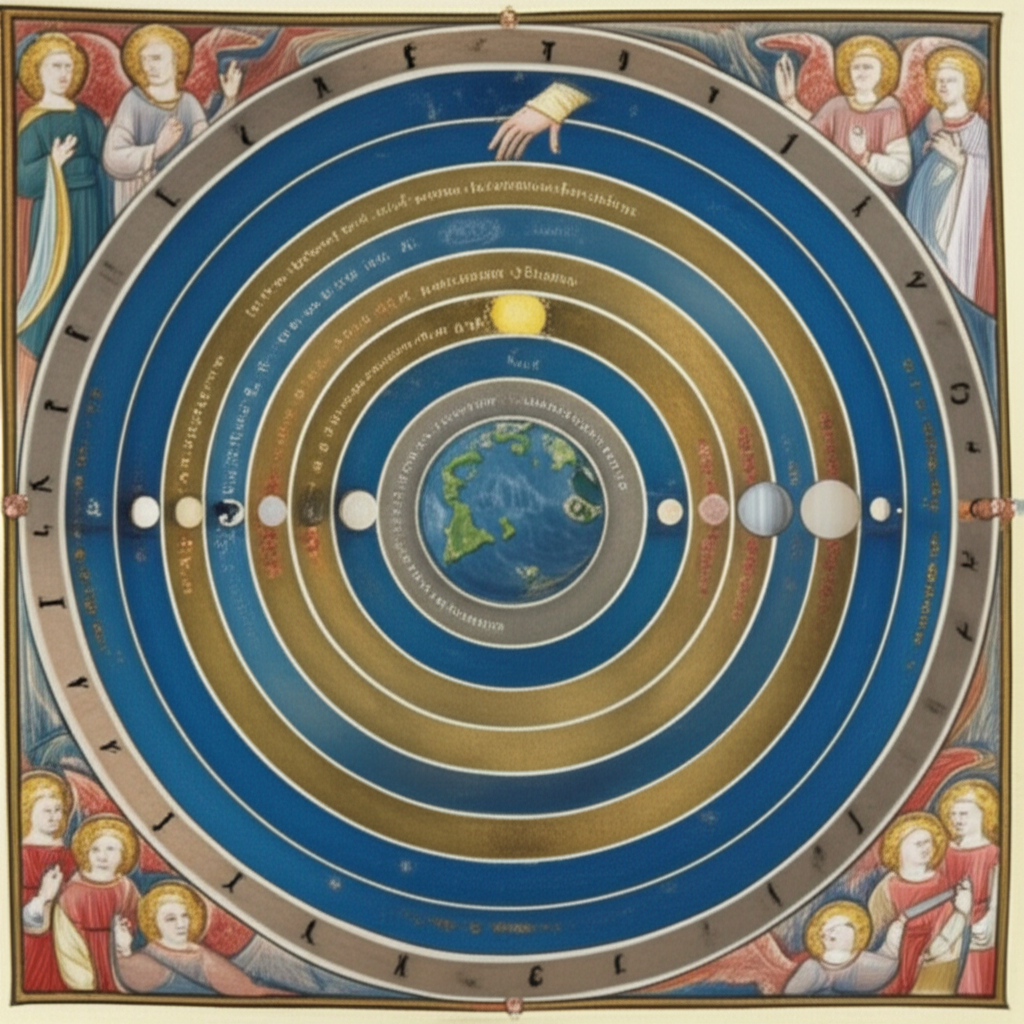
For millennia, humanity lived within a seemingly self-evident world: Earth, stationary and central, orbited by the Sun, Moon, and stars. This geocentric model, eloquently articulated by thinkers like Aristotle and later codified by Ptolemy in his Almagest, formed the bedrock of ancient and medieval philosophy and theology. The heavens, a realm of perfect, unchanging spheres, contrasted sharply with the mutable, imperfect Earth. This vision of the world was not merely scientific; it was deeply philosophical, establishing a hierarchical order and a sense of cosmic purpose.
- Aristotle's Cosmology: In works like On the Heavens, Aristotle described a finite, spherical universe with Earth at its center, surrounded by concentric spheres carrying the planets and fixed stars. This model imbued the world with a qualitative distinction between the earthly and the celestial.
- Ptolemy's Refinement: Ptolemy provided the mathematical framework to predict planetary motions, using epicycles and deferents to account for observed irregularities, thus solidifying the geocentric world for over fourteen centuries.
This ancient understanding of space was finite and structured, and time was often perceived in cyclical terms, mirroring the celestial movements. The world was a knowable, enclosed system, albeit one full of wonder.
The Copernican Revolution: A Heliocentric Shift
The 16th century brought a profound intellectual earthquake with Nicolaus Copernicus's On the Revolutions of the Heavenly Spheres. By proposing a heliocentric model—placing the Sun, not Earth, at the center of the planetary system—Copernicus initiated a paradigm shift that reverberated through every domain of thought. This was not just an astronomical adjustment; it was a philosophical re-evaluation of our place in the world.
| Astronomical Shift | Key Figure(s) | Philosophical Impact on "World" Concept Galileo Galilei's Observations: With his telescope, Galileo saw a mottled Moon, not a perfect sphere. He saw moons orbiting Jupiter, a miniature universe in miniature. These observations, though challenging, were not immediately accepted. The philosophical underpact was that the world might not be ordered around humanity.
- Kepler's Laws: Johannes Kepler, building on Tycho Brahe's meticulous astronomy, mathematically described elliptical planetary orbits, a radical departure from the ancient perfect circles. This further complicated the traditional, neat philosophical order of the cosmos.
The shift was from an anthropocentric world to a heliocentric one, forcing a re-evaluation of divine purpose and human significance. The concept of space began to expand, and the perceived simplicity of time began to give way to more complex, dynamic processes.
Newton, Space, and the Infinite World
Isaac Newton's Principia Mathematica (1687) synthesized terrestrial and celestial mechanics, demonstrating that the same laws governed both an apple's fall and the Moon's orbit. This unified view of the world profoundly altered the philosophical landscape. Newton's absolute space and time provided a universal stage for all physical phenomena.
- Universal Gravitation: Newton's law of universal gravitation explained the forces holding the cosmos together, suggesting a mechanistic, predictable world. This vision resonated with Enlightenment thinkers, who sought universal laws in all domains.
- Infinite Space: While not strictly proven by Newton, his mechanics implied an infinite, homogeneous space in which celestial bodies could move. This pushed the boundaries of the world beyond any finite, enclosed sphere. The very idea of an infinite world presented new theological and philosophical dilemmas about God's omnipresence and humanity's insignificance.
- Absolute Time: Newton's concept of absolute time, flowing independently of events, provided a universal constant for understanding cosmic processes.
The Newtonian world was one of vastness, governed by immutable laws, a grand clockwork universe that, while perhaps divinely created, operated without constant intervention.
Kant and the Phenomenal World
Immanuel Kant, deeply influenced by the scientific advancements of his era, particularly Newton's astronomy, grappled with the implications for human knowledge. In his Critique of Pure Reason, Kant argued that space and time are not objective features of the world-in-itself, but rather a priori forms of intuition, inherent structures of the human mind that enable us to perceive and organize experience.
- Space and Time as Intuitions: For Kant, we cannot conceive of objects outside of space and time because these are the very frameworks through which we apprehend reality. Astronomy, then, explores phenomena organized by these innate human categories.
- The World as Phenomenon: This means our "world" is fundamentally a phenomenal world—the world as it appears to us, structured by our minds. The "noumenal world"—the world as it is in itself—remains unknowable. This philosophical move addressed the vastness and complexity revealed by astronomy by placing limits on human understanding, while still affirming the validity of scientific inquiry within the phenomenal realm.
Kant's philosophy, therefore, sought to reconcile the objective advances of astronomy with the subjective nature of human experience, redefining the "world" as a construct deeply intertwined with consciousness.
Modern Astronomy and the Expanding Cosmos
The 20th and 21st centuries have witnessed an explosion of astronomical discovery, further shattering previous conceptions of the world. Einstein's theories of relativity redefined space and time as interwoven and dynamic, a flexible spacetime fabric warped by mass and energy. Edwin Hubble's observations confirmed that the universe is expanding, and that our galaxy is just one of billions.
- Relativistic Space-Time: Einstein's space-time continuum, where space and time are relative to the observer and affected by gravity, fundamentally altered the Newtonian absolute framework. This dynamic world is far more complex than previously imagined, with implications for causality and perception.
- The Expanding Universe: The discovery of an expanding universe, with a finite age (the Big Bang), introduced a cosmic history and evolution into our concept of the world. Time became not just a backdrop, but an integral component of the universe's unfolding story.
- Cosmic Scale: Modern astronomy reveals a world of staggering scale, with dark matter and dark energy dominating its composition, and the possibility of a multiverse. This confronts us with profound questions about uniqueness, contingency, and the limits of human knowledge.
These discoveries continue to fuel philosophical inquiry, prompting questions about the origin and fate of the world, the nature of reality, and the possibility of life beyond Earth.
The Enduring Philosophical Questions
The journey of astronomy has been a continuous process of humbling and elevating humanity. Each new discovery reframes our understanding of the world, forcing us to reconsider our place, our purpose, and the very nature of existence. The interplay between observing the cosmos and philosophizing about its implications remains a fertile ground for intellectual exploration. The concepts of space and time, once seemingly straightforward, have become profound philosophical puzzles, intertwined with the fabric of reality itself.
The world is no longer a static stage but an active participant in our philosophical dramas, challenging us to constantly update our deepest convictions about what is real, what is knowable, and what it means to be conscious beings within such an awe-inspiring, mysterious expanse.
YouTube: "Philosophy of Space and Time"
YouTube: "Cosmology and Metaphysics"
📹 Related Video: What is Philosophy?
Video by: The School of Life
💡 Want different videos? Search YouTube for: "Astronomy and the Concept of the World philosophy"