

The Cosmic Mirror: How Astronomy Forged Our Concept of the World
Astronomy, the most ancient of sciences, has always been more than mere observation of the heavens; it is a profound philosophical endeavor that has continually reshaped our understanding of the World itself. From ancient geocentric models that placed humanity at the universe's heart to the vast, expanding cosmos we perceive today, the study of the stars has fundamentally altered our grasp of Space, Time, and our own significance within the grand scheme. This article explores how astronomical discoveries have not just mapped the physical universe but have deeply influenced the very concept of existence and our place within it, a journey chronicled implicitly within the Great Books of the Western World.
Introduction: Gazing Upwards, Looking Inwards
For millennia, humanity has looked to the night sky with a mixture of awe, wonder, and trepidation. The celestial tapestry, seemingly immutable, has served as both a practical calendar and a profound canvas upon which we project our deepest questions about existence. What is this World we inhabit? How big is it? What is our place within its grand design? These are not solely scientific inquiries, but fundamental philosophical challenges. The evolution of Astronomy is, in essence, the story of our evolving concept of the World—a narrative that has consistently redefined the boundaries of Space and the flow of Time.
The Ancient Cosmos: A Finite, Human-Centric World
Before the advent of powerful telescopes and mathematical models, the World was largely understood through direct observation and philosophical reasoning. The ancient Greeks, whose foundational texts populate the Great Books, conceived of a cosmos that was both orderly and finite.
From Myth to Reason: Early Cosmologies
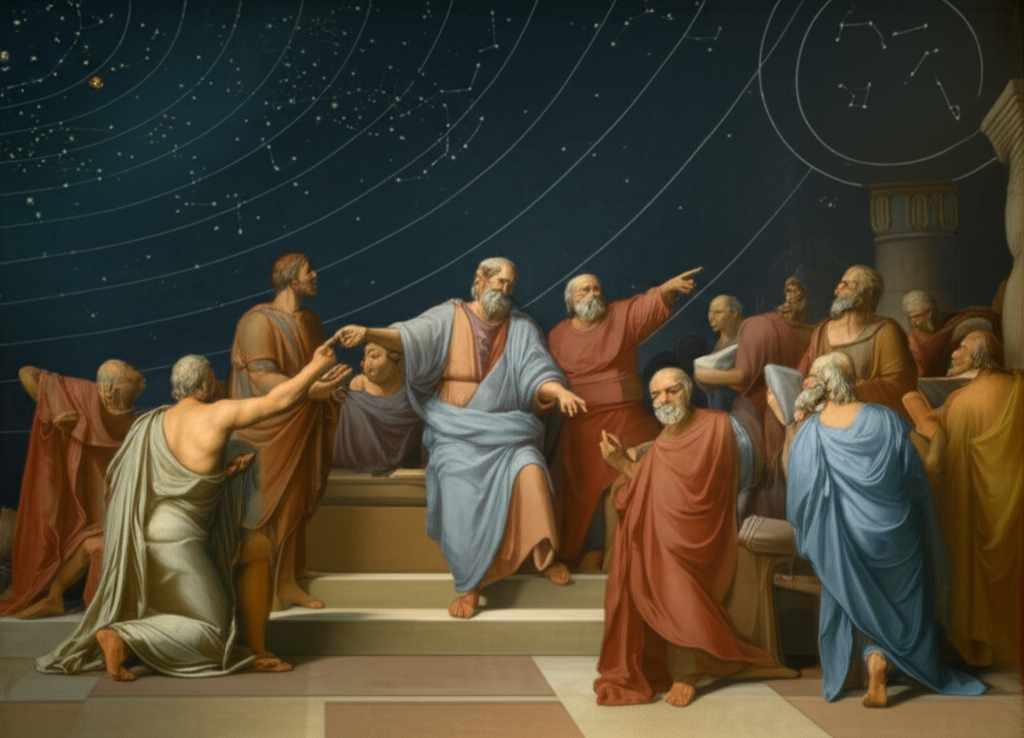
Thinkers like Plato and Aristotle, building upon earlier mythological traditions, offered sophisticated models of the universe. For Aristotle, the Earth was undeniably at the center, a unique, imperfect sphere surrounded by perfect, crystalline spheres carrying the moon, sun, planets, and fixed stars. This geocentric model, later refined by Ptolemy, placed humanity at the very heart of creation. The World was a nested series of spheres, a harmonious, if somewhat confined, cosmic architecture. Space was bounded, Time cyclical, and our existence possessed a clear, central significance. The heavens were a realm of divine perfection, distinct from the terrestrial realm of change and decay.
Revolution in the Heavens: The Copernican Shift
The 16th and 17th centuries ushered in a monumental shift, often termed the Copernican Revolution, which irrevocably altered humanity's understanding of its place in the World.
Galileo's Telescope and the Expanding Horizon
When Nicolaus Copernicus proposed a heliocentric model, placing the Sun, not the Earth, at the center of the solar system, it was more than a mere scientific hypothesis; it was a profound philosophical challenge. It questioned the very notion of human centrality. Galileo Galilei, with his revolutionary use of the telescope, provided empirical evidence that shattered the Aristotelian-Ptolemaic worldview. He observed the phases of Venus, the moons of Jupiter, and the imperfections of the Moon, demonstrating that the heavens were not immutable and perfect in the way previously imagined. This expansion of observable Space began to hint at a World far vaster and more complex than previously conceived. The once finite cosmos began to stretch, pushing the boundaries of human imagination and forcing a re-evaluation of our unique status.
The Clockwork Universe: Space, Time, and Universal Laws
The philosophical implications of the Copernican revolution were fully realized with the work of Isaac Newton, whose grand synthesis provided a coherent, mechanistic framework for the universe.
Newton's Grand Synthesis
Newton's laws of motion and universal gravitation explained the celestial mechanics with unprecedented precision, uniting the terrestrial and celestial realms under a single set of physical laws. The World was no longer a collection of distinct spheres but a vast, orderly machine operating according to predictable principles. This vision of the universe introduced concepts of absolute Space and absolute Time—an infinite, unchanging backdrop against which all cosmic events unfolded. This deterministic World had profound implications for philosophy, influencing Enlightenment thinkers who sought to apply similar rational principles to human society and governance. The universe, once seen as a living organism or a divine creation, became a grand, intricate clockwork.
Beyond the Milky Way: The Modern World-View
The 20th century, spurred by Einstein's theories of relativity and new astronomical observations, further expanded our concept of the World, challenging Newton's absolutes and revealing a cosmos of unimaginable scale and dynamism.
The Infinite and the Indifferent
Discoveries of other galaxies, the expansion of the universe, and the Big Bang theory have pushed the boundaries of the World to an almost incomprehensible degree. We now understand that our solar system is but a speck in the Milky Way, which itself is one of billions of galaxies in an ever-expanding cosmos. This infinite Space and the deep Time of cosmic evolution—billions of years rather than thousands—have profoundly altered our philosophical perspective. Humanity, once central, is now adrift in a cosmic ocean, small and perhaps insignificant against the backdrop of an indifferent universe. This perception, while humbling, also inspires a new kind of wonder, prompting us to seek meaning not in our physical centrality, but in our capacity for understanding and consciousness.
The Philosophical Echoes: Re-evaluating Our Place
The ongoing discoveries in Astronomy continue to shape our philosophical understanding of the World. Each new image from the Hubble or James Webb Space Telescope is not just a scientific datum, but a prompt for existential reflection.
The Humbling Vastness
The shift from a geocentric to a heliocentric, and then to a galactocentric and finally an acentric universe, has forced philosophy to grapple with the implications of our cosmic scale. What does it mean to be human in a World so vast? It challenges anthropocentrism, encourages humility, and compels us to redefine our values and purpose. The interconnectedness of cosmic phenomena, from the formation of elements in stars to the origins of life on Earth, underscores the intricate relationship between the physical World and the emergence of consciousness.
Table 1: Evolution of the Concept of the World Through Astronomy
| Era/Key Thinker | Astronomical Model | Concept of Space | Concept of Time | Philosophical Implication |
|---|---|---|---|---|
| Ancient Greeks (Plato, Aristotle, Ptolemy) | Geocentric, finite spheres | Bounded, hierarchical | Cyclical, divine | Human centrality, cosmic order |
| Renaissance (Copernicus, Galileo) | Heliocentric, expanding | Less bounded, relative | Linear, observational | Shift from centrality, empirical evidence |
| Enlightenment (Newton) | Mechanical Universe | Absolute, infinite | Absolute, uniform | Determinism, universal laws |
| Modern (Einstein, Hubble) | Expanding Universe, Relativity | Relative, dynamic, curved | Relative, dynamic | Humbling vastness, interconnectedness |
Conclusion: The Enduring Quest for Understanding
Astronomy is not merely the study of distant objects; it is a mirror reflecting our deepest questions about the World and our place within it. From the ancient philosophers who sought order in the celestial spheres to modern cosmologists probing the origins of Space and Time, the human quest to understand the universe is inextricably linked to our quest for self-understanding. The World we inhabit is not just a physical place, but a concept continually refined by our gaze upwards, forever challenging us to expand our minds as the cosmos expands before our eyes.
📹 Related Video: PLATO ON: The Allegory of the Cave
Video by: The School of Life
💡 Want different videos? Search YouTube for: ""Great Books of the Western World Cosmology" - for discussions on ancient and classical views of the universe from a philosophical perspective."
📹 Related Video: What is Philosophy?
Video by: The School of Life
💡 Want different videos? Search YouTube for: ""Philosophy of Science Copernican Revolution" - for analyses of the philosophical impact of the shift from geocentrism to heliocentrism."