

Astronomy and the Concept of Eternity: Glimpses Beyond the Chronological
Summary: The human gaze has been drawn to the heavens since antiquity, transforming raw astronomical observation into profound philosophical inquiry. This article explores how our evolving understanding of the cosmos, from ancient cyclical perceptions to modern theories of deep time and an expanding universe, has continuously shaped and challenged the philosophical concept of Eternity. We delve into the distinction between mere endless Time and true Eternity, drawing on classical philosophical texts to illuminate how Astronomy serves as a tangible, empirical lens through which we grapple with the infinite nature of existence and the fundamental structure of the World.
The Cosmic Mirror: Humanity's Ancient Quest for the Eternal
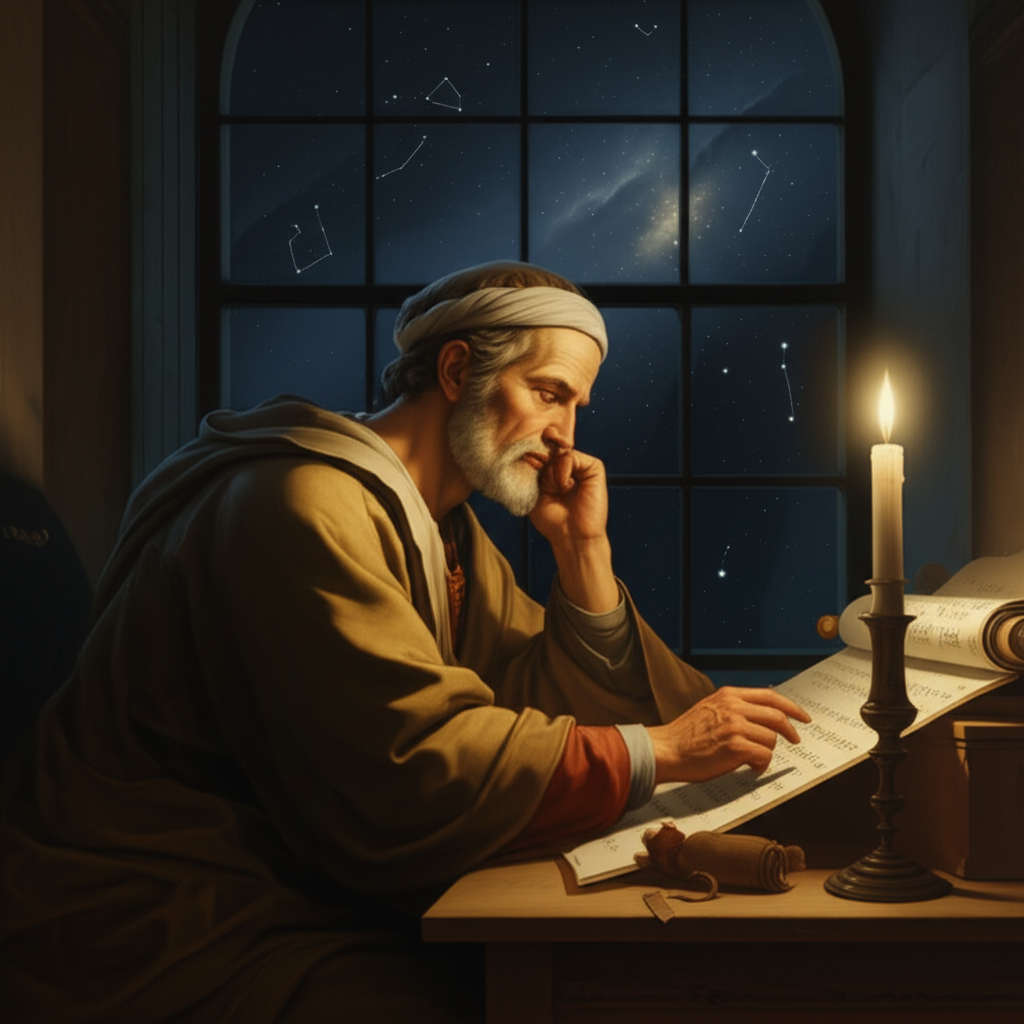
From the earliest flickers of consciousness, humanity has looked skyward, not merely for navigation or agricultural timing, but for answers to the deepest questions of existence. The regularity of the stars, the predictable dance of the planets, and the rhythmic cycle of day and night offered a stark contrast to the often chaotic and transient nature of earthly life. This celestial order became a primary source for contemplating concepts of order, permanence, and ultimately, Eternity. As Daniel Sanderson, I find this enduring fascination speaks volumes about our innate desire to transcend the fleeting moment and connect with something boundless.
The Great Books of the Western World are replete with examples of thinkers who wrestled with these very connections. Plato, in his Timaeus, describes the cosmos as a created World, a "moving image of Eternity." Aristotle, in On the Heavens, posited an eternal, unchanging celestial realm, distinct from the mutable sublunary World. These early astronomical observations, however rudimentary by modern standards, laid the groundwork for philosophical definitions of Time and the eternal.
Astronomy's Evolving Lens on Time and the World
Our understanding of the universe has undergone revolutionary shifts, each profoundly impacting our philosophical grasp of Time and Eternity.
Ancient Astronomy: Cycles, Predictability, and the Eternal Heavens
For millennia, Astronomy was primarily the study of cycles. The movements of the sun, moon, and stars dictated calendars, seasons, and religious festivals. This led to a perception of Time as cyclical, a recurring pattern rather than a linear progression.
- Mesopotamian and Egyptian Civilizations: Developed sophisticated astronomical observations to predict floods, mark solstices, and organize their societies. Their cosmologies often featured recurring cycles of creation and destruction.
- Greek Philosophy:
- Pythagoreans: Saw mathematical harmony in celestial movements, suggesting an underlying eternal order.
- Plato: Argued for an ideal, eternal realm of Forms, of which the physical World is but an imperfect reflection. The ordered cosmos hinted at this higher reality.
- Aristotle: Believed the celestial spheres, composed of an incorruptible 'aether,' moved in perfect, eternal circles, embodying a form of changeless duration. This stood in sharp contrast to the perishable earthly World.
This ancient view, while acknowledging the passage of Time, often envisioned the cosmos itself as largely stable and eternal in its fundamental structure.
The Copernican Revolution: Expanding Horizons and Shifting Perspectives
The shift from a geocentric to a heliocentric model, championed by Copernicus and later supported by Galileo's telescopic observations, began to dismantle the Aristotelian celestial spheres. This wasn't merely a scientific revolution; it was a philosophical earthquake.
- Galileo's Discoveries: The imperfections on the moon, the phases of Venus, and the moons of Jupiter shattered the notion of perfect, unchanging heavens. The celestial World was no longer fundamentally different from Earth.
- Implications for Eternity: If the heavens were not perfect and unchanging, what did that imply about their Eternity? The universe began to feel less like a static backdrop and more like a dynamic, potentially evolving entity. The sheer scale of the cosmos also began to expand, challenging the human-centric view and hinting at a vastness that stretched the imagination towards the infinite.
Modern Astronomy: Deep Time, Cosmic Evolution, and the Universe's Story
The 20th century brought forth an explosion of astronomical knowledge, pushing the boundaries of Time and space to unimaginable scales.
- Hubble's Discoveries: The expanding universe, the existence of myriad galaxies beyond our own, and the concept of "deep time" – billions of years – fundamentally altered our perception of the World.
- The Big Bang Theory: Proposed a definitive beginning for the universe, suggesting that even the cosmos itself might not be eternal in the traditional sense, but rather a temporal phenomenon within a larger, perhaps eternal, framework.
- Stellar Evolution: Stars are born, live, and die, recycling matter. Galaxies collide and merge. The universe is a dynamic, evolving tapestry, making the concept of an unchanging, eternal cosmos difficult to sustain purely empirically.
This modern perspective presents a universe of immense, almost incomprehensible Time, where billions of years are the norm. While not Eternity itself, this vastness forces us to confront timescales that dwarf human experience, nudging our minds towards the infinite.
The Philosophical Distinction: Eternity vs. Endless Time
It is crucial to differentiate between Eternity and merely endless Time. This distinction is a cornerstone of philosophical thought, particularly within the tradition of the Great Books.
| Feature | Endless Time (Aevum) | Eternity (Aeternitas) |
|---|---|---|
| Nature | Duration without beginning or end, a sequence of moments. | Complete, simultaneous, and perfect possession of life; timeless. |
| Experience | Succession, change, past, present, future. | A single, indivisible 'now'; immutable presence. |
| Relation to God | God exists throughout infinite time (less precise). | God is Eternity; God is outside and transcendent of time. |
| Philosophers | Ancient cyclical views, some modern cosmological models. | Boethius, Augustine, Aquinas, Plato (Forms). |
Boethius, in The Consolation of Philosophy, famously defined Eternity as "the complete, simultaneous and perfect possession of everlasting life." For Boethius, God does not merely exist for an infinite duration of Time; rather, God exists in an eternal present, encompassing all Time without being subject to its succession.
Augustine of Hippo, in his Confessions, grappled with the question of what God was doing before He created the World. His profound insight was that God did not create in Time, but with Time. Therefore, to ask what happened "before" creation is nonsensical, as Time itself began with the creation of the World. God, by definition, is outside of Time, dwelling in Eternity.
Astronomy as a Catalyst for Eternal Questions
While Astronomy provides us with empirical data about the World and its vast Time scales, it invariably pushes us towards philosophical questions about Eternity.
- The Universe's Beginning and End: If the universe began with a Big Bang and may end in a "heat death" or "Big Crunch," then it is not eternal in itself. This raises the question: what framework contains this temporal universe? Is that framework eternal?
- Underlying Laws: The consistent laws of physics that govern the cosmos across billions of light-years and billions of years suggest an underlying order. Is this order a reflection of an eternal truth, a Platonic Form, or an eternal mind?
- The Human Scale: Our own fleeting existence, measured in decades, against the backdrop of cosmic eons, compels us to seek meaning beyond our finite span. The vastness of the World through Astronomy humbles us and simultaneously elevates our thoughts to the possibility of something truly eternal.
- The "Now" of Observation: When we look at distant galaxies, we are seeing them as they were millions or billions of years ago. This act of observing the past in the present is a tangible experience of Time's vastness, blurring our conventional understanding of "now" and hinting at a simultaneity akin to the philosophical concept of Eternity.
Conclusion: The Unending Dialogue
The dialogue between Astronomy and the concept of Eternity is an enduring testament to humanity's intellectual curiosity. Astronomy continually expands our empirical understanding of the World and its incredible Time scales, while philosophy provides the conceptual tools to grapple with the profound implications of these discoveries. Whether we are gazing at ancient star charts or analyzing data from distant galaxies, the heavens continue to be a fertile ground for contemplating the timeless, the infinite, and the ultimate nature of reality. The pursuit of understanding the World through the stars remains one of our most profound avenues for touching upon the eternal.
📹 Related Video: What is Philosophy?
Video by: The School of Life
💡 Want different videos? Search YouTube for: ""Philosophy of Time and Eternity Explained""
📹 Related Video: KANT ON: What is Enlightenment?
Video by: The School of Life
💡 Want different videos? Search YouTube for: ""Cosmology Metaphysics Great Books Western World""