

The Cosmic Canvas: Astronomy and the Concept of Eternity
Summary: The act of gazing into the cosmos, an ancient human endeavor, inevitably confronts us with the profound concept of eternity. Astronomy, far from being a mere scientific discipline, serves as a powerful philosophical lens, forcing us to re-evaluate our understanding of Time, the transient nature of our World, and the enduring, perhaps eternal, fabric of the universe itself. This article explores how the vastness revealed by Astronomy challenges our conventional perceptions, pushing us towards a deeper contemplation of what Eternity truly entails.
The Cosmic Mirror: Reflecting on Eternity
From the earliest civilizations, the celestial sphere has been a source of both wonder and profound philosophical inquiry. The consistent, predictable movements of the stars and planets, observed long before the advent of modern Astronomy, hinted at an order and a scale of existence far beyond the immediate human experience. This ancient observation was the first step in a journey that continues to this day, one where the scientific pursuit of understanding the universe inextricably intertwines with the philosophical quest to comprehend our place within it, particularly in relation to the concept of Eternity.
The Great Books of the Western World are replete with examples of thinkers grappling with the implications of the cosmos. Plato's Timaeus, for instance, delves into the creation of the World and Time itself, positing a divine craftsman ordering eternal forms. Aristotle, too, through his physics and metaphysics, contemplated the unmoving mover and the eternal nature of the cosmos. These foundational texts reveal a deep-seated human impulse to find permanence amidst flux, an impulse amplified by the seemingly unchanging heavens.
Time, the Universe, and Human Perception
Our everyday understanding of Time is linear, marked by beginnings and endings, by the ticking of clocks and the progression of seasons. However, Astronomy shatters this familiar framework. When we speak of light-years, of galaxies billions of years old, or of the universe's estimated age, our minds struggle to grasp the sheer magnitude. This cosmic scale renders human history, indeed the entire history of our planet, as a mere blink in the eye of the universe.
This immense temporal expanse forces a re-evaluation of Time itself. Is Time merely a human construct, a measure of change within a larger, possibly timeless reality? Or is it an intrinsic property of the World, a river flowing endlessly? The cyclical models of Time favored by some ancient philosophies, where the World might undergo vast periods of creation and destruction, resonate with certain cosmological theories today. These ideas provoke us to consider whether Eternity is simply endless Time, or something fundamentally different – a state beyond temporal succession.
Eternity: A Philosophical Inquiry Beyond the Stars
Eternity is often mistakenly equated with infinite duration. However, many philosophical traditions, particularly those influenced by thinkers like Boethius in "The Consolation of Philosophy," define Eternity not as endless Time, but as a complete, simultaneous possession of boundless life. It is a state outside of Time altogether, a single, indivisible 'now' that encompasses all moments without experiencing them sequentially.
How does Astronomy inform this concept? The laws of physics, as far as we understand them, appear to be constant throughout the universe and across vast stretches of cosmic Time. The fundamental forces, the behavior of matter and energy, seem to possess an unchanging quality that hints at something eternal. While galaxies are born and die, stars ignite and fade, the underlying principles governing their existence seem to persist. This enduring framework, the "rules" of the World, might be seen as a reflection of an eternal order.
Philosophical Questions Posed by the Cosmos:
- Does the universe's vastness imply an infinite number of possibilities, and thus an eternal recurrence of events?
- If the cosmos had a beginning, does that preclude its future Eternity, or is Eternity a quality of its underlying essence?
- How do the transient lives of stars and planets reconcile with the apparent Eternity of cosmic laws?
- Is human consciousness capable of truly apprehending Eternity, or are we forever bound by our temporal existence?
Our Fleeting World in an Eternal Cosmos
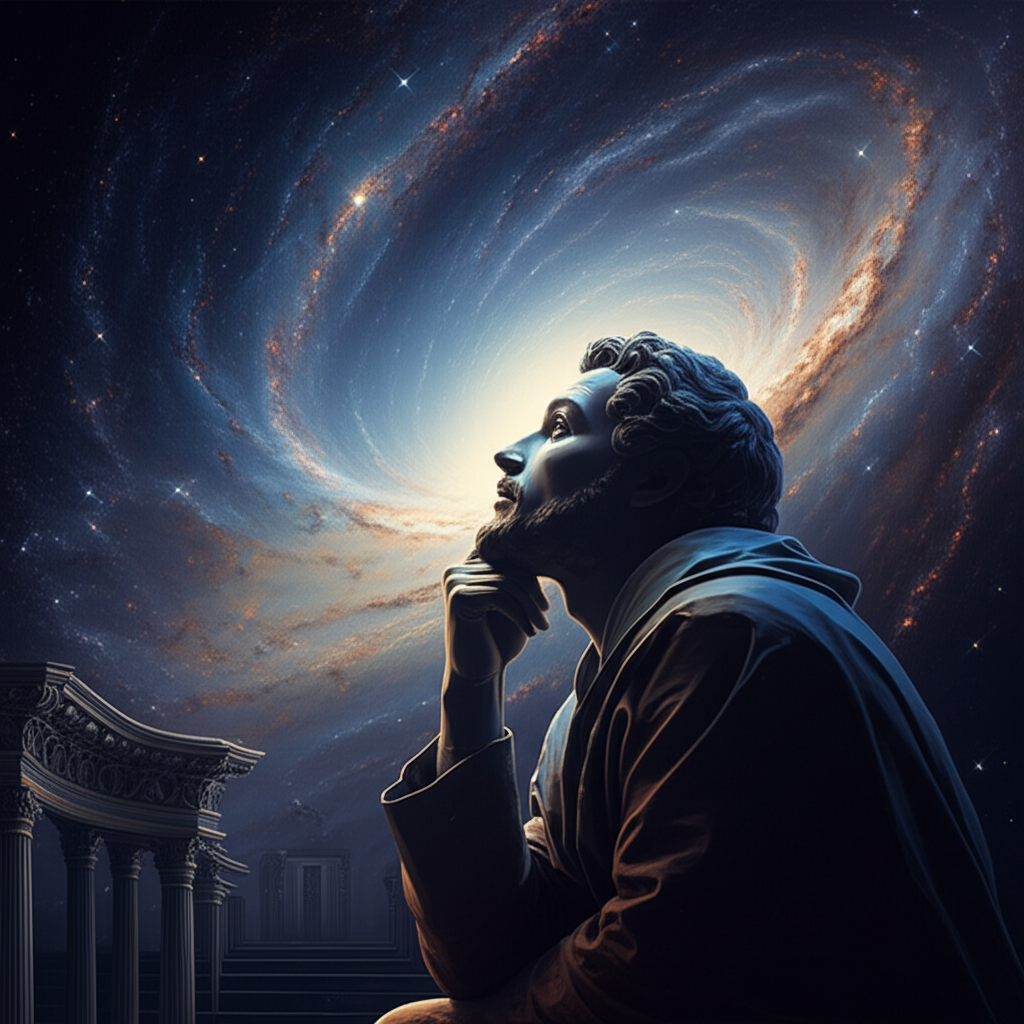
The contemplation of Eternity through the lens of Astronomy can be both humbling and inspiring. It reminds us of the profound transience of our individual lives and even of our entire World. Planets form, civilizations rise and fall, stars burn out – all against a backdrop of cosmic processes that unfold over timescales we can barely imagine. This perspective, however, is not one of despair but of profound significance.
Understanding our place in this grand scheme can re-orient our values, shifting focus from the ephemeral to the enduring. It encourages us to seek wisdom, to appreciate the preciousness of our fleeting existence, and to contribute to something that might resonate beyond our brief moment in Time. The pursuit of knowledge, the creation of beauty, the acts of compassion – these endeavors, while performed in Time, strive for a quality that touches upon the eternal.
📹 Related Video: PLATO ON: The Allegory of the Cave
Video by: The School of Life
💡 Want different videos? Search YouTube for: ""Plato's Cosmology Timaeus Explained""
📹 Related Video: What is Philosophy?
Video by: The School of Life
💡 Want different videos? Search YouTube for: ""The Philosophy of Time and Eternity""
Conclusion: The Enduring Quest
Astronomy continues to expand our horizons, revealing a universe of breathtaking scale and complexity. With each new discovery, our understanding of Time and the World is challenged and refined. Yet, the fundamental philosophical question remains: What does this vastness tell us about Eternity? Whether we conceive of Eternity as infinite duration, a timeless state, or a quality inherent in the cosmic order, the stars remain our most ancient and profound guide in this never-ending quest. They beckon us to look beyond the immediate, to contemplate the boundless, and to find our own meaning within the eternal dance of the cosmos.