

Astronomy and the Unfolding Tapestry of Eternity
The vast, silent expanse of the cosmos, meticulously charted by astronomy, has long served as humanity's grandest canvas for contemplating the profound concept of eternity. From the ancient philosophers gazing at unchanging celestial spheres to modern cosmologists probing the universe's origins and ultimate fate, the study of the World beyond our immediate grasp inevitably leads us to grapple with the nature of time itself—its beginning, its end, and the possibility of a reality that transcends it. This article explores how our understanding of the universe, both historical and contemporary, has shaped and challenged our philosophical inquiries into the infinite and the everlasting.
The Cosmic Canvas and Human Contemplation
To gaze upon the night sky is to confront the immeasurable. The sheer scale, the incredible distances, and the seemingly endless cycles of celestial mechanics compel us to consider what lies beyond our finite existence. This inherent human inclination to look upwards and ponder the infinite is not merely scientific curiosity but a profound philosophical impulse. It is here, amongst the stars, that the abstract notion of eternity finds its most tangible, albeit still elusive, representation.
Ancient Gazes: Eternity in the Classical World
For the thinkers of antiquity, the heavens represented order, permanence, and often, the divine. The cyclical motions of the planets and stars suggested an enduring, perhaps eternal, cosmic dance.
Plato's Forms and the Timeless Cosmos
Within the pages of the Great Books of the Western World, particularly in Plato's Timaeus, we find an early, sophisticated attempt to link the observed World with an eternal reality. Plato posited a distinction between the fleeting, imperfect physical world and a realm of perfect, unchanging Forms. For Plato, the cosmos, while created, was a "moving image of eternity," a reflection of a timeless order. The regular, predictable motions of the celestial bodies were seen as manifestations of this eternal order, providing a stable backdrop against the flux of earthly existence.
Aristotle's Unmoved Mover and Eternal Motion
Aristotle, another titan of the Great Books, further explored the concept of eternity in relation to the cosmos. In his Metaphysics and Physics, he argued for an eternal, uncreated universe. His concept of the "Unmoved Mover" was a primary cause that imparted eternal motion to the cosmos without itself moving, suggesting a timeless, self-sufficient principle underpinning the World. For Aristotle, both time and motion were eternal, without beginning or end, a continuous cycle reflective of the perfection of the celestial spheres.
These ancient perspectives laid foundational questions that continue to resonate:
- Is eternity an infinite extension of time, or something entirely outside of it?
- Does the World itself have a beginning and an end, or is it eternal?
- How does the observed regularity of astronomy reflect a deeper, perhaps eternal, truth?
Modern Astronomy: Expanding Horizons, Deepening Mysteries
The advent of modern astronomy has dramatically reshaped our understanding of the universe, providing new data points for our contemplation of eternity. Discoveries like the Big Bang, the expansion of the universe, and the lifecycle of stars have introduced concepts of cosmic genesis and potential demise, challenging some classical notions of an unchanging or infinitely cyclical cosmos.
The Universe's Age and Infinite Duration
Modern astronomy tells us the universe has a finite age—approximately 13.8 billion years. This discovery immediately introduces a temporal boundary, a "beginning" to our observable World, which prompts new questions about what, if anything, existed before time began. Does this finite age preclude eternity, or does eternity encompass this finite span within a larger, timeless reality? The concept of an infinitely expanding universe also pushes the boundaries of our imagination, suggesting a future of potentially infinite duration, even if the past is finite.
Cosmic Cycles and the End of Time
While the Big Bang suggests a linear progression, some cosmological models still entertain cyclical scenarios, like the "Big Crunch" or "Big Bounce," where the universe might contract and restart, echoing ancient ideas of eternal recurrence. Even in models of continuous expansion, the ultimate fate—a cold, dark, "heat death"—presents an "end" to meaningful time as we understand it, forcing us to consider whether eternity can truly be characterized by such a desolate, unchanging state.
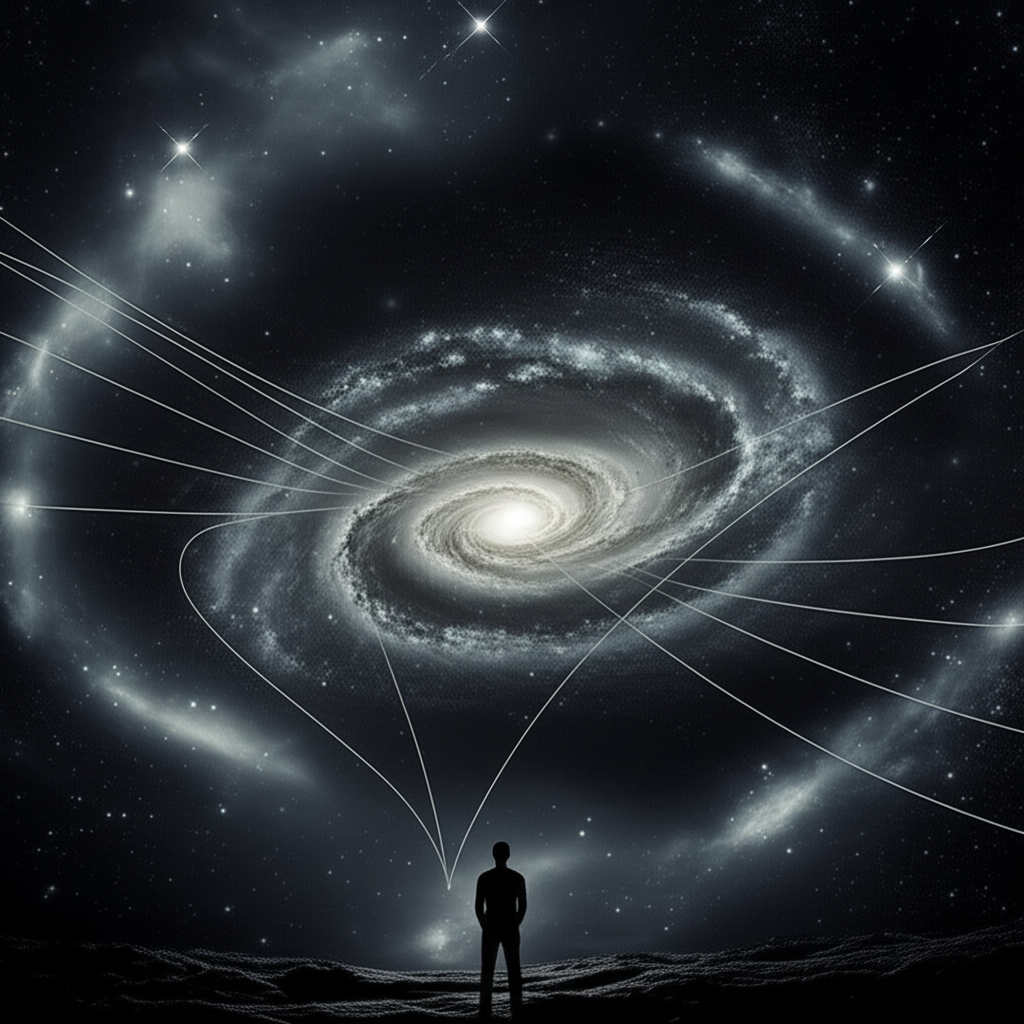
Deconstructing Eternity: Time, World, and the Human Mind
The relationship between astronomy and eternity forces us to dissect the very definitions of time and the World.
Eternity as Infinite Time vs. Timelessness
Philosophers have long debated whether eternity is merely time without end (infinite duration) or a state entirely outside of time (timelessness). The vast expanses and long durations revealed by astronomy often lead us to consider the former—a world that simply continues without cessation. However, the idea of a universe originating from a singularity, or potentially collapsing back into one, also invites the latter interpretation: a state where time itself might cease to have meaning, or where a reality exists prior to, or beyond, temporal progression.
The "World" as a Framework for Eternity
The "World" in this context refers not just to Earth, but to the entire cosmos, the universe as a coherent system. How we conceive of this World directly impacts our understanding of eternity. If the World is a closed system, does its eternity imply an eternal return? If it is an open system, eternally expanding, does eternity imply a never-ending journey into novelty? Astronomy provides the empirical data, but philosophy must interpret what these cosmic narratives mean for the ultimate nature of existence.
Key Philosophical Questions Arising from Astronomy's View of Eternity:
- Does the finite age of the universe imply a non-eternal God or a God who exists outside of time?
- If the universe is destined for a "heat death," what does that mean for the concept of an eternal future?
- Can human consciousness, bound by time, ever truly grasp or experience eternity?
- Is the concept of eternity a human construct, or an objective feature of reality revealed by astronomy?
The Philosophical Resonance of the Starlit Sky
Ultimately, the dialogue between astronomy and the concept of eternity is a testament to the human spirit's relentless quest for ultimate understanding. The cold, hard facts of cosmic scale and evolution, unearthed by astronomy, do not diminish the philosophical questions but rather elevate them, providing a richer, more complex backdrop against which to ponder the timeless. As we continue to peer deeper into the universe, the stars remain our most profound instructors, teaching us not only about the World but about our own place within the grand, unfolding mystery of time and eternity.
📹 Related Video: PLATO ON: The Allegory of the Cave
Video by: The School of Life
💡 Want different videos? Search YouTube for: ""Plato Timaeus Summary Philosophy Eternity""
📹 Related Video: What is Philosophy?
Video by: The School of Life
💡 Want different videos? Search YouTube for: ""Cosmic Time and Eternity Physics Philosophy""