

The Celestial Ladder: Unpacking Angelic Hierarchy in Theology
The concept of angelic hierarchy is far more than a whimsical notion of winged beings; it represents a profound philosophical and theological attempt to understand the very form and structure of the divine cosmos. For centuries, thinkers across various religions have grappled with the idea of celestial intermediaries, culminating in intricate systems that map out the heavens, providing a cosmic blueprint that reflects divine order and purpose. This article delves into the historical development and philosophical significance of these angelic ranks, primarily drawing from the rich intellectual traditions preserved within the Great Books of the Western World.
Angels as Agents of Divine Order
At its core, angelic hierarchy posits that the spiritual realm is not a chaotic expanse but a meticulously organized structure, mirroring the perfect order of God. These hierarchies classify different types of angels based on their proximity to the divine, their specific functions, and their degree of intellectual perfection. This systematic arrangement offers a framework for understanding the transmission of divine will, the governance of the cosmos, and the spiritual ascent of humanity. It’s a testament to the human desire to impose order on the unknowable, reflecting a deep philosophical inquiry into the nature of being and emanation.
The Genesis of Celestial Ranks: From Scripture to Scholasticism
The seeds of angelic hierarchy are found in ancient religious texts, where various types of celestial beings are mentioned – Cherubim guarding Eden, Seraphim attending God's throne, and numerous unnamed messengers. However, it was in the early Christian tradition that these scattered references began to coalesce into a systematic theological framework.
- Early Christian Thought: Patristic writers like Origen and Augustine pondered the nature and role of angels, but a definitive, universally accepted hierarchy remained elusive. They recognized the existence of different orders but didn't always delineate them with the precision seen later.
- Pseudo-Dionysius the Areopagite: The pivotal figure in formalizing the Christian angelic hierarchy is undoubtedly Pseudo-Dionysius, an anonymous Syrian monk writing in the late 5th or early 6th century. His seminal work, On the Celestial Hierarchy, became the foundational text for subsequent Christian theology on the subject. Dionysius, deeply influenced by Neoplatonic thought, presented a cosmos ordered by emanation, where divine light descends through successive ranks of angels, each mediating God's perfection to the next, culminating in humanity. This work profoundly shaped medieval thought and is a cornerstone of the Great Books tradition.
The Dionysian Celestial Hierarchy: A Triadic Structure
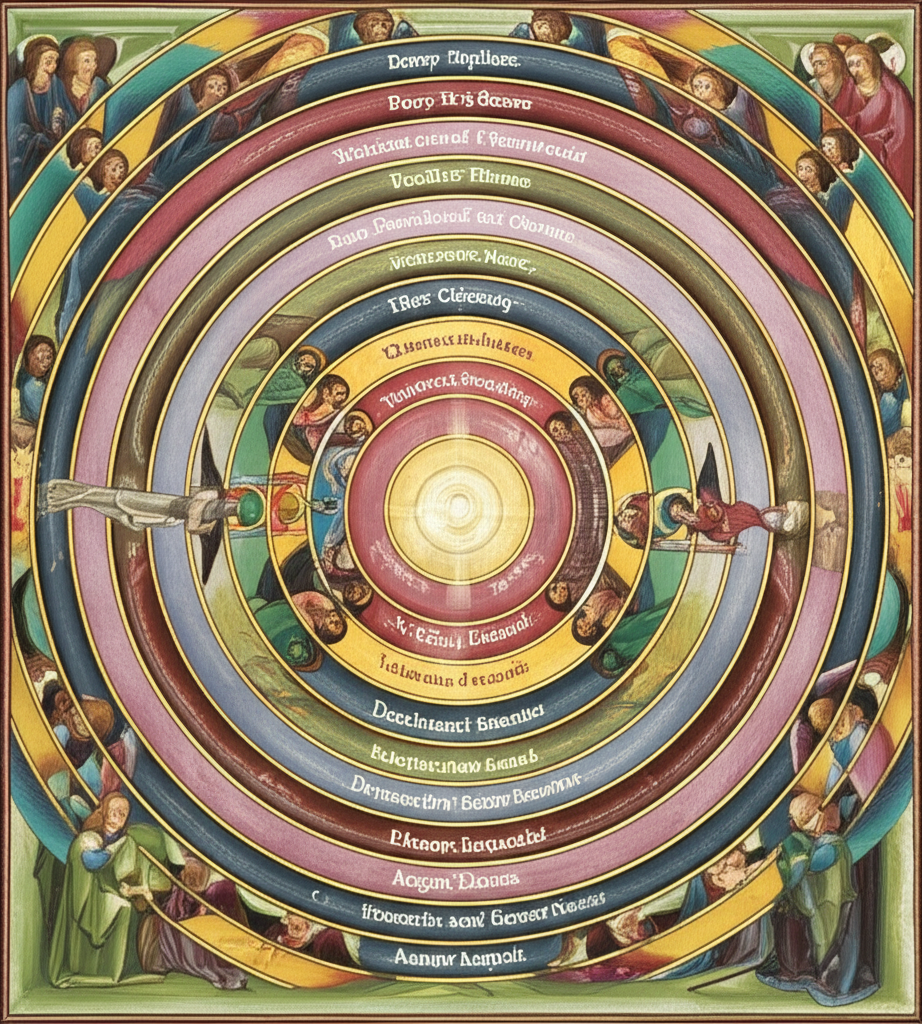
Pseudo-Dionysius organized the celestial beings into nine distinct choirs, grouped into three triads, each representing a different level of proximity to God and a unique set of functions. This structure emphasizes the concept of form – each rank embodying a specific aspect of divine perfection and mediating it downwards.
| Triad | Choirs (from highest to lowest) | Primary Function |
|---|---|---|
| First Triad | Seraphim, Cherubim, Thrones | Closest to God. Engaged in direct contemplation of the divine. Represent perfect love, knowledge, and stability. |
| Second Triad | Dominions, Virtues, Powers | Govern the Cosmos. Regulate the universe, impart strength, and oversee the order of creation. |
| Third Triad | Principalities, Archangels, Angels | Interact with Humanity. Guide nations, deliver messages, and serve as individual guardians. |
- The First Triad: These angels are described as being in the most intimate communion with God. The Seraphim (from the Hebrew for "burning ones") are consumed by divine love, reflecting God's fiery passion. The Cherubim ("fullness of knowledge") possess profound wisdom and understanding of divine mysteries. The Thrones symbolize divine justice and stability, serving as the very seat of God's presence.
- The Second Triad: These choirs are responsible for the administration and ordering of the universe. Dominions (or Lordships) regulate the duties of lower angels. Virtues (or Strengths) perform miracles and convey grace, particularly in the natural world. Powers (or Authorities) combat evil forces and maintain cosmic balance.
- The Third Triad: These are the angels most commonly associated with human interaction. Principalities (or Rulers) oversee nations and cities. Archangels are chief messengers, often mentioned by name (e.g., Gabriel, Michael). The ordinary Angels are the lowest rank, serving as direct messengers and guardians for individuals.
Scholastic Integration: Thomas Aquinas and the Intellectual Form of Angels
The Dionysian schema was enthusiastically adopted and elaborated upon by medieval scholastic philosophers, most notably Thomas Aquinas in his Summa Theologica. Aquinas, drawing heavily on Aristotelian metaphysics, integrated the angelic hierarchy into a comprehensive Christian cosmology. For Aquinas, angels were pure intellects, immaterial substances whose very form was their existence. Their position in the hierarchy was determined by their intellectual capacity and their direct apprehension of God.
Aquinas emphasized that the higher angels possessed a more perfect and immediate knowledge of divine truths, which they then illuminated to the lower ranks. This intellectual transmission highlights the hierarchical nature not just of being, but of knowledge itself, reflecting a structured path to understanding God's infinite wisdom. The study of angels thus became a profound exercise in understanding the nature of intellect, will, and divine governance.
Philosophical Resonance: Form, Order, and the Chain of Being
The concept of angelic hierarchy resonates deeply with broader philosophical themes, particularly the idea of a Great Chain of Being. This ancient concept, prevalent from Plato and Aristotle through the medieval period, posits a hierarchical ordering of all existence, from the lowest forms of matter to the highest divine being, with each link possessing a degree of perfection and participating in the divine essence. Angels, in this context, form crucial links in this chain, mediating between the purely spiritual and the material worlds.
The emphasis on form is also critical. Each angelic choir, by virtue of its specific attributes and functions, embodies a particular divine form or idea. They are not merely messengers but living expressions of God's perfect order, demonstrating how divine unity unfolds into diverse, yet harmonious, manifestations across creation. This structured understanding provides a sense of cosmic coherence and purpose, reassuring believers and philosophers alike that the universe is not random but governed by intelligent design.
Beyond the Christian Framework: Similarities in Other Religions
While Pseudo-Dionysius's hierarchy is distinctly Christian, the impulse to categorize and understand celestial beings is not unique to Christianity.
- Judaism: Jewish mystical traditions, particularly Kabbalah, describe complex hierarchies of spiritual entities, often linked to the Sefirot (divine emanations) and different heavenly realms. These beings, while not always termed "angels" in the same way, fulfill similar roles as intermediaries and agents of divine will.
- Islam: Islamic theology also features a clear hierarchy of angels, with prominent figures like Gabriel (Jibril), Michael (Mika'il), Raphael (Israfil), and Azrael (Malak al-Mawt) holding specific, significant roles. These angels are created from light and are entirely obedient to God, performing tasks ranging from delivering revelations to recording deeds and taking souls.
In each of these religions, the structured nature of celestial beings underscores a fundamental belief in a divinely ordered universe, where every entity, from the highest angel to the smallest atom, has its place and purpose within the grand cosmic design.
Conclusion: The Enduring Legacy of Celestial Order
The study of angelic hierarchy in theology offers a fascinating window into humanity's enduring quest for meaning and order within the cosmos. Far from being quaint mythological tales, these intricate systems represent sophisticated philosophical and theological constructs designed to explain divine governance, the nature of spiritual beings, and the interconnectedness of all creation. From the Neoplatonic influences on Pseudo-Dionysius to the scholastic rigor of Thomas Aquinas, the concept of a celestial ladder has shaped our understanding of God, angels, and humanity's place in the grand divine scheme, leaving an indelible mark on Western thought and religion.
📹 Related Video: KANT ON: What is Enlightenment?
Video by: The School of Life
💡 Want different videos? Search YouTube for: ""Pseudo-Dionysius Celestial Hierarchy explained", "Thomas Aquinas on Angels""