

Ascending the Celestial Ladder: Exploring Angelic Hierarchy in Theology
The concept of an Angelic hierarchy stands as one of the most enduring and fascinating structures within Theology and Religion. Far from being a mere whimsical arrangement, this intricate ordering of celestial beings offers profound insights into the divine mind, cosmic order, and the very nature of spiritual existence. This article delves into the historical development and philosophical implications of these hierarchies, primarily drawing from the rich intellectual tradition preserved in the Great Books of the Western World, revealing how the idea of a graded celestial order shapes our understanding of the divine and our place within a structured cosmos.
The Divine Blueprint: Order and Form in the Heavens
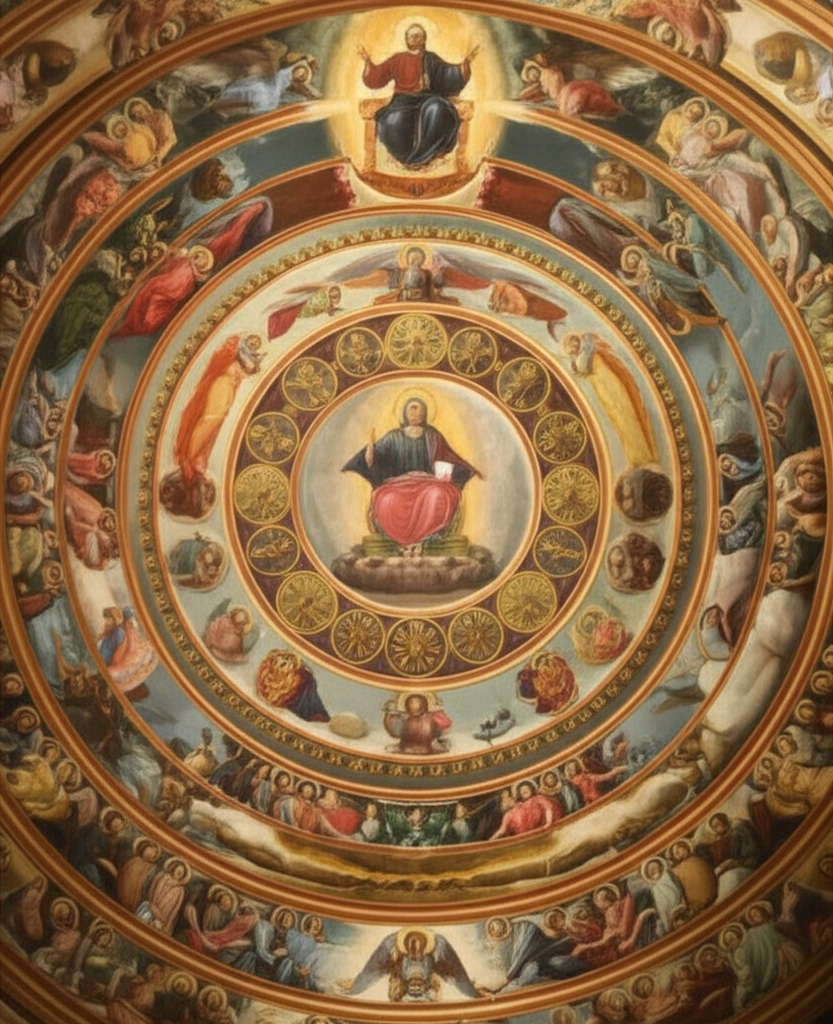
From the earliest philosophical inquiries into the nature of reality, humanity has sought to discern order in the universe. For many theological traditions, this order extends beyond the visible cosmos to the invisible realms inhabited by spiritual intelligences – the Angels. The idea that these pure spirits are not a monolithic entity but are organized into distinct ranks or "choirs" speaks to a fundamental principle: that the divine wisdom manifests itself through a structured, purposeful creation. Each Form within this hierarchy is understood to possess unique attributes, responsibilities, and a specific proximity to the divine source, facilitating the transmission of divine grace and knowledge throughout creation.
Historical Roots and Scholastic Refinements
The most influential schema for Angelic hierarchy in Western Theology emerged from the writings of Pseudo-Dionysius the Areopagite in his seminal work, The Celestial Hierarchy. Writing in the 5th or 6th century, Dionysius synthesized Neoplatonic concepts with Christian revelation, proposing a tripartite division of nine angelic orders. His work became a cornerstone for later scholastic philosophers, most notably St. Thomas Aquinas.
Aquinas, drawing heavily from Dionysius and other Church Fathers, elaborated upon this framework in his Summa Theologica. For Aquinas, the Angelic hierarchy was not arbitrary but deeply rational, reflecting the degrees of perfection and illumination that God bestows upon His creation. The structure itself, therefore, becomes a testament to divine reason and the graduated reception of divine light. Each higher order of Angels illuminates the one below it, acting as intermediaries in the divine plan, a cosmic chain of being that connects the Creator to all created things. This philosophical understanding of graduated Form and function is central to comprehending the theological significance of the hierarchy.
The Nine Choirs: A Traditional Framework
The most widely accepted Angelic hierarchy divides the celestial host into three main hierarchies, each containing three choirs. These divisions reflect varying degrees of proximity to God and distinct functions within the divine economy.
| Hierarchy | Choirs (Orders of Angels) | Primary Function |
|---|---|---|
| First Hierarchy | Seraphim | Closest to God; characterized by burning love and adoration. Their name means "the burning ones." They are depicted with six wings. |
| (Counselors) | Cherubim | Guardians of divine wisdom and knowledge; possess deep insight into God's mysteries. Often depicted with four wings and eyes. |
| Thrones | Represent divine justice and authority; associated with humility and peace. They are often described as living wheels of fire, signifying stability and the swiftness of divine judgment. | |
| Second Hierarchy | Dominions | Regulate the duties of lower Angels; ensure divine order is maintained in the cosmos. They are leaders, embodying God's authority. |
| (Governors) | Virtues | Responsible for miracles, signs, and wonders; channel divine energy to the world. They are associated with strength and courage, often involved in cosmic and natural phenomena. |
| Powers | Combat evil forces and protect humanity from demonic influence; maintain cosmic balance. They are spiritual warriors, defending the divine order against chaos. | |
| Third Hierarchy | Principalities | Guide and protect nations, cities, and larger groups of people; inspire earthly leaders. They oversee the larger collective destinies of humankind. |
| (Messengers & Soldiers) | Archangels | Chief messengers of God, delivering important divine messages; often have specific roles (e.g., Michael, Gabriel, Raphael). They are the most commonly named Angels in religious texts. |
| Angels | The lowest order, closest to humanity; serve as guardians, messengers, and guides for individuals. They are the most familiar Form of Angel to us, directly interacting with human affairs. |
Philosophical Implications of the Hierarchy
The Angelic hierarchy is more than a mere classification; it is a profound theological statement about the nature of reality. It implies:
- Divine Providence and Order: The very existence of such a structured hierarchy speaks to a universe governed by a meticulous and wise Creator. Nothing is left to chance; every spiritual being has its place and purpose.
- Graduated Illumination: Divine light and grace are not received uniformly but flow down through the ranks, with higher Angels receiving more direct illumination and then transmitting it, in a modified Form, to those below. This mirrors the Neoplatonic concept of emanation.
- The Nature of Spiritual Beings: It highlights the distinct intellectual and volitional capacities of various Angels, suggesting that even within spiritual existence, there are different degrees of perfection and understanding. Each Form of Angel embodies a particular facet of divine perfection.
- Humanity's Place: By understanding the Angelic realms, humans gain a clearer perspective on their own position within the cosmic order – below the Angels but still connected to the divine through these celestial intermediaries. It provides a ladder for spiritual ascent, both for the Angels in their service and for humans in their understanding.
Enduring Relevance in Modern Thought
While modern secular thought may dismiss Angelic hierarchies as antiquated mythology, their philosophical underpinnings remain relevant. The drive to understand order, the transmission of information (or grace), and the concept of distinct archetypal Forms within a larger structure continues to resonate. The theological framework of Angelic hierarchy, meticulously developed by thinkers like Aquinas, offers a powerful lens through which to explore questions of divine governance, spiritual intelligence, and the interconnectedness of all creation. It reminds us that even in the invisible realms, there is a profound, rational design, inviting continuous contemplation and wonder.
📹 Related Video: KANT ON: What is Enlightenment?
Video by: The School of Life
💡 Want different videos? Search YouTube for: "Thomas Aquinas Angelic Hierarchy Explained"
📹 Related Video: ARISTOTLE ON: The Nicomachean Ethics
Video by: The School of Life
💡 Want different videos? Search YouTube for: "Pseudo-Dionysius the Areopagite Celestial Hierarchy Summary"